Claude Comes to iPhone: Anthropic’s Biggest Consumer Expansion in History
Table of Contents
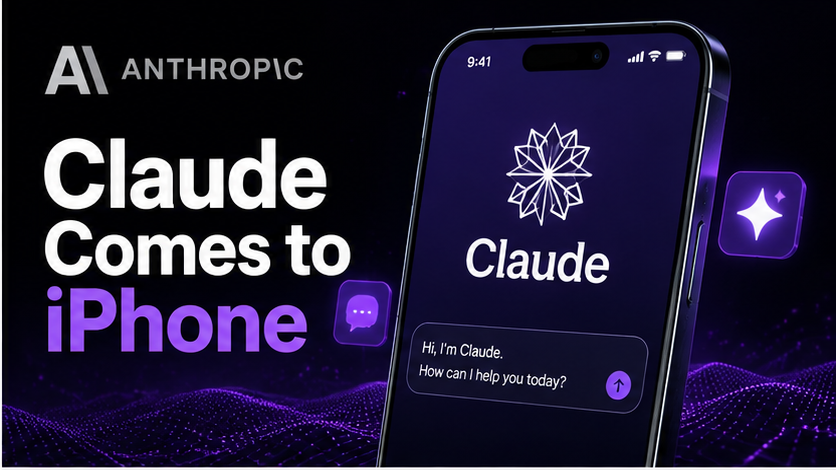
Claude is coming to every iPhone. At WWDC 2026, Apple announced that iOS 27 will let users choose Anthropic’s Claude as their default AI model inside Apple Intelligence — alongside ChatGPT and Gemini. This is the biggest consumer distribution deal in Anthropic’s history, and it could not have come at a better time.
Here is everything we know about Claude on iPhone, what it means for the AI wars, and why this changes Anthropic’s entire trajectory.
What Apple Announced About Claude
Apple confirmed at WWDC 2026 that iOS 27, iPadOS 27, and macOS 27 will include a new AI Extensions system. Users can choose which AI model powers their Apple Intelligence features from three options: Google Gemini (default), OpenAI ChatGPT, and Anthropic Claude.
When you select Claude as your AI provider, you interact with Claude’s voice and persona when asking Siri for help with writing, research, complex questions, and cross-app tasks. Each AI model has a distinct voice and personality — so you always know which one is responding.
Claude on iPhone is not a standalone app running in a sandbox. It is deeply integrated into Apple Intelligence — the same system that powers Siri, Photos AI editing, Calendar suggestions, Health insights, and cross-app actions. If you choose Claude, it becomes the brain behind all of those features.
The Scale of This Expansion
The numbers tell the story. Apple has approximately 2.2 billion active devices globally. Claude was previously available only through Anthropic’s own apps and APIs. Even a modest adoption rate transforms Anthropic’s consumer reach overnight.
Consider the math: if just 5% of iOS 27 users select Claude as their preferred AI provider, that is over 100 million new Claude users. Anthropic’s current estimated user base is approximately 50 million. A 5% iPhone adoption rate would triple their total users. A 10% rate would mean 220 million Claude users — making it the second-largest AI assistant by consumer reach behind ChatGPT.
The consumer brand exposure alone is worth more than any advertising spend Anthropic could buy. Every time an iPhone user asks Siri a question and Claude responds, that is an organic brand impression on the most premium consumer device platform in the world.
How Claude on iPhone Actually Works
Based on what Apple showed at WWDC 2026, here is how the Claude integration works technically:
Settings → Apple Intelligence → AI Provider → Claude. Once selected, Claude handles all cloud-based AI requests that go through Apple Intelligence. On-device tasks — basic Siri commands, dictation, autocorrect — still run on Apple’s local models regardless of your choice.
The architecture splits tasks between on-device and cloud processing. Simple requests stay on your iPhone using Apple’s own neural engine. Complex requests — writing assistance, research questions, multi-step reasoning, creative tasks — route to Claude through Apple Private Cloud Compute (PCC) servers.
This is the key technical detail: Claude does not run on Anthropic’s servers when accessed through Apple Intelligence. It runs on Apple’s PCC infrastructure. Apple controls the compute layer, the data handling, and the privacy guarantees. Anthropic provides the model weights and receives usage-based compensation, but never sees your personal data directly.
What This Means for Anthropic’s IPO
Anthropic filed its confidential IPO paperwork on June 1, 2026. The Apple deal landing seven days later is either extraordinary timing or careful coordination. Either way, it transforms the S-1 filing narrative.
Before today, Anthropic’s revenue story was primarily enterprise API contracts and Claude.ai subscriptions. The Apple deal adds a new consumer revenue stream — a per-query or per-active-user fee for Claude responses handled through Apple Intelligence. Industry analysts expect a revenue-share arrangement, though the specific terms have not been disclosed.
For IPO investors, this answers one of the biggest questions about Anthropic: can it compete for consumers? The company was seen as an enterprise-focused AI lab that built the best coding model but lacked ChatGPT’s consumer brand recognition. The Apple deal sidesteps that problem entirely — Claude gets consumer distribution without Anthropic needing to build a consumer marketing machine.
The risk for investors: this consumer revenue depends on how many iPhone users actively choose Claude in Settings. That is harder to model than predictable enterprise contracts. Apple could also change the terms, add competitors, or make the default harder to change in future iOS versions.
Claude vs ChatGPT vs Gemini on iPhone
With all three major AI models now competing inside the same device, the comparison becomes unavoidable. Here is how they stack up for iPhone users:
Google Gemini has the massive advantage of being the default. Most users never change defaults — Google’s search default on Safari proves this generates billions in revenue. Gemini also has the deepest integration since Apple’s Siri rebuild is architecturally built on a custom Gemini model. Even if you switch to Claude for Apple Intelligence tasks, the underlying Siri planning layer may still use Gemini components.
OpenAI ChatGPT brings the strongest consumer brand recognition. ChatGPT still holds 54.7% market share in AI chatbot web visits. For users who already have a ChatGPT Plus subscription, choosing ChatGPT on iPhone creates a seamless cross-device experience.
Anthropic Claude has the strongest reputation for writing quality, coding assistance, and thoughtful responses. In developer communities, Claude is increasingly preferred for complex reasoning tasks. The question is whether that developer enthusiasm translates to mainstream consumer preference.
The Default Advantage Problem
Google being the default AI model on iPhone is a significant competitive hurdle for both Claude and ChatGPT. Research consistently shows that default settings capture 80-95% of users. Google pays Apple an estimated $20+ billion annually to be the default search engine on Safari — because defaults matter that much.
For Claude to win meaningful iPhone adoption, Anthropic needs users to actively navigate to Settings, find the Apple Intelligence section, and change their AI provider. That requires either a strong existing relationship with Claude (likely from developers and power users) or a viral word-of-mouth campaign where Claude users convince friends to switch.
The optimistic scenario: Apple’s AI Extensions system is designed to make switching easy, and tech-savvy early adopters — who tend to influence purchasing decisions in their social circles — disproportionately prefer Claude. The pessimistic scenario: 90% of users never touch the setting, Gemini captures the vast majority of Apple Intelligence queries, and Claude’s iPhone presence becomes a footnote.
Privacy Architecture: Who Controls Your Data
One of the most interesting aspects of Claude on iPhone is the privacy architecture. Regardless of which AI model you choose, all cloud processing runs through Apple Private Cloud Compute. This means:
- Your data never goes directly to Anthropic, OpenAI, or Google servers
- Apple controls the encryption, data handling, and retention policies
- Personal context (emails, photos, files) is processed within Apple’s secure enclave
- Neither the AI model provider nor Apple retains your queries after processing
This is a fundamentally different privacy model than using Claude.ai directly, where Anthropic processes your data on its own infrastructure. For privacy-conscious users, Apple’s approach offers frontier AI capabilities with Apple-level privacy guarantees — regardless of which model runs underneath.
For cybersecurity professionals and enterprise users, this means you can use Claude’s capabilities on your iPhone without worrying about corporate data leaving Apple’s ecosystem. That is a genuine selling point that neither the Claude app nor the ChatGPT app can match.
The Bottom Line
Claude on iPhone is Anthropic’s most important distribution deal ever. It transforms the company from an enterprise-focused AI lab into a potential consumer AI powerhouse — without requiring Anthropic to build consumer marketing infrastructure from scratch. Apple provides the distribution, the privacy architecture, and the brand association with premium quality.
The deal arrives at the perfect time for Anthropic’s IPO, adding a consumer revenue stream that strengthens the investment thesis. The risk is that Gemini’s default advantage captures most users and Claude’s iPhone presence remains niche.
But even the niche scenario is significant. If Claude captures just 5% of Apple Intelligence users, that is 100+ million new users interacting with Claude daily. For a company valued at $965 billion heading into its IPO, that consumer story could be the difference between a successful public offering and a historic one.
iOS 27 launches in September 2026. The AI model choice will be available on day one.