Apple iOS 27 Lets You Ditch Siri for Gemini or Claude — Everything We Know About AI Extensions 2026
Table of Contents
Table of Contents
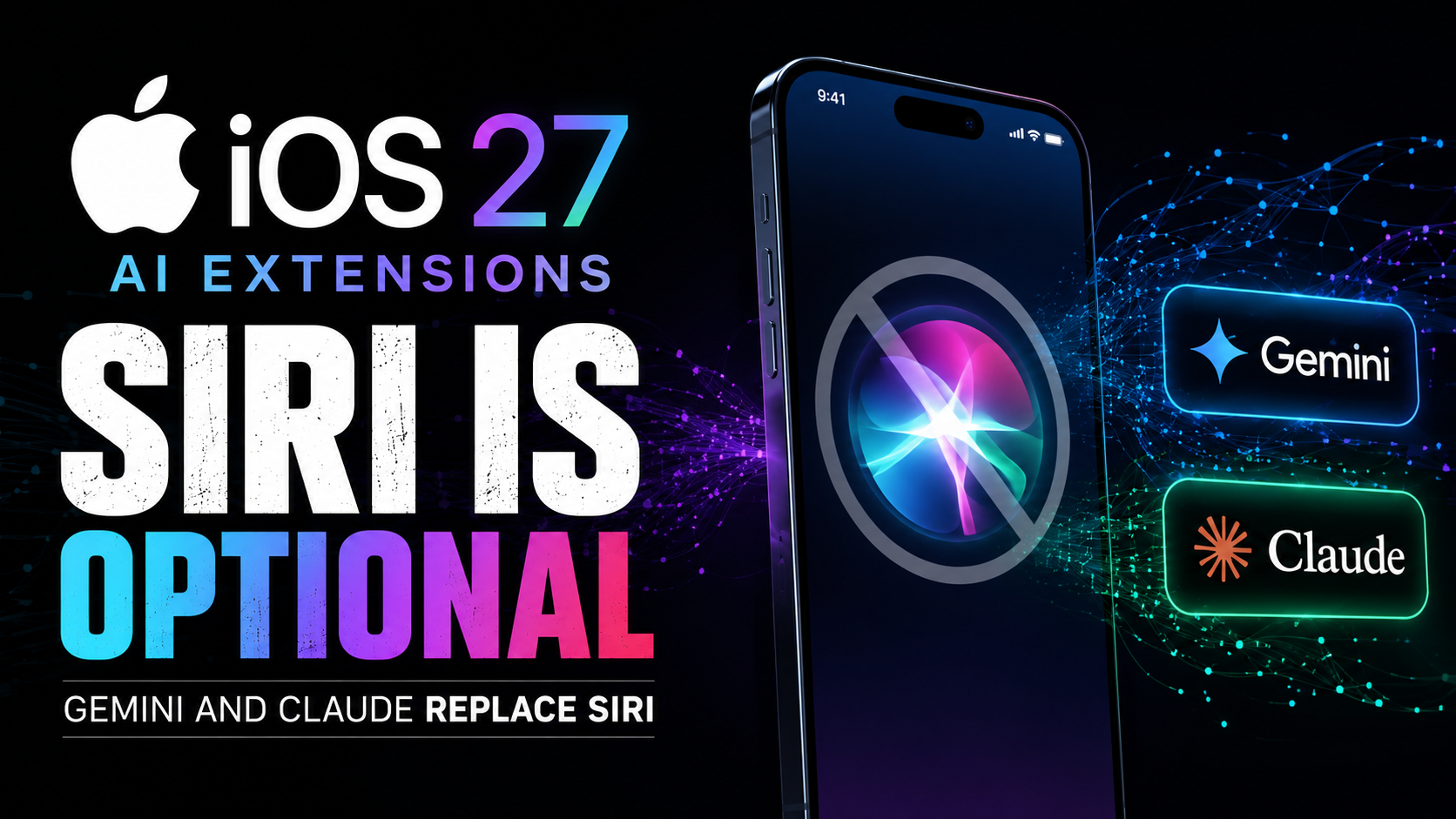
Apple is doing something it almost never does: admitting its AI isn’t good enough and letting competitors in. According to multiple credible reports from Bloomberg, Engadget, and 9to5Mac, Apple iOS 27 will introduce a feature called AI Extensions that allows users to route Siri queries, Writing Tools requests, and Image Playground prompts to third-party AI providers of their choosing — including Google Gemini and Anthropic’s Claude. This is the biggest structural shift to Apple Intelligence since its launch, and it changes everything about how the AI wars are being fought in 2026.
For context: when Apple launched Apple Intelligence in 2024, the company promised Siri would be the last AI you’d ever need. That vision quietly collapsed as users discovered Siri’s limitations compared to ChatGPT, Gemini, and Claude. Apple had already partnered with OpenAI for ChatGPT integration — but the new Extensions system goes much further, creating an open(ish) AI marketplace directly inside iOS.
What Are Apple AI Extensions in iOS 27?
Apple AI Extensions are a new integration layer arriving in iOS 27, iPadOS 27, and macOS 27 that allow installed third-party apps to provide AI capabilities directly to Apple’s built-in features. Rather than requiring users to switch between apps, Extensions let AI providers plug directly into the system — so when you ask Siri a complex question, it can route to Gemini in the background and surface the answer as if Siri answered it.
According to Apple’s internal documentation referenced in the reports, Extensions will integrate with:
- Siri — for natural language queries and task completion
- Writing Tools — for drafting, editing, and rewriting text across all apps
- Image Playground — for AI image generation
- Genmoji — for custom emoji creation
- Priority notifications and summaries — for intelligent inbox management
Users will see a new “Extensions” option in Settings where they can choose which AI provider handles different types of requests. You could, for example, use Claude for writing assistance, Gemini for research queries, and keep Apple’s own models for privacy-sensitive on-device tasks. The system is designed to be modular — there’s no requirement to pick one AI for everything.
Which AI Providers Are Coming to iOS 27?
Apple has confirmed testing with at least two providers internally: Google (Gemini) and Anthropic (Claude). The reports suggest additional providers may be added before iOS 27’s official reveal at WWDC in June 2026. OpenAI, which already has a ChatGPT integration with iOS 18, is expected to deepen its integration through the Extensions framework as well.
The AI landscape in 2026 makes this particularly interesting. As we covered in our analysis of Google Gemini 3.1 Pro’s launch, Google’s models have made dramatic quality improvements. Meanwhile, Anthropic’s Claude has built a strong reputation for nuanced writing and coding assistance. By integrating these models, Apple is essentially acknowledging that diversity of AI capability matters — one model simply cannot be best at everything.
Here’s what makes this significant for developers: Apple will reportedly create a dedicated section in the App Store to highlight AI apps that support the Extensions framework. If you build an AI app that integrates with Extensions, you get premium visibility. That’s a powerful incentive structure designed to pull the entire iOS developer ecosystem toward supporting this new platform.
How Apple AI Extensions Actually Work Under the Hood
Apple has designed the Extensions framework with a specific architecture: third-party AI providers integrate through App Store applications, not directly. This means Google can’t have a system-level deal that bypasses the App Store — they need to ship a Gemini app that implements the Extensions API, just like any other developer. Apple maintains control of the distribution channel even while opening the AI pipeline.
When a user makes an AI request, here’s the flow: the request hits Apple’s on-device routing layer, which decides based on user preferences and task type whether to handle it locally, send it to Apple’s cloud models, or forward it to the user’s chosen Extension provider. The response comes back through the same channel and surfaces in the native iOS UI. The third-party provider sees the query but not the broader context of the user’s device, location, or behavior — at least in theory.
One interesting detail from the reports: iOS 27 will let users assign different voices to different AI models. Your device’s standard Siri voice handles Apple’s own AI responses; queries routed to Claude or Gemini can use distinctly different voice profiles so you know which model is responding. It’s a small UX detail but it signals Apple is thinking carefully about transparency in the new multi-model environment.
Privacy Implications: Who Sees Your Data When You Use AI Extensions?
This is where things get complicated. Apple has built its entire brand around privacy — “What happens on iPhone, stays on iPhone” has been their AI marketing mantra. But once you enable a third-party AI Extension, your queries are leaving Apple’s privacy bubble and entering Google’s or Anthropic’s data infrastructure.
Apple’s solution is transparency rather than restriction: the company is reportedly requiring Extensions providers to prominently disclose their data practices before users activate them, and to comply with iOS App Store privacy nutrition labels. But compliance disclosure is not the same as privacy protection. A user who chooses Gemini as their AI Extension is essentially opting into Google’s AI data practices, full stop.
This tension is particularly relevant in a year when Meta has been making headlines for its own AI privacy moves — just this week, Meta launched WhatsApp Incognito Chat, promising that not even Meta can see your AI conversations. Apple’s approach is more permissive: they’ll let third-party AI providers see your queries, but they’ll make sure you know that’s happening. Whether users will actually read and understand those disclosures before enabling Extensions is a different question entirely.
What This Means for Siri’s Future
Let’s be direct: Apple AI Extensions is a tacit admission that Siri has failed to compete. Apple spent decades positioning Siri as the definitive mobile AI assistant. They’ve invested billions in Apple Intelligence. And yet, here they are in 2026, building an entire framework specifically designed to let better AI systems replace Siri for the tasks users actually care about.
That doesn’t mean Apple is giving up on Siri. The on-device capabilities — processing data that never leaves your phone, understanding your personal context, integrating deeply with iOS — remain valuable and remain Siri’s domain. What Apple is doing is being pragmatic: they’re optimizing for user experience over platform pride. If users want Claude for writing and Gemini for research, Apple would rather keep those users within the iOS ecosystem using Extensions than lose them to Android where they’d access those models directly.
For Siri specifically, the Extensions rollout puts enormous pressure on Apple’s AI team to deliver meaningful improvements before iOS 27 launches. If Siri isn’t dramatically better by fall 2026, users will simply flip the Extensions switch and forget Siri exists for complex tasks. That would be an embarrassing outcome for a company that once defined what AI assistants could be.
The Competitive AI Landscape Just Changed — Again
For Google and Anthropic, iOS 27 AI Extensions is a dream scenario. Suddenly, they have potential access to Apple’s billion-plus active device users — users who have historically been harder to reach because they live primarily within the Apple ecosystem. This is why the stakes of iOS integration are so enormous: whoever becomes the default Extension provider for writing, or research, or coding assistance, gains exposure at a scale that no amount of ad spending can replicate.
The race to become the default third-party AI on iOS 27 is already underway. Both Google and Anthropic are almost certainly allocating significant engineering resources to nail the Extensions API integration before WWDC. The quality of that integration — response speed, accuracy, voice quality, privacy disclosures — will determine which AI provider captures the most iOS users.
For the broader AI industry, Apple’s move validates something important: no single AI model will dominate every use case. The future is modular, with users mixing and matching AI providers based on task requirements. We’re entering an era of multi-agent AI architectures at the consumer level, and Apple just made iOS the platform where that future arrives first for mainstream users.
Apple is expected to officially reveal iOS 27 and the Extensions framework at WWDC in June 2026. Watch for announcements about which providers will be launch partners — that reveal will be one of the most watched moments in tech this year.
Sources: Engadget | Apple World Today | Thurrott | 9to5Mac | PYMNTS