Ask.com Shuts Down After 30 Years: The End of Ask Jeeves in 2026
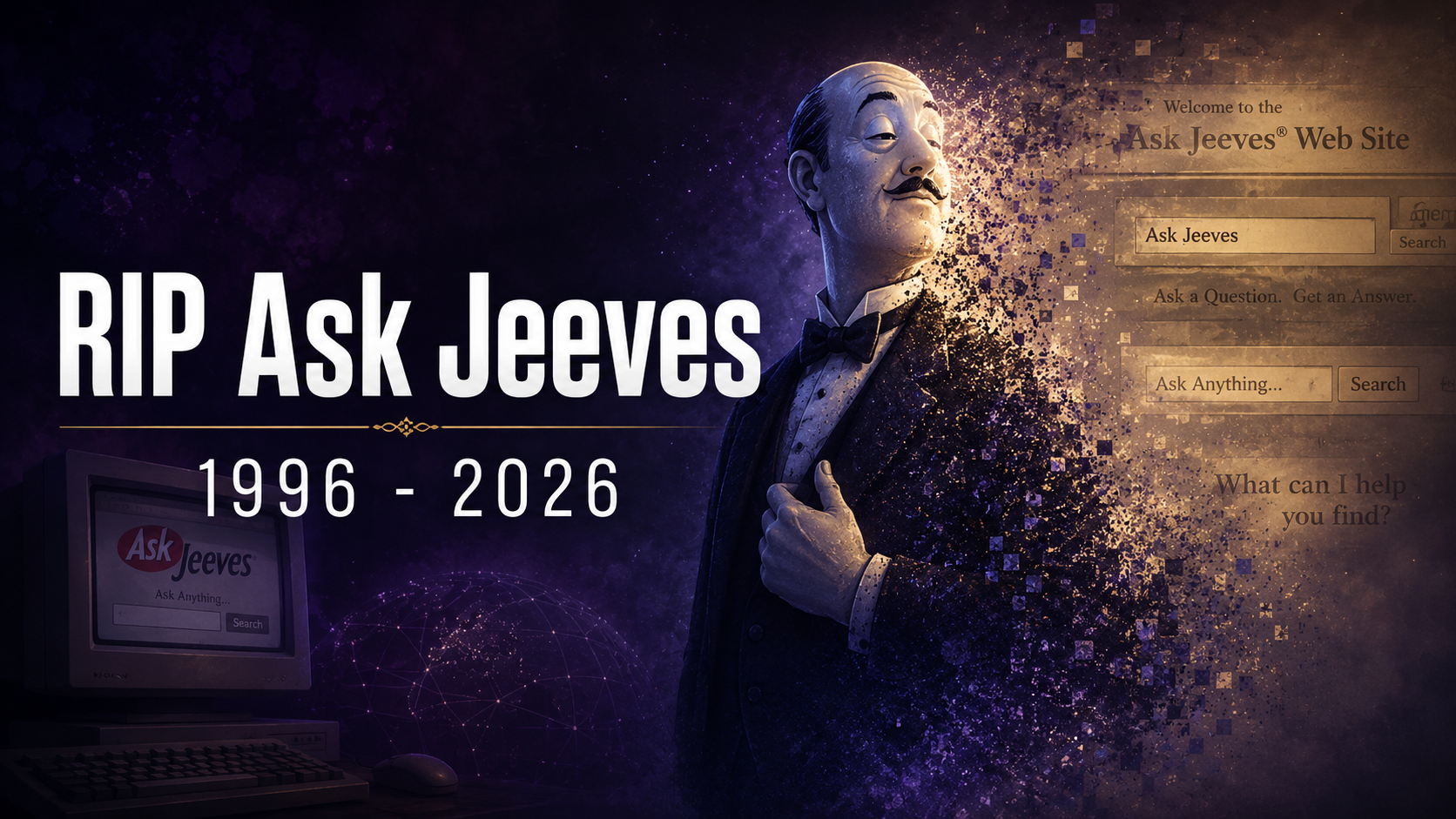
Ask.com shuts down after three decades online, marking the end of one of the internet’s most recognizable search engines. It’s official. Ask.com is dead. The search engine that launched in 1996 — famous for its friendly butler Jeeves who would answer your questions in plain English — shut down permanently on May 1, 2026. As Ask.com shuts down, the homepage now displays a simple message as Ask.com shuts down permanently: “Every great search must come to an end.”
For anyone who grew up in the late ’90s and early 2000s, Ask Jeeves was the internet. Before Google dominated everything, millions of people typed full questions into Ask Jeeves and got actual answers. It was conversational search before AI chatbots made it cool. The fact that Ask.com shuts down now is a reminder of how quickly the internet evolves.
And now, after nearly 30 years, parent company IAC (InterActiveCorp) pulled the plug. As Ask.com shuts down, an era ends. Here’s the full story of how Ask Jeeves rose, fell, and finally disappeared. As Ask.com shuts down, the search engine industry loses a pioneer.
Table of Contents
Why Ask.com Shuts Down After 30 Years
IAC made the announcement with a brief statement: “As IAC continues to sharpen its focus, we have made the decision to discontinue our search business, which includes Ask.com.”
The truth is, Ask.com has been on life support for over a decade. IAC acquired Ask Jeeves in 2005 for $1.85 billion in an all-stock deal — and almost immediately regretted it. By 2010, IAC chairman Barry Diller publicly admitted at TechCrunch Disrupt that Ask.com simply couldn’t compete with Google and wasn’t adding value to IAC’s portfolio.
That same year, IAC gutted Ask.com’s engineering team, outsourced its search technology, and pivoted the site into a generic question-and-answer platform. The writing was on the wall — it just took 16 more years for IAC to make it official.
The Rise of Ask Jeeves: How It All Started
Ask Jeeves was founded in 1996 by Garrett Gruener and David Warthen in Berkeley, California. The concept was revolutionary for its time: instead of forcing users to type cryptic keyword queries, Ask Jeeves let you ask questions in plain, natural English.
The name “Jeeves” came from P.G. Wodehouse’s fictional valet — the quintessential English butler who always had the perfect answer. The branding was genius. A cartoon butler in a suit, ready to serve your every question. It made the internet feel approachable at a time when most people were still figuring out what a browser was.
When Ask Jeeves launched publicly in April 1997, it was an instant hit. Within two years, the search engine was handling over one million queries per day. The company went public in 1999 during the dot-com boom, and its stock price soared.
At its peak, Ask Jeeves was the third most popular search engine in the United States, behind Yahoo and AltaVista — Google didn’t even exist yet when Jeeves first appeared.
What Made Ask Jeeves Different From Google?
The fundamental difference was philosophy. Ask Jeeves believed in human-curated, conversational answers. When you typed a question, a team of human editors had pre-written answers to thousands of common queries. For everything else, the system used natural language processing to match your question with relevant results.
Google, which launched in 1998, took the opposite approach. Instead of human curation, Google’s PageRank algorithm analyzed the link structure of the entire web to rank pages by authority. It was faster, more scalable, and ultimately more accurate.
The irony is striking: Ask Jeeves was doing conversational search in 1997 — the exact thing that AI chatbots like ChatGPT and Claude have made mainstream in 2024-2026. Ask Jeeves was 25 years too early. The technology just wasn’t there to deliver on the promise.
The Fall of Ask Jeeves: Timeline of Decline
Here’s how one of the internet’s most beloved brands slowly crumbled:
- 1996: Ask Jeeves founded by Gruener and Warthen
- 1997: Public launch — hits 1 million queries/day within 2 years
- 1999: IPO during dot-com boom — stock price peaks
- 2001: Dot-com crash devastates the company — massive layoffs
- 2005: IAC acquires Ask Jeeves for $1.85 billion
- 2006: “Jeeves” dropped from the name — rebranded to Ask.com
- 2010: IAC outsources search technology, pivots to Q&A
- 2010: Barry Diller admits Ask.com can’t compete with Google
- 2014-2024: Ask.com exists as a zombie site — minimal traffic, no innovation
- 2026: IAC officially shuts down Ask.com on May 1
Ask Jeeves Was the Original AI Search
Here’s what most people don’t realize: Ask Jeeves was essentially the first attempt at AI-powered search. The idea of typing a question in natural language and getting a direct answer — that’s exactly what ChatGPT, Claude, Google Gemini, and Perplexity do today.
The difference? In 1997, “AI” meant human editors manually writing answers to anticipated questions. In 2026, large language models can generate answers to literally anything in real-time. The vision was the same — the technology finally caught up 25 years later.
As TechCrunch noted in their farewell piece, Ask Jeeves’ focus on answering conversational questions in natural language made it “arguably a precursor to today’s AI-powered chatbots.”
Ask.com Shuts Down: What Happens to the Domain?
IAC hasn’t announced plans for the ask.com domain. Given that IAC still owns properties like Dotdash Meredith, The Daily Beast, and Care.com, it’s possible the domain could be repurposed.
Some tech writers are already begging IAC not to revive Ask Jeeves as an AI chatbot — arguing it would cheapen the legacy of what was once a genuinely innovative product.
Others think it’s inevitable. An “Ask Jeeves AI” chatbot powered by modern LLMs would be a nostalgic goldmine. Whether IAC sees the opportunity remains to be seen.
The Search Engine Graveyard: Who Else Has Fallen?
Ask.com joins a long list of search engines that once challenged Google and lost:
- AltaVista (1995-2013) — Once the most popular search engine, shut down by Yahoo
- Lycos (1994-present) — Still technically alive as a web portal, but irrelevant
- Excite (1995-present) — Exists as a zombie portal
- Dogpile (1996-present) — Meta-search engine, barely functional
- Yahoo Search (1995-present) — Powered by Bing since 2009
- Ask.com (1996-2026) — RIP Jeeves
Google currently holds approximately 91% of the global search market. The only real competitor left is Microsoft’s Bing, which has gained some ground thanks to its integration with OpenAI’s ChatGPT.
The Bottom Line on Ask.com Shuts Down
Ask Jeeves deserved better. It was a genuinely innovative product that asked the right question — “What if people could just ask their computer things in plain English?” — decades before the technology existed to properly answer it.
In a world where AI agents now handle everything from coding to customer service using natural language, the original Ask Jeeves concept has been vindicated. The butler was right all along — he was just too early.
Rest in peace, Jeeves. You were the first AI search before anyone knew what AI was. The internet won’t forget you — even if Google made sure nobody used you.