OpenClaw: The Open-Source AI Agent With 250,000 GitHub Stars That Just Dethroned React in 2026
Table of Contents
Table of Contents
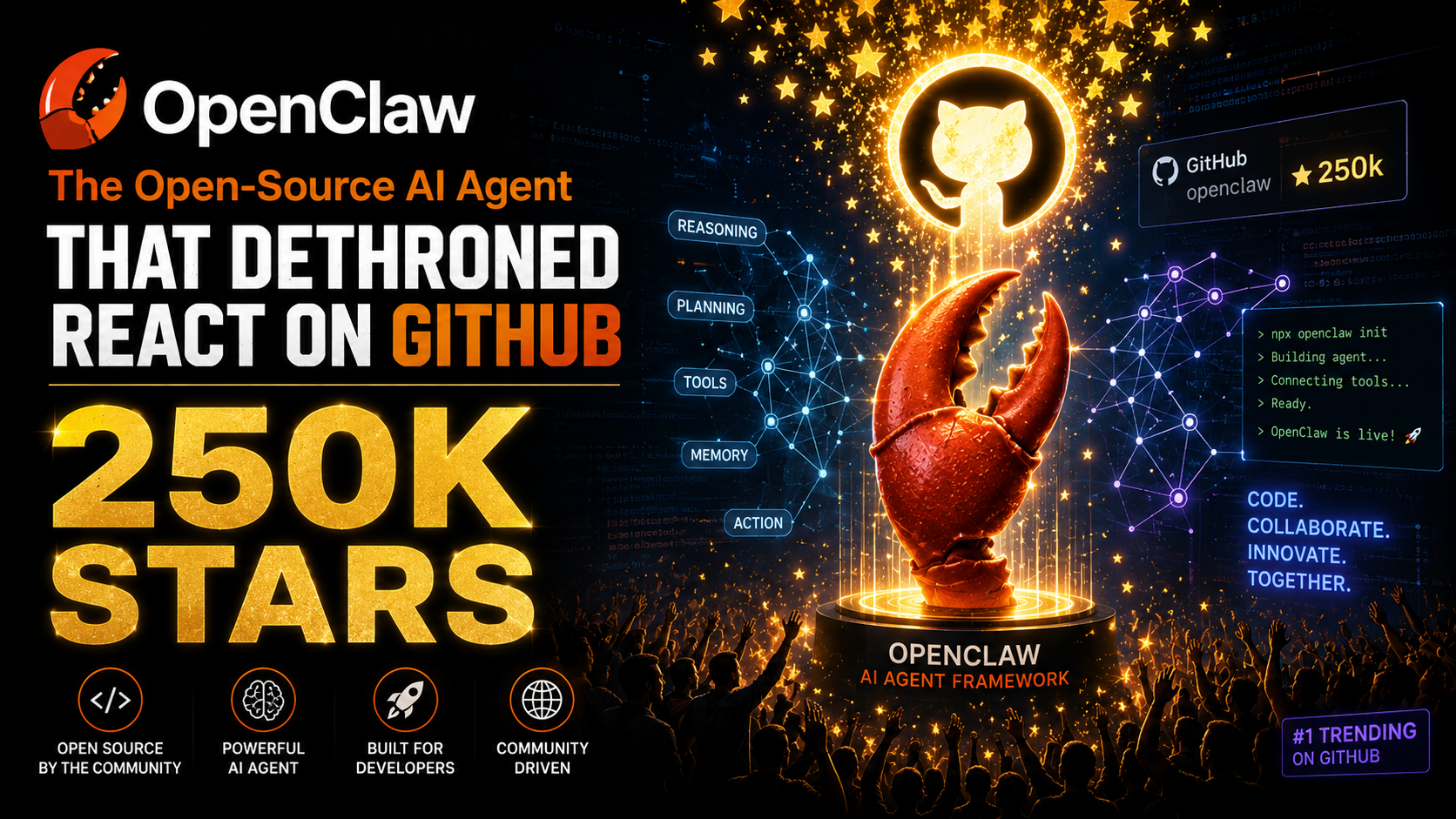
A project called OpenClaw has done something that seemed impossible: it overtook React to become the most-starred software project in the history of GitHub, crossing 250,000 stars in March 2026 after achieving 100,000 in January. If you haven’t heard of OpenClaw, you’re not alone — it’s been growing almost entirely through word of mouth in developer and privacy communities, with almost no mainstream tech press coverage. That’s exactly why it belongs in this article. OpenClaw is the kind of project that looks like a curiosity today and looks like infrastructure tomorrow.
OpenClaw is a personal AI agent that runs entirely on your own hardware — your Mac, Windows PC, or Linux machine — and connects to the messaging apps and services you already use. It’s privately hosted, locally processed, and designed from the ground up so your sensitive data never touches a third-party server. In a world where every AI product from ChatGPT to Meta AI stores your conversations, OpenClaw’s pitch is simple: what if the AI knew everything about your life, but only you controlled that knowledge?
What Is OpenClaw? The Open-Source AI Agent Explained
OpenClaw describes itself as “your own personal AI assistant. Any OS. Any Platform.” That tagline undersells it significantly. OpenClaw is a fully autonomous personal agent that can read your emails, access your local files and notes, monitor your calendar, and communicate with you across WhatsApp, Telegram, Slack, Discord, Signal, iMessage, Microsoft Teams, and dozens of other messaging platforms — proactively, without being summoned.
The core architecture consists of what OpenClaw calls a “local-first Gateway” — a single control plane that manages sessions, channels, tools, and events on your machine. The Gateway connects to AI model providers of your choice: you can run local models via Ollama for maximum privacy, or connect to cloud providers like Anthropic or OpenAI if you prefer their capabilities. The key insight is that the orchestration layer — the part that knows your data and your context — stays local, even if individual AI inferences are made to cloud providers.
Practical examples of what OpenClaw can do out of the box:
- Monitor your email and Slack for messages that need a response, draft replies for your review, and send them on your behalf
- Scan your local files to answer questions like “what did I write about X last month?”
- Proactively notify you via WhatsApp when calendar conflicts arise
- Summarize overnight Slack discussions so you’re caught up when you wake up
- Automate repetitive workflows that previously required multiple apps and manual steps
All of this runs on hardware you own, with no OpenClaw account required and no data transmitted to OpenClaw’s servers (there are none). The project is MIT-licensed, meaning anyone can inspect, modify, and redistribute the code.
How OpenClaw Hit 250K Stars Faster Than Any Project in GitHub History
OpenClaw’s GitHub trajectory is genuinely unprecedented. The project went from obscurity to 100,000 stars in roughly 60 days — a pace that left React, TensorFlow, and every other legendary open-source project in the dust. By March 2026 it had 250,000 stars, making it the most-starred software repository ever on GitHub. The speed of adoption tells you something important about the underlying demand.
Three factors drove the viral growth. First, the timing was perfect: 2026 is the year when AI assistants have become genuinely useful, but also the year when mainstream users became genuinely anxious about what AI companies do with their data. OpenClaw addressed both the capability demand and the privacy anxiety simultaneously.
Second, the demo videos were extraordinary. OpenClaw’s documentation includes demos of the agent managing a user’s entire communications workflow — drafting emails, scheduling meetings, surfacing relevant files — and the capability gap between OpenClaw and traditional AI chatbots is immediately apparent. People who watched the demos shared them. Widely.
Third, the developer community embraced it as infrastructure rather than just a tool. Unlike consumer AI products that lock you into specific workflows, OpenClaw is extensible — you can write plugins, connect custom data sources, and build your own automations. For developers tired of building on top of AI providers’ APIs only to have the terms change, OpenClaw represents sovereignty. As we’ve noted in our coverage of building AI agents in 2026, the demand for self-hosted, controllable agent infrastructure has never been higher.
How OpenClaw Actually Works Under the Hood
OpenClaw’s architecture is more sophisticated than most comparable projects. The Gateway process runs persistently on your machine and maintains connections to configured channels (email, Slack, WhatsApp, etc.) through their official APIs. When a relevant event occurs — a new email arrives, a Slack message mentions you, a calendar conflict is detected — the Gateway’s event system fires, which can trigger automated responses, AI processing, or notifications.
The AI layer is pluggable. OpenClaw ships with support for Ollama (local models), OpenAI, Anthropic, and several other providers. You configure which provider handles which type of task — so you could use a fast local model for simple triage and a more powerful cloud model for complex writing. The system maintains context across sessions using local embeddings and a vector database that stays on your machine.
Setup requires comfort with the command line — the official documentation acknowledges that “if you can’t understand how to run a command line, this is far too dangerous of a project for you to use safely.” That warning reflects a genuine risk: OpenClaw has access to your email, calendar, messaging, and files. A misconfigured instance could expose sensitive data or enable unauthorized access. The power of the tool is directly proportional to the care required in deploying it.
The Nvidia Connection: NemoClaw Integration
One of the most interesting recent developments in the OpenClaw ecosystem is the emergence of NVIDIA NemoClaw — an official Nvidia integration that allows OpenClaw to run on Nvidia’s NIM (Nvidia Inference Microservices) platform for optimized local inference. Nvidia published a technical blog post and documentation on NemoClaw, essentially blessing OpenClaw as an enterprise-ready deployment platform.
NemoClaw integration means organizations can deploy OpenClaw on Nvidia-accelerated hardware with production-grade inference performance, while maintaining the local-first privacy guarantees that make OpenClaw attractive. For enterprises that have been investing heavily in AI infrastructure, NemoClaw is a compelling option: local AI agent capabilities with GPU-accelerated performance, no cloud dependency, and an open-source codebase that security teams can audit.
DigitalOcean has also published extensive documentation on deploying OpenClaw in cloud environments, which creates an interesting middle path: cloud-hosted but operator-controlled, with the privacy guarantees of a self-hosted deployment. This is pushing OpenClaw from a pure developer tool toward a legitimate enterprise product.
The Security Risks Nobody Is Talking About
OpenClaw’s power creates real security risks that the project’s enthusiastic growth has somewhat overshadowed. The system’s access to email, calendar, messaging platforms, and local files means that a compromised OpenClaw instance — or a user who accidentally misconfigures permissions — could expose an extraordinary amount of sensitive information.
Specific risks security teams should consider before deploying OpenClaw:
- Plugin ecosystem trust: OpenClaw’s extensible plugin system means third-party plugins have the same access as the core system. Plugin provenance and code review are critical before installation.
- API token exposure: OpenClaw stores API tokens for email, messaging, and other services. Proper secret management and token scoping are essential.
- Agent autonomy risks: If configured to act autonomously (send emails, post messages, modify files), a bug in custom automation code could have real consequences.
- Network exposure: The Gateway’s web interface, if accidentally exposed to the internet, becomes a high-value attack target.
None of these risks are reasons to avoid OpenClaw — they’re reasons to deploy it thoughtfully. For technical users and security-conscious organizations, OpenClaw’s risks are manageable. The project’s open-source nature actually helps here: every line of code is auditable, which is more than you can say for any commercial AI assistant.
Why OpenClaw Matters for the Future of AI
OpenClaw’s success is a data point in a larger argument about the future of AI deployment. The dominant model today — cloud-based AI services where your data is processed on someone else’s infrastructure — has clear advantages in capability and convenience. But it has a fundamental limitation: you are not in control. Your data, your conversations, your context are held by companies whose incentives don’t perfectly align with yours.
OpenClaw represents the other model: local-first, user-controlled, open-source AI infrastructure. The 250,000 developers who starred the project aren’t all going to deploy it — many are bookmarking it, watching it, waiting for it to mature. But the signal is clear: there is enormous demand for AI that respects user sovereignty.
As AI becomes more deeply integrated into professional and personal life, the question of who controls the AI layer will become increasingly significant. OpenClaw is today’s answer for technical users. The question is whether similar capabilities become accessible to mainstream users — and when that happens, what the implications are for the AI companies whose business models depend on data collected from user interactions.
Watch OpenClaw. It went from zero to dethroning React in months. Whatever comes next for this project, the underlying demand it represents isn’t going away.
Sources: OpenClaw GitHub | OpenClaw.org | DigitalOcean | Nvidia Blog | Wikipedia | Nvidia Technical Blog