OpenAI Hit $25B Revenue but Its Own CFO Says the IPO Isn’t Ready — Here’s Why
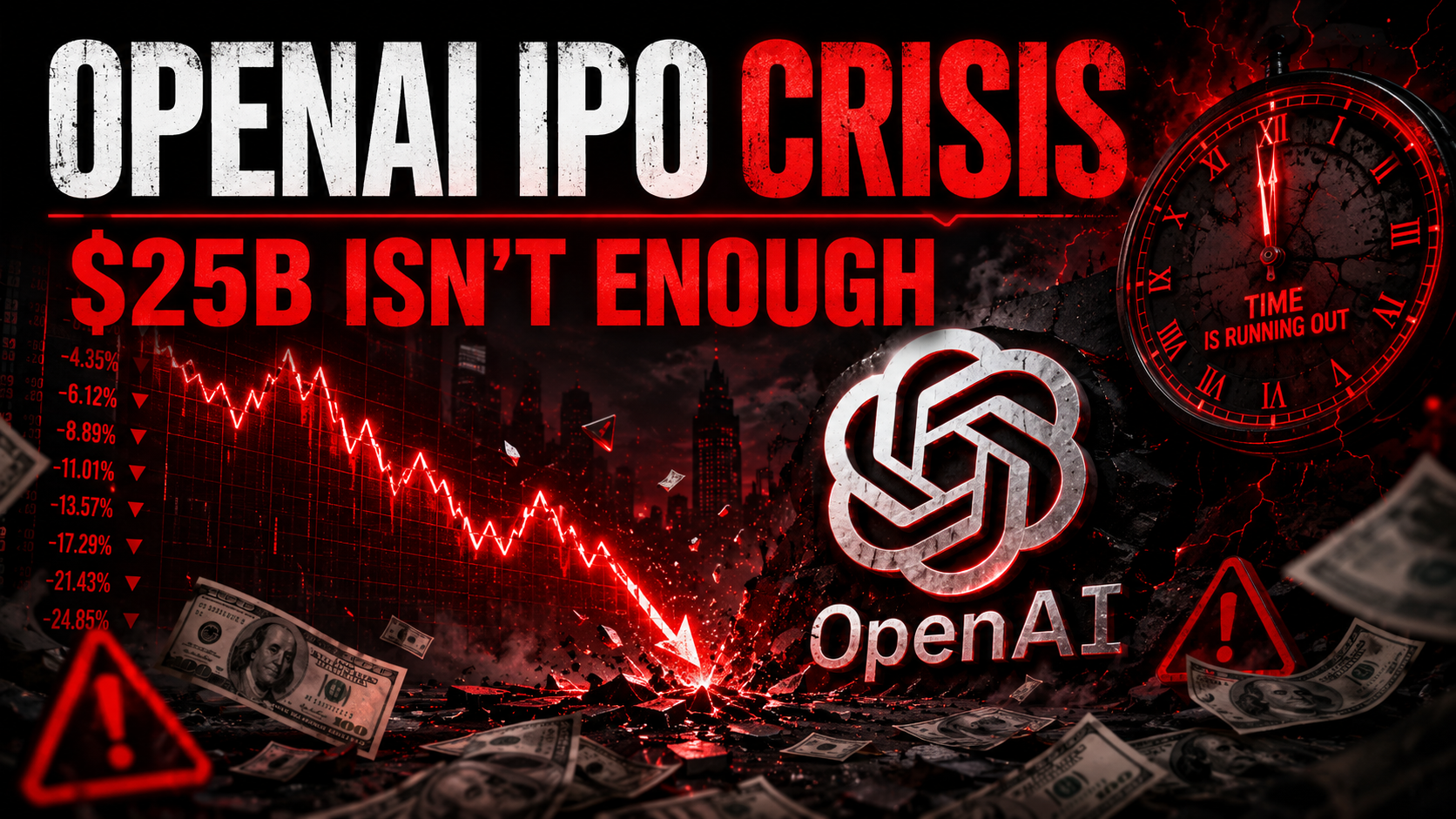
The OpenAI IPO 2026 story keeps getting stranger. OpenAI is printing $2 billion a month. It has the most famous AI brand on the planet. And its own CFO just told the board they’re not ready to go public. Here’s the inside story of why OpenAI’s $25 billion revenue milestone isn’t the victory lap everyone thinks it is.
Table of Contents
OpenAI IPO 2026: The $25 Billion Number Sounds Incredible — Until You Do the Math
In February 2026, OpenAI hit a landmark: $25 billion in annualized revenue, generating roughly $2 billion per month. For a company that barely existed five years ago, that growth trajectory is staggering. ChatGPT alone has become one of the fastest-growing consumer products in history, and enterprise adoption of the GPT API is accelerating across every industry.
But here’s the problem: OpenAI has signed nearly $1 trillion in compute and infrastructure obligations. That means for every dollar OpenAI earns, it has committed roughly $40 in future spending on data centers, GPUs, and cloud contracts. According to CNBC reporting, CFO Sarah Friar has been telling colleagues that if revenue growth doesn’t accelerate, the company “could face difficulty funding future compute agreements.”
That 40-to-1 ratio of obligations to revenue is what keeps Friar up at night — and it’s the core reason she’s pushing back against Sam Altman’s aggressive IPO timeline.
OpenAI Missed Its Own Targets
The headline revenue number hides a concerning trend: OpenAI missed both its internal revenue and user growth targets for early 2026. The Wall Street Journal reported that the company fell short on key metrics that executives had presented to investors during their most recent fundraising round.
Internal targets put 2026 revenue at 2.3x the 2025 figure, with a wildly ambitious $280 billion annual revenue target by 2030. But when your current growth is already falling below projections, those future targets start looking less like forecasts and more like fantasy. Enterprise revenue, which OpenAI had counted on to diversify beyond consumer subscriptions, showed signs of softening as competitors like Google Gemini and Anthropic Claude ate into market share.
The CFO vs. The CEO: Friar Wants 2027, Altman Wants Now
The most dramatic tension inside OpenAI right now is between CEO Sam Altman and CFO Sarah Friar over IPO timing. According to TechTimes, Friar has been telling colleagues and board members that OpenAI is not financially ready to go public on Altman’s preferred Q4 2026 schedule. She wants to wait until 2027.
Friar’s argument centers on the math. OpenAI is projecting losses of approximately $14 billion in 2026 alone. The company doesn’t expect to reach profitability until around 2030. Going public while burning $14 billion a year — with nearly $1 trillion in future compute obligations — would make OpenAI one of the most loss-heavy IPOs in history. For comparison, Uber’s famously rough IPO in 2019 came with annual losses of about $8.5 billion.
Altman, on the other hand, wants to strike while the AI hype is hot. The company raised $40 billion at a $300 billion valuation in March 2025, and more recently secured a $122 billion funding round at an $852 billion post-money valuation. Some internal projections suggest OpenAI could debut at a $1 trillion valuation — making it the most valuable IPO in history. But that window could close if AI sentiment shifts or competitors catch up.
In a joint statement to CNBC, both Altman and Friar said they are “totally aligned on buying as much compute as we can.” But the public unity masks a real disagreement about timing and risk tolerance that could define OpenAI’s future.
The $852 Billion Valuation Problem
OpenAI’s most recent private valuation of $852 billion creates its own set of challenges. At that price, OpenAI would need to justify a market cap larger than every company on Earth except Apple, Microsoft, Nvidia, and Amazon. To support that valuation with fundamentals, OpenAI would need to grow revenue by roughly 10-15x from current levels while simultaneously achieving profitability.
The company is also navigating several legal and structural risks that could complicate an IPO. The ongoing lawsuit from Elon Musk, copyright litigation from publishers including the New York Times, the controversial nonprofit-to-for-profit conversion, and increasing regulatory scrutiny from both U.S. and EU authorities all create uncertainty that public market investors typically punish.
What’s Burning All That Cash?
OpenAI’s spending is concentrated in three areas. First, compute infrastructure: training and running models like GPT-5 and its successors requires massive GPU clusters. OpenAI has committed to long-term contracts with Microsoft Azure and is building its own data centers. Second, talent: OpenAI employs some of the highest-paid researchers and engineers in the world, with total compensation packages that can exceed $10 million per year for senior researchers. Third, product expansion: from the AI phone project to the $100M+ TBPN media acquisition, OpenAI is spending aggressively on non-core initiatives.
The question investors will ask: can OpenAI generate enough revenue to justify this spending before it runs out of runway? With $25 billion in annual revenue and $14 billion in annual losses, the company has roughly 18-24 months of financial cushion from its recent fundraising — assuming spending doesn’t increase (which it will).
The AI IPO Wave: OpenAI Isn’t Alone
OpenAI’s IPO drama is playing out against the backdrop of a broader AI IPO wave. Cerebras already went public at a $26.6 billion valuation. Anthropic and xAI are both reportedly exploring public listings. SpaceX — another company in Sam Altman’s orbit — is also eyeing an IPO.
The risk for all these companies is that the IPO window is time-limited. If AI sentiment sours — due to a major safety incident, regulatory crackdown, or simply diminishing returns on model improvements — the trillion-dollar valuations could evaporate quickly. That’s why Altman wants to move fast, and why Friar’s caution, while financially prudent, could cost OpenAI its shot at a generational IPO.
What Happens Next
OpenAI is at a crossroads. The company needs to either accelerate revenue growth dramatically to justify its valuation, or accept a lower valuation and go public on more conservative terms. Neither option is attractive to a company that has positioned itself as the undisputed leader in AI.
Watch for Q2 2026 revenue numbers closely. If OpenAI can demonstrate reacceleration in growth — particularly in enterprise revenue — the Q4 2026 IPO becomes viable. If growth continues to disappoint, expect the listing to slip to 2027, and expect Altman and Friar’s public alignment to become increasingly difficult to maintain.
One thing is certain: when OpenAI does go public, it will be the most closely watched IPO since Facebook. And whether it becomes a triumph or a cautionary tale will depend on whether $25 billion in revenue is enough to sustain a company that’s burning cash like it’s racing against time — because it is.
Related Reading
If you found this article interesting, check out these related stories: OpenAI’s $100M TV network acquisition, Big Tech’s $725 billion AI infrastructure race, Cerebras’ $3.5B IPO. Also worth reading: Nvidia’s $40 billion AI investments and 76% of companies hiring Chief AI Officers.