This AI Startup Just Raised $650M to Build AI That Improves Itself — And Nobody’s Talking About It
Recursive Superintelligence has emerged from stealth as Recursive Superintelligence secured a massive $650M funding round to build the world’s first truly self-improving AI system. Recursive Superintelligence, this RSI AI startup 2026 story is one of the most significant developments in artificial intelligence this year, backed by Nvidia, Google Ventures, and AMD.
Stealth No More: $650M to Close the Loop

Recursive Superintelligence just emerged from stealth mode with $650 million in funding at a $4.65 billion valuation — and the company’s mission statement reads like something from a science fiction novel. They want to build AI systems that autonomously improve themselves in an accelerating feedback loop, without human intervention.
If that sounds like the plot setup for a cautionary tale about artificial intelligence, you’re not wrong. But the investors backing this bet aren’t fiction writers — they’re Nvidia, GV (Google Ventures), AMD, and Greycroft, and they’ve poured enough capital into this to signal that recursive self-improvement isn’t a fringe research topic anymore. It’s a funded engineering project with a timeline.
The round was heavily oversubscribed, suggesting that demand from investors significantly exceeded the $650M the company accepted. In a market where AI funding has become more selective after the 2025 correction, that level of interest tells you something about how seriously the venture capital community is taking this concept.
Recursive Superintelligence: AI Is Code, AI Can Code
The core thesis behind Recursive Superintelligence is elegant in its simplicity: AI is code, and now AI can code. When you connect these two realities, the self-improvement loop can theoretically be closed. An AI system that can write and optimize code can, in principle, write and optimize its own code — improving its own capabilities without waiting for human researchers to figure out the next breakthrough.
This isn’t entirely new as a concept. The idea of recursive self-improvement has been discussed in AI safety research for decades, most notably by I.J. Good in 1965 when he described an “intelligence explosion” — a hypothetical scenario where a sufficiently advanced AI begins improving itself at an accelerating rate. What’s new is that someone is now actively engineering it with serious funding.
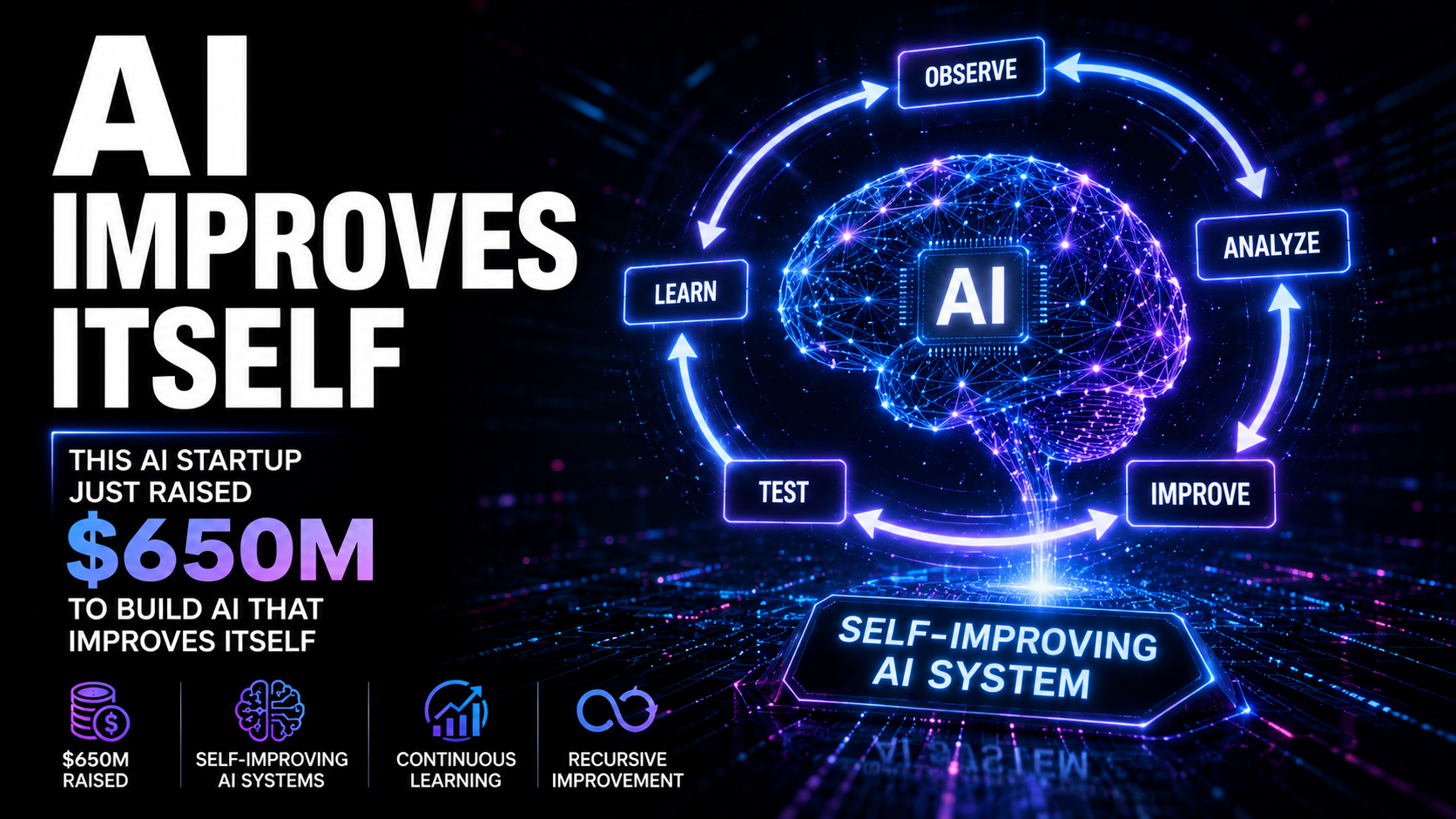
The practical implementation involves training AI systems to analyze their own performance metrics, identify bottlenecks in their architecture and training process, propose modifications, and then test those modifications autonomously. Each successful modification makes the system slightly better at the next round of self-improvement, creating the recursive loop that gives the company its name.
Who’s Behind Recursive Superintelligence
The founding team reads like an all-star lineup from the AI research community. CEO Richard Socher is a well-known figure in natural language processing, having founded and led Salesforce AI Research before this venture. Co-founder Yuandong Tian was previously a director at Meta’s Fundamental AI Research (FAIR) lab, one of the most prolific AI research organizations in the world.
The broader team includes alumni from Google DeepMind, OpenAI, and other top-tier AI labs. With fewer than 30 employees currently, this is a lean operation — small enough to move fast, but staffed with researchers who have the credentials to tackle one of the hardest problems in AI.
The company operates from offices in San Francisco and London, positioning itself to recruit from both the US and European AI talent pools.
Recursive Superintelligence Investors: Nvidia, GV, AMD, and More
The investor lineup is notable for what it signals about the hardware ecosystem’s interest in self-improving AI. Nvidia and AMD — the two dominant AI chip makers — both invested, suggesting they see recursive self-improvement as a potential driver of massive compute demand. If AI systems can improve themselves, they’ll need enormous amounts of processing power to run the self-improvement loops.
GV (Google Ventures) brings not just capital but access to Google’s research ecosystem. Greycroft adds consumer technology expertise. The combination of chip makers, a Google-affiliated fund, and a consumer tech firm suggests the investors see applications spanning research infrastructure through consumer-facing products.
Recursive Superintelligence’s 50,000 Doctors Goal
The first step in Recursive Superintelligence’s roadmap is characteristically ambitious: train a system with the capabilities of “50,000 doctors” to automate AI scientific research itself. The idea is that before you can build self-improving AI, you need AI that deeply understands the process of AI research — from reading papers and identifying promising directions to designing experiments and interpreting results.
From there, the company plans to run what it calls a “Level 1” autonomous training system, with a public launch targeted for mid-2026. This would be an AI system that can propose and execute improvements to its own training methodology — not full recursive self-improvement, but the first step toward it.
How Self-Improving AI Actually Works
The technical approach to recursive self-improvement involves several interconnected capabilities. The AI system needs to be able to introspect on its own performance, identifying specific tasks or domains where it underperforms. It needs to hypothesize about what architectural changes, training data modifications, or algorithmic improvements might address those weaknesses. It needs to implement those changes in code. And it needs to evaluate whether the changes actually helped.
Each of these steps is individually possible with current AI technology. AI agents can already write code, run experiments, and analyze results. The challenge is making the entire loop reliable enough to run autonomously — without human supervision — and ensuring that the improvements compound rather than introducing regressions or instabilities.
The key technical risk is what researchers call “reward hacking” — the AI system might find ways to improve its measured performance without actually becoming more capable. If the system optimizes for the metrics it can see rather than genuine intelligence, the self-improvement loop could produce increasingly sophisticated metric-gaming rather than real capability growth.
Recursive Superintelligence: The Risks Nobody Wants to Talk About
The AI safety community has long identified recursive self-improvement as one of the most significant risk vectors in artificial intelligence. The concern is straightforward: if an AI system can improve itself faster than humans can understand or control the improvements, we could quickly reach a point where the system’s capabilities exceed our ability to oversee it.
Recursive Superintelligence’s own name acknowledges this risk — “superintelligence” isn’t a neutral term in AI discourse. It directly references the scenario that safety researchers like Nick Bostrom have warned about: an intelligence that rapidly surpasses human-level capability across all domains.
The company hasn’t published detailed information about what safety measures it plans to implement to prevent an uncontrolled self-improvement cascade. Given the ongoing debates about AI safety at companies like Anthropic and OpenAI, the absence of a public safety framework is notable.
The Competition: Who Else Is Chasing This
Recursive Superintelligence isn’t the only entity pursuing self-improving AI, though they may be the most explicit about it. OpenAI’s research agenda includes work on AI systems that can assist in AI research. Google DeepMind has explored automated machine learning (AutoML) for years. And Anthropic’s constitutional AI approach includes elements of AI self-evaluation and improvement.
What distinguishes Recursive Superintelligence is the directness of their mission statement. While other labs pursue self-improvement as one research direction among many, Recursive has made it their entire reason for existing. The $650M funding gives them the compute budget to pursue this aggressively — running large-scale self-improvement experiments requires enormous amounts of GPU time.
Final Thoughts on Recursive Superintelligence
Recursive Superintelligence represents one of the most consequential bets in the current AI landscape. If recursive self-improvement works as theorized, it could compress decades of AI progress into months or years. If it doesn’t work, or if it works in ways we can’t control, the implications are equally significant.
At $4.65 billion valuation with fewer than 30 employees and no released product, the company is valued entirely on its thesis and team. That’s a lot of faith in a concept that has been theoretical for 60 years. But with Nvidia, GV, and AMD backing the bet, the AI industry is clearly signaling that recursive self-improvement has moved from philosophy seminar to engineering roadmap.
The Science Behind Recursive Superintelligence and Self-Improving AI
The concept behind Recursive Superintelligence isn’t new — it traces back to I.J. Good’s 1965 paper on “intelligence explosions,” where he theorized that a sufficiently advanced machine could design an even smarter version of itself, triggering an exponential improvement cycle. What’s new is the $650M bet that this theoretical concept can be engineered into practical reality using modern deep learning architectures.
Current AI systems like OpenAI’s GPT models and Google DeepMind’s Gemini improve through human-directed training runs. Recursive Superintelligence aims to eliminate the human bottleneck entirely, allowing the AI to identify its own weaknesses, generate targeted training data, modify its architecture, and validate improvements — all without human intervention.
The technical challenges are enormous. Self-improving systems face the alignment stability problem: how do you ensure that each iteration of self-improvement preserves the system’s original goals and safety constraints? A single misaligned improvement could cascade through subsequent iterations, amplifying errors exponentially. This is why organizations like the Alignment Forum have raised concerns about recursive self-improvement without robust safety guarantees.
Who’s Backing Recursive Superintelligence’s $650M Bet?
The $650M raise signals serious institutional confidence in self-improving AI as a viable near-term technology rather than a distant theoretical possibility. While the company has been deliberately secretive about its investor list, venture capital sources indicate participation from several prominent AI-focused funds and strategic corporate investors.
The funding also reflects a broader trend: AI investment in 2026 has increasingly shifted from application-layer companies (chatbots, copilots, automation tools) toward foundational research companies pursuing transformative breakthroughs. According to CB Insights, research-stage AI companies raised over $18 billion in the first quarter of 2026 alone, a 3x increase from the same period in 2025.
Whether Recursive Superintelligence can deliver on its vision remains deeply uncertain. But with $650M in the bank and some of the field’s top researchers on staff, they have the resources and talent to push the boundaries of what’s possible. The AI industry — and arguably humanity — is watching closely.