Pentagon Signs AI Deals With 8 Tech Giants — Why Was Anthropic Left Out?
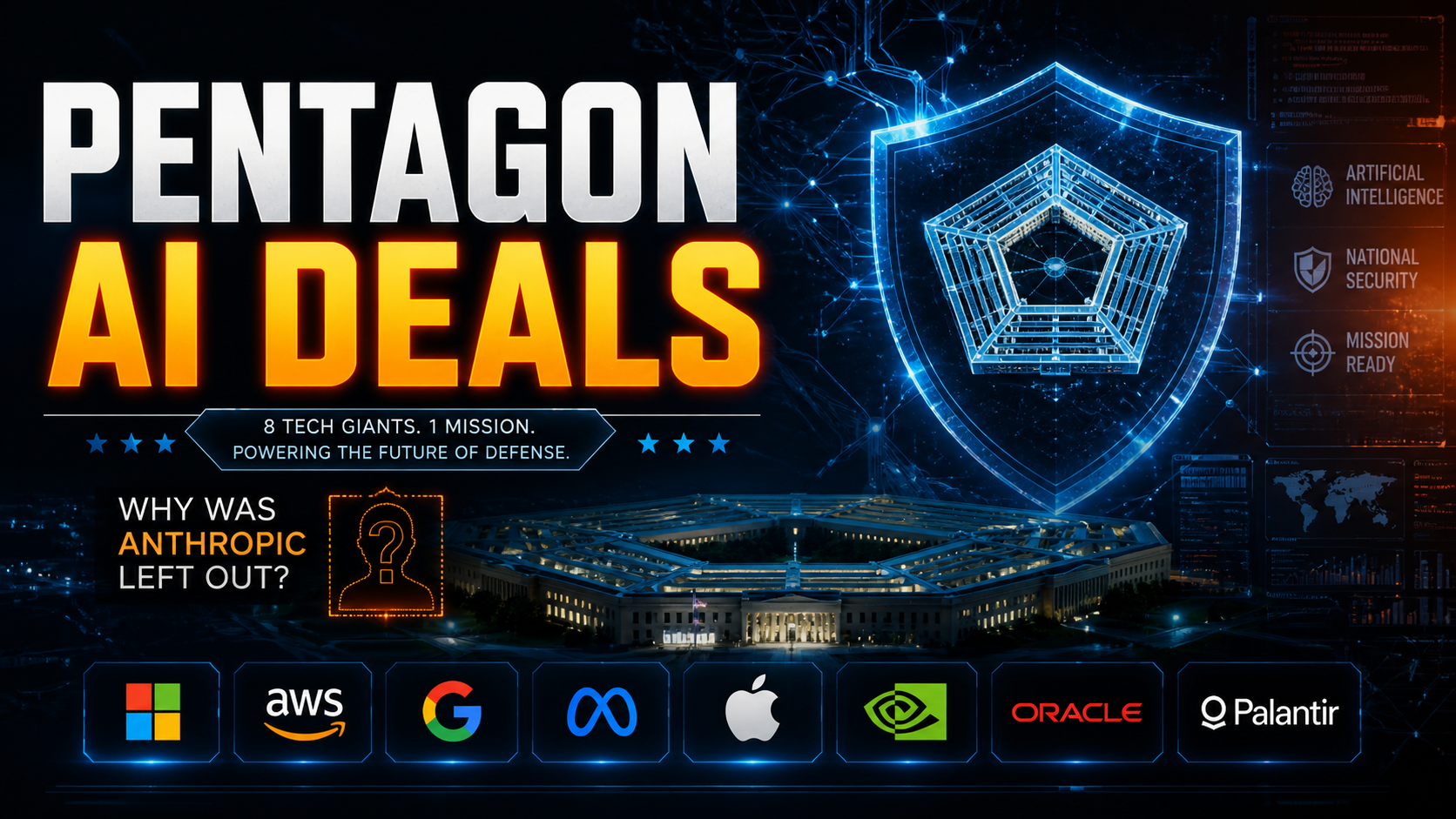
Table of Contents: Pentagon Ai Deals
On May 1, 2026, the Pentagon announced classified AI agreements with eight of the biggest names in tech. OpenAI, Google, Microsoft, Nvidia, Amazon Web Services, Oracle, SpaceX, and a startup called Reflection AI all signed on to deploy their models on America’s most sensitive classified networks. One major frontier AI lab was conspicuously absent: Anthropic.
This isn’t just a contract snub. The Pentagon blacklisted Anthropic — labeling it a “supply chain risk,” a designation historically reserved for companies linked to foreign adversaries like China and Russia. How did the maker of Claude and Mythos end up on the same list as Huawei? The answer involves a standoff over autonomous weapons, a lawsuit against the Trump administration, and a secret White House meeting that may have changed everything.
The Deal: 8 Companies, Classified Networks, Zero Anthropic: Pentagon Ai Deals
The Department of Defense confirmed agreements with eight technology companies to integrate AI capabilities into its classified networks at Impact Level 6 (secret) and Impact Level 7 (top secret). These are the most sensitive information systems in the U.S. military — the networks where intelligence analysts process satellite imagery, where cyber operators track adversary movements, and where strategic planners run war simulations.
The scale of this Pentagon AI push is staggering. These aren’t pilot programs or research partnerships. The DoD wants production-grade AI models running inside classified environments, accessible to warfighters, intelligence analysts, and civilian planners alike. The contracts cover everything from data synthesis and situational awareness to augmenting decision-making in complex operational environments.
And every major frontier AI company got a seat at the table — except one.
Who Got In — And What They’re Building: Pentagon Ai Deals
Here’s the full list of companies the Pentagon partnered with for classified AI deployment:
- Microsoft — Already operates Azure Government Secret/Top Secret clouds. Deep existing relationship with DoD through JEDI successor contracts.
- Amazon Web Services — Runs GovCloud and has been a Pentagon cloud provider since the C2E (Commercial Cloud Enterprise) contract.
- Google — Recently added its latest Gemini models to GenAI.mil. Previously controversial due to Project Maven employee protests in 2018.
- OpenAI — Reversed its previous ban on military use in early 2024. Now fully committed to defense work.
- Nvidia — Providing GPU infrastructure and AI acceleration hardware for classified compute environments.
- Oracle — Government cloud infrastructure, particularly strong in database and enterprise systems for defense.
- SpaceX — Satellite communications and Starshield (the military variant of Starlink) for connected AI at the edge.
- Reflection AI — A stealth startup that has been building models specifically designed for government and defense applications from day one.
The inclusion of SpaceX is particularly notable. Elon Musk’s company isn’t an AI lab — it’s a rocket and satellite company. Its role likely centers on providing the communication backbone (via Starshield) that lets AI models operate in disconnected or contested environments where traditional internet doesn’t reach.
GenAI.mil: The Pentagon’s AI Platform Has 1.3 Million Users
To understand the Pentagon AI deals, you need to understand GenAI.mil — the Department of Defense’s enterprise AI platform that has quietly become one of the largest AI deployments in the world.
Over 1.3 million DoD personnel now use GenAI.mil. Users have built more than 100,000 AI agents on the platform. These agents handle everything from drafting intelligence reports and analyzing satellite imagery to streamlining logistics and processing after-action reviews. Tasks that once took months now take days.
Until now, GenAI.mil operated primarily on unclassified and lower-classification networks. The new agreements push AI into IL6 and IL7 — the networks where the military’s most sensitive operations happen. This is a massive escalation in both capability and risk.
For context, the AI agents being built on GenAI.mil aren’t simple chatbots. They’re sophisticated tools that can process multi-source intelligence, generate operational plans, and even draft communications — all within classified environments where data cannot leak to the public internet.
Why Anthropic Got Blacklisted
The story begins in July 2025, when Anthropic signed a $200 million contract with the Pentagon. Everything seemed fine — until the detailed negotiations over Claude’s deployment on GenAI.mil began in September.
The Department of Defense wanted Anthropic to grant the military unfettered access to Claude across “all lawful purposes.” Anthropic pushed back on two specific use cases:
- Fully autonomous weapons systems — AI making lethal decisions without human oversight
- Domestic mass surveillance — Using Claude to monitor U.S. citizens at scale
Anthropic’s position wasn’t that it refused to work with the military. The company argued that AI models aren’t yet reliable enough for autonomous weapons, and that U.S. law hasn’t caught up to protect Americans from AI-driven mass surveillance. They wanted contractual guardrails — specific assurances in writing.
The Pentagon’s response? Drop the guardrails or lose the contract.
Anthropic didn’t drop them. And in February 2026, Defense Secretary Pete Hegseth escalated dramatically — threatening to make Anthropic a “pariah” if it refused to comply.
The “Supply Chain Risk” Label — Reserved for Foreign Adversaries
When Anthropic still wouldn’t budge, the Pentagon didn’t just cancel the contract. It labeled Anthropic a “supply chain risk” — a nuclear option in government contracting.
This designation has historically been reserved for companies linked to foreign adversaries. Think Huawei, Kaspersky, and Chinese telecom companies suspected of espionage. Anthropic became the first American company ever to receive this label.
The designation doesn’t just block Anthropic from Pentagon contracts. It effectively blacklists the company from the entire federal government. Other agencies, defense contractors, and even allied nations take signals from DoD supply chain risk assessments when making their own procurement decisions.
For Anthropic — a company valued at over $60 billion — this was an existential threat dressed up as a procurement decision.
Anthropic’s Legal Battle Against the Trump Administration
In March 2026, Anthropic CEO Dario Amodei said the company had “no choice” but to challenge the supply chain risk designation in court. Anthropic filed a lawsuit against the Trump administration, arguing the label was arbitrary, punitive, and designed to coerce the company into dropping its safety commitments.
The Electronic Frontier Foundation weighed in, arguing that the dispute highlights a deeper problem: privacy protections shouldn’t depend on the ethical decisions of a few powerful tech CEOs. If Anthropic caves, the guardrails disappear. If Anthropic wins, it sets precedent — but only until the next company faces the same pressure.
In early April, a federal judge in California issued a partial block on the government’s exclusion effort. But the appeals court denied Anthropic’s bid for a broader temporary injunction, meaning the blacklist designation remains in effect while the case works its way through the courts.
The result: as of May 2026, Anthropic is simultaneously winning in court and losing contracts. The other seven companies signed their classified AI deals. Anthropic watched from the sidelines.
Dario Amodei’s Secret White House Meeting
On April 17, 2026, something unexpected happened. Anthropic CEO Dario Amodei walked into the White House for a meeting with Chief of Staff Susie Wiles and Treasury Secretary Scott Bessent.
Both sides called it a “productive introductory meeting.” The White House reportedly began convening companies across various sectors for “table reads” of possible executive guidance that could walk back the Office of Management and Budget’s directive banning Anthropic from government use.
President Trump himself commented on the situation in late April, saying Anthropic was “shaping up” and that a deal was “possible.” This was a dramatic shift from February, when the administration was threatening to make the company a pariah.
What changed? Two words: Claude Mythos.
The Mythos Factor: Did It Change Anything?
In late April, Anthropic unveiled Claude Mythos — a cybersecurity tool that can autonomously discover and exploit vulnerabilities in complex systems. Mythos found 12 zero-day vulnerabilities in production software during its demonstration, including critical flaws in widely-used enterprise tools.
The Pentagon noticed. Pentagon tech chief Michael Brown stated that Anthropic is “still blacklisted” but acknowledged that Mythos is a “separate issue” — suggesting the DoD might find a way to access Mythos’s capabilities even while maintaining the broader ban on Anthropic.
This creates an absurd situation: the Pentagon simultaneously considers Anthropic too dangerous to do business with and too valuable to ignore. The supply chain risk label says Anthropic is a threat. Mythos’s capability says Anthropic is indispensable.
AI Ethics vs. National Security: Who Wins?
The Anthropic-Pentagon standoff has become a referendum on a fundamental question: should AI companies have the right to set ethical boundaries on how governments use their technology?
Google faced a similar moment in 2018 with Project Maven, when employee protests forced the company to withdraw from a Pentagon drone imagery analysis program. Google has since reversed course and is now one of the eight companies in the classified AI deal.
OpenAI similarly reversed its previous ban on military use in January 2024, arguing that democratic nations need AI capabilities to maintain security advantages. Microsoft and Amazon never had such restrictions in the first place.
Anthropic stands alone among frontier AI companies in maintaining that certain military uses of AI should have contractual guardrails. Whether that’s principled leadership or naive idealism depends entirely on your perspective.
The stakes are enormous. If the government can effectively destroy a company’s business by labeling it a “supply chain risk” for insisting on ethical guidelines, then no company will dare push back in the future. The precedent being set here will shape AI governance for decades.
What Happens Next
The Pentagon’s eight AI partners are already deploying their models to classified networks. Anthropic’s court case continues to wind through the federal system. The White House appears to be exploring a diplomatic resolution that would let both sides save face.
The most likely outcome? Anthropic eventually gets back in — but on the Pentagon’s terms, not its own. The supply chain risk label will be quietly dropped, Anthropic will sign a modified version of the “all lawful purposes” clause with some face-saving language about “responsible AI principles,” and Claude will join the other models on GenAI.mil’s classified networks.
Until then, America’s most capable cybersecurity AI tool (Mythos) remains locked out of America’s most sensitive networks. And the company that built it is classified as a national security threat.
That’s the Pentagon AI story of 2026: eight companies building the future of military AI, one company fighting for the right to say “not like that,” and a government that would rather blacklist its own technology than accept conditions on how it’s used.
The question isn’t whether AI will be used in warfare. It’s whether anyone gets to say how.
Understanding the full scope of the Pentagon AI deals situation requires looking at both the immediate impact and long-term consequences. The Pentagon AI deals story has generated significant discussion among industry analysts, with many pointing to the Pentagon AI deals developments as a potential turning point for the sector.
What makes the Pentagon AI deals case particularly noteworthy is the speed at which events unfolded. Within days of the initial Pentagon AI deals announcement, competitors and stakeholders began repositioning their strategies. The ripple effects of Pentagon AI deals continue to be felt across the technology industry.
Looking ahead, the Pentagon AI deals developments are expected to influence policy decisions and investment strategies throughout 2026 and beyond. Experts suggest that the Pentagon AI deals outcome could serve as a blueprint for similar situations in the future, making the Pentagon AI deals case a critical reference point for the industry.
For readers following the Pentagon AI deals story, staying informed about new developments is essential. The Pentagon AI deals situation remains fluid, and additional details are expected to emerge in the coming weeks.
Industry observers note that the Pentagon AI deals impact extends beyond the immediate parties involved. The broader implications of Pentagon AI deals are reshaping how organizations approach strategic planning in this space.
Key Takeaway: The Pentagon AI Deals story represents a major shift in the technology landscape for 2026. As Pentagon AI Deals continues to make headlines, we’ll keep tracking developments and providing analysis on SudoFlare.