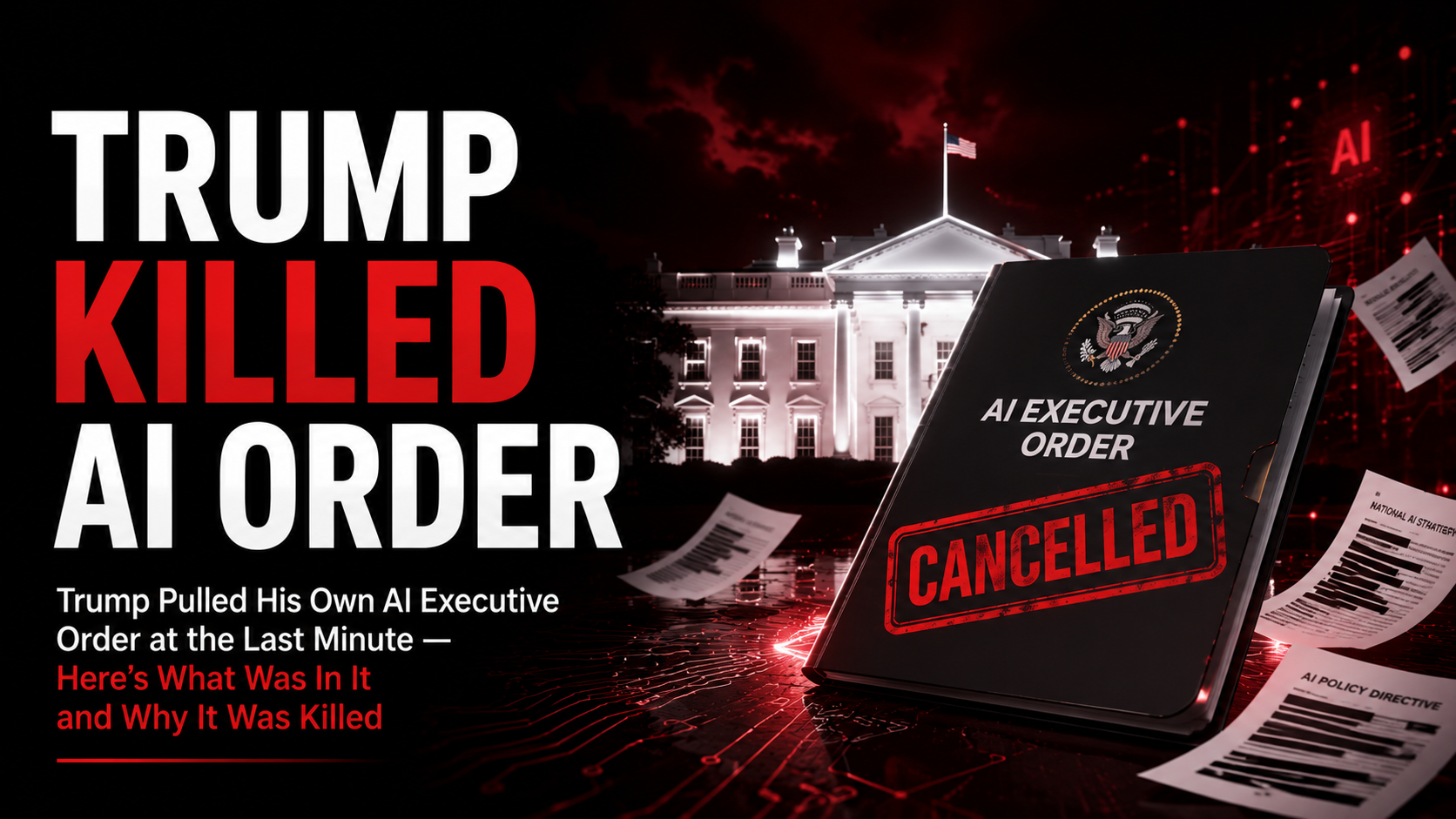
Trump Pulled His Own AI Executive Order at the Last Minute — Here’s What Was In It and Why It Was Killed
The AI Executive Order That Almost Changed Everything — Then Didn’t
On Thursday, May 21, 2026, tech industry leaders gathered at the White House expecting to witness a landmark moment: President Donald Trump signing a sweeping executive order on artificial intelligence that would reshape how the U.S. government secures AI systems and interacts with frontier AI companies. The cameras were ready. The guests were assembled.
Trump pulled the order at the last minute. It was not signed.
The abrupt reversal — confirmed by Bloomberg, Axios, and NBC News — sent shockwaves through Washington’s AI policy circles and revealed deep internal divisions within the Trump administration about how aggressively the federal government should regulate artificial intelligence. It also highlighted something more fundamental: the President’s instinctive hostility to any rule that could be characterized as constraining American companies, even in the name of national security.
What Was Actually In the Order
The draft executive order was substantive. According to reporting from Bloomberg and Axios, it contained several major provisions that would have represented the most significant federal AI policy action since the Biden administration’s October 2023 AI executive order:
- Voluntary government testing of frontier AI systems: The order would have called for AI companies to voluntarily submit their most powerful models for testing by federal agencies, with the goal of identifying vulnerabilities that could be exploited to attack government networks, hospitals, banks, and critical infrastructure
- AI cybersecurity information sharing: Existing cybersecurity information-sharing programs — which allow companies to report threat intelligence to the government without liability — would have been expanded to explicitly include AI companies and AI-specific threats
- Pentagon and intelligence agency protections: Specific provisions aimed at hardening the Department of Defense, NSA, and other national security agencies against AI-powered attacks
- Cyber hiring surge: Directives to expand cybersecurity workforce programs, with an emphasis on AI security specialists
- Critical infrastructure protection: Requirements for hospitals, financial institutions, and energy companies to implement AI-specific security measures
Crucially, the order stopped short of requiring mandatory federal approval of frontier AI models — a concession to the tech industry that was baked in from the start. This was not a regulatory hammer. It was, by Washington standards, a relatively modest first step.
Why Trump Killed His Own Order
Sources told Axios that the signing was delayed because Trump “just hates regulation” — a characterization that multiple White House officials declined to deny. His AI adviser David Sacks, a prominent tech entrepreneur and Silicon Valley Republican, also opposed the order, according to reporting.
The concern, according to people familiar with the internal deliberations, was that any government testing program for AI models — even voluntary — could be characterized as government interference in private sector AI development. In the current political climate, where American AI dominance is framed explicitly as a strategic competition with China, any friction on AI development is seen as potential competitive disadvantage.
The NBC News reporting was blunter: Trump “abruptly scrapped” the signing after deciding it “could interfere with American competitiveness on AI.” That framing — competitiveness over security — captures the central tension in Trump’s approach to AI policy.
It’s a remarkable position. The cybersecurity provisions in the draft order were designed to protect American AI infrastructure from foreign attacks. The Pentagon, hospitals, and financial institutions the order targeted for hardening are the same institutions that would suffer most from a successful AI-powered cyberattack by China, Russia, or Iran. Framing security measures as an “interference with competitiveness” inverts the logic of what the order was designed to accomplish.
The Leak That Changed the Conversation: Early Government Access to Frontier Models
Before the signing collapse, Axios published a scoop that added a controversial dimension to the debate: the draft order also included a provision seeking early government access to frontier AI models before their public release. Specifically, federal agencies would have gained the ability to test unreleased frontier models for security vulnerabilities and national security risks prior to companies making those models available to the public.
This provision reportedly sparked significant backlash within the tech industry. Companies including OpenAI, Anthropic, and Google had been generally supportive of voluntary security testing — but pre-release government access to unreleased models raised intellectual property concerns and, for some executives, the specter of government influence over product roadmaps.
David Sacks’s opposition to the order appears to have focused largely on this provision, which sits at the intersection of national security interests and tech industry autonomy. The internal White House fight reflects a genuine and unresolved tension: how do you protect national security without creating a government backdoor into the most sensitive AI development happening in America?
What’s Left of U.S. AI Policy Without This Order
The Trump administration revoked Biden’s October 2023 AI executive order shortly after taking office in January 2025, eliminating the most comprehensive federal AI governance framework the U.S. had ever had. What replaced it was largely a deregulatory posture: let American companies develop AI without federal constraints, compete against China, and self-regulate on safety.
The order that was just pulled would have been the first significant re-engagement with AI governance under Trump — and it’s now off the table, at least for now. That leaves a notable gap: the U.S. has no comprehensive federal framework governing how AI systems should be secured, tested, or monitored at the national level.
This matters in the context of the Verizon DBIR 2026’s findings that AI is accelerating the speed of cyberattacks and that critical infrastructure patching rates are declining. The threat environment the executive order was designed to address hasn’t gone away just because the order was pulled.
For context: the EU has moved aggressively on AI governance with the AI Act. China has implemented specific regulations for generative AI and frontier model development. The U.S. pulling an AI security order — not even a broad regulatory framework, just a cybersecurity-focused directive — signals a stark divergence in approach that the global AI industry will be navigating for years.
Will It Come Back? What Happens Next
White House officials described the delay as a postponement rather than a permanent cancellation. The order may be revised to remove the early government model access provisions and resubmitted for signing at a later date. Sources familiar with the discussions suggest a narrower, more industry-friendly version focused purely on cybersecurity information sharing — without any model access components — could move forward.
But the pulling of the order at the last minute, after industry leaders had assembled at the White House, is a political signal that the Trump administration will not move on AI governance against the wishes of Silicon Valley. David Sacks’s influence over AI policy appears stronger than many observers expected, and his libertarian instincts about government involvement in tech are clearly shaping how the administration approaches these questions.
For OpenAI, Anthropic, Google, and the rest of the frontier AI industry, the short-term outcome is favorable: no new mandatory testing requirements, no government model access provisions, no regulatory overhead. In the long run, however, operating in a regulatory vacuum creates its own risks — particularly if a significant AI-related security incident occurs and the absence of government oversight becomes a political liability.
The room was full. The pen was ready. And then it wasn’t. That’s where U.S. AI policy stands today: canceled at the last minute, and no one is quite sure when, or whether, it’s coming back.