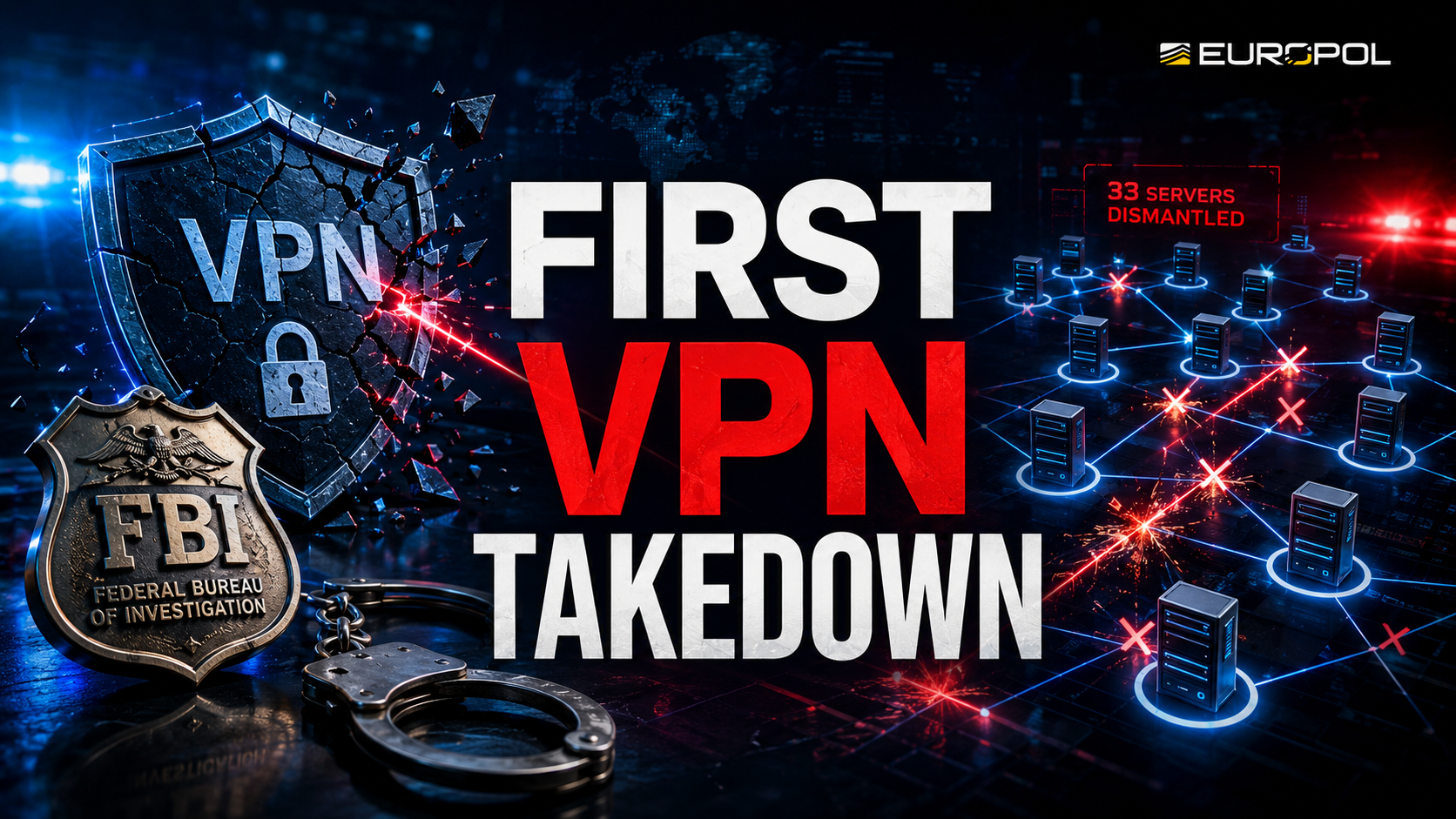
First VPN Takedown 2026: Europol Seizes 33 Servers Used by 25 Ransomware Groups
Table of Contents
For over a decade, a VPN service called First VPN quietly operated as the digital backbone of global cybercrime. From ransomware command-and-control servers to phishing infrastructure and botnet coordination, this wasn’t your average privacy tool — it was a full-blown criminal anonymization network. And on May 19-20, 2026, it all came crashing down.
Operation Saffron, a coordinated strike by law enforcement agencies across seven countries, didn’t just shut down First VPN — it seized its entire user database, exposed 5,000+ criminal accounts, and arrested the Ukrainian administrator who kept the whole operation running. This is the biggest VPN takedown in cybercrime history, and the intelligence haul could unravel criminal operations for years to come.
What Was First VPN?
First VPN wasn’t advertised on the Google Play Store or promoted in YouTube sponsorship deals. This service was marketed exclusively on underground criminal forums, offering what the cybersecurity world calls “bulletproof hosting” — infrastructure specifically designed to resist law enforcement takedowns and abuse complaints.
Operating under domains including 1vpns.com, 1vpns.net, 1vpns.org, and associated dark web onion sites, First VPN provided VPN tunnels through 32 exit nodes spread across 27 countries. The service had been active since approximately 2014, meaning it survived for over a decade while serving as the anonymization layer for some of the most destructive cybercriminal operations in modern history.
According to Europol’s official statement, First VPN appeared in “almost every major cybercrime investigation” the agency has supported in recent years. That’s not hyperbole — when investigators tracked ransomware payments, phishing campaigns, or data breaches back through the infrastructure chain, First VPN kept showing up as the anonymization layer criminals used to cover their tracks.
Operation Saffron: The Two-Day Blitz
The takedown, codenamed Operation Saffron, was executed over two days — May 19 and May 20, 2026. Led by French and Dutch authorities with support from Europol’s European Cybercrime Centre (EC3) and Eurojust, the operation spanned seven countries and resulted in:
- 33 servers seized across 27 countries
- Multiple domains shut down including 1vpns.com, 1vpns.net, 1vpns.org, and onion sites
- Ukrainian administrator arrested
- Complete user database captured
- All VPN infrastructure dismantled
The participating countries included France, the Netherlands, and five other nations whose specific roles in the operation highlight the increasingly international nature of cybercrime enforcement. Eurojust facilitated the cross-border judicial coordination that made simultaneous seizures across dozens of jurisdictions possible.
25 Ransomware Groups, One VPN
Here’s where it gets really alarming. The FBI confirmed that at least 25 distinct ransomware groups used First VPN to hide their operations. That includes Avaddon, one of the most prolific ransomware-as-a-service (RaaS) operations that terrorized organizations before its operators allegedly retired in 2021 — though its infrastructure and affiliates clearly didn’t disappear overnight.
The ransomware groups used First VPN for multiple purposes across the attack chain. During the reconnaissance phase, threat actors routed their scanning and probing activity through First VPN to avoid attribution. Once inside a target network, they used it to obscure command-and-control (C2) communications between compromised systems and their operator infrastructure. For data exfiltration, stolen data was funneled through First VPN tunnels to make tracing the destination virtually impossible.
This single VPN service essentially acted as the shared anonymization infrastructure for a significant portion of the global ransomware economy. When you consider that ransomware caused an estimated billions in damages in 2025 alone, the scale of criminal activity that flowed through First VPN’s 32 exit nodes is staggering.
5,000 Criminal Accounts Exposed
Perhaps the most devastating blow to the cybercriminal ecosystem isn’t the server seizures — it’s the user database. Europol now possesses the complete account records for more than 5,000 criminal users who believed their identities were beyond law enforcement’s reach.
Think about that for a moment. Five thousand cybercriminals chose First VPN specifically because they trusted it to keep them anonymous. They conducted ransomware attacks, fraud campaigns, phishing operations, and botnet management through this service, generating years of activity logs, connection records, and potentially payment information. All of that data is now in the hands of investigators.
For the criminals who used First VPN, the math is simple: every operation they ran through the service is now potentially traceable. Every ransomware attack, every stolen database, every compromised network — investigators now have the infrastructure-side records to correlate with victim reports and existing case files.
The Four-Year Investigation
Operation Saffron didn’t happen overnight. The investigation that culminated in this week’s takedown began in December 2021, when law enforcement agencies first identified First VPN as a high-priority target and began working with Europol’s EC3 to develop an operational strategy.
French authorities discovered the service being actively advertised on known criminal forums. Eurojust formally opened a case in May 2022, establishing the legal framework for cross-border cooperation. An Operational Taskforce (OTF) was created at Europol to coordinate the multi-year investigation.
Here’s the critical detail that should terrify every First VPN user: investigators gained internal access to the VPN service before the takedown. By the time servers went offline on May 19-20, law enforcement had already been monitoring traffic flowing through the network. The public takedown was the final act of a years-long intelligence-gathering operation, not the beginning of one.
This mirrors the strategy used in previous major cybercrime takedowns, where law enforcement infiltrates criminal infrastructure quietly, collects evidence for months or years, and then executes a coordinated takedown once maximum intelligence value has been extracted.
Intelligence Windfall: 83 Packages and 506 Users
The intelligence gathered from First VPN is already being distributed across law enforcement agencies worldwide. Europol’s Operational Taskforce produced 83 intelligence packages that have been shared with ongoing international investigations. Additionally, 506 specific users were identified and their data distributed to partner agencies for further investigation.
Those 83 intelligence packages likely contain correlation data linking First VPN accounts to specific cyberattacks, victim organizations, cryptocurrency wallets, and other criminal infrastructure. For ongoing investigations into ransomware groups, fraud networks, and other cybercriminal operations, this data represents a massive intelligence windfall.
The 506 identified users represent the highest-priority targets — individuals whose First VPN activity has been directly correlated with specific criminal operations. Expect to see arrests and indictments flowing from this data for months, possibly years, to come.
What This Means for Cybercriminals
The First VPN takedown sends a clear message to the cybercriminal ecosystem: bulletproof doesn’t mean forever-proof. The service operated for over a decade, building a reputation as a reliable anonymization tool that law enforcement couldn’t touch. That reputation is now destroyed, and every criminal who used it is exposed.
For the broader cybercrime community, several implications are worth noting. First, there’s a trust crisis. If a service that operated for 10+ years and appeared genuinely bulletproof was actually compromised, what other “safe” services might law enforcement already be monitoring? This kind of uncertainty is poison for criminal operational security.
Second, there’s the operational disruption factor. Twenty-five ransomware groups just lost their shared anonymization infrastructure. While they’ll migrate to alternatives, the transition creates a window of vulnerability where operational mistakes are more likely.
Third comes the downstream arrests. The user database and intelligence packages will fuel investigations for years. Criminals who thought their past activities were safely hidden may find themselves facing charges based on First VPN records.
The Bigger Picture: VPN Takedowns Are Accelerating
First VPN’s takedown follows a pattern of increasingly sophisticated law enforcement operations targeting criminal infrastructure. In recent years, authorities have dismantled several major cybercrime services, from encrypted communication platforms to bulletproof hosting providers.
What’s changed is the approach. Rather than simply shutting down services, law enforcement is now prioritizing intelligence extraction — infiltrating services, monitoring traffic, building case files, and then executing takedowns designed to maximize the long-term investigative value. The four-year timeline of the First VPN investigation demonstrates this patient, intelligence-driven approach.
For legitimate VPN users, it’s worth emphasizing that this takedown targeted a service specifically marketed to criminals on underground forums, not mainstream privacy VPNs used by journalists, activists, and privacy-conscious individuals. The distinction matters: using a VPN for privacy is legal and often advisable. Operating a VPN service specifically designed to help ransomware groups hide their infrastructure is a very different proposition.
The operation also highlights the growing effectiveness of international cybercrime cooperation. Seven countries, coordinated through Europol and Eurojust, executed simultaneous seizures across 27 jurisdictions. That kind of coordination was nearly impossible a decade ago. Today, it’s becoming routine — and that should concern anyone operating criminal infrastructure across borders.
Final Thoughts
Operation Saffron represents one of the most significant strikes against cybercriminal infrastructure in recent years. The seizure of 33 servers, arrest of the administrator, and capture of 5,000+ criminal account records gives law enforcement an intelligence goldmine that will fuel investigations well into the future.
For the 25 ransomware groups that relied on First VPN, the scramble to find alternative infrastructure has already begun. But the real damage isn’t the loss of a VPN service — it’s the knowledge that law enforcement was inside their trusted anonymization network for years before anyone realized it.
The cybercrime ecosystem just got a harsh reminder: the tools you trust to keep you hidden might already be keeping records for the people hunting you.
What do you think about law enforcement’s evolving approach to cybercrime takedowns? Share your thoughts in the comments below.