Škoda Auto Data Breach 2026: VW Subsidiary Online Shop Hacked, Customer Data Exposed
Table of Contents
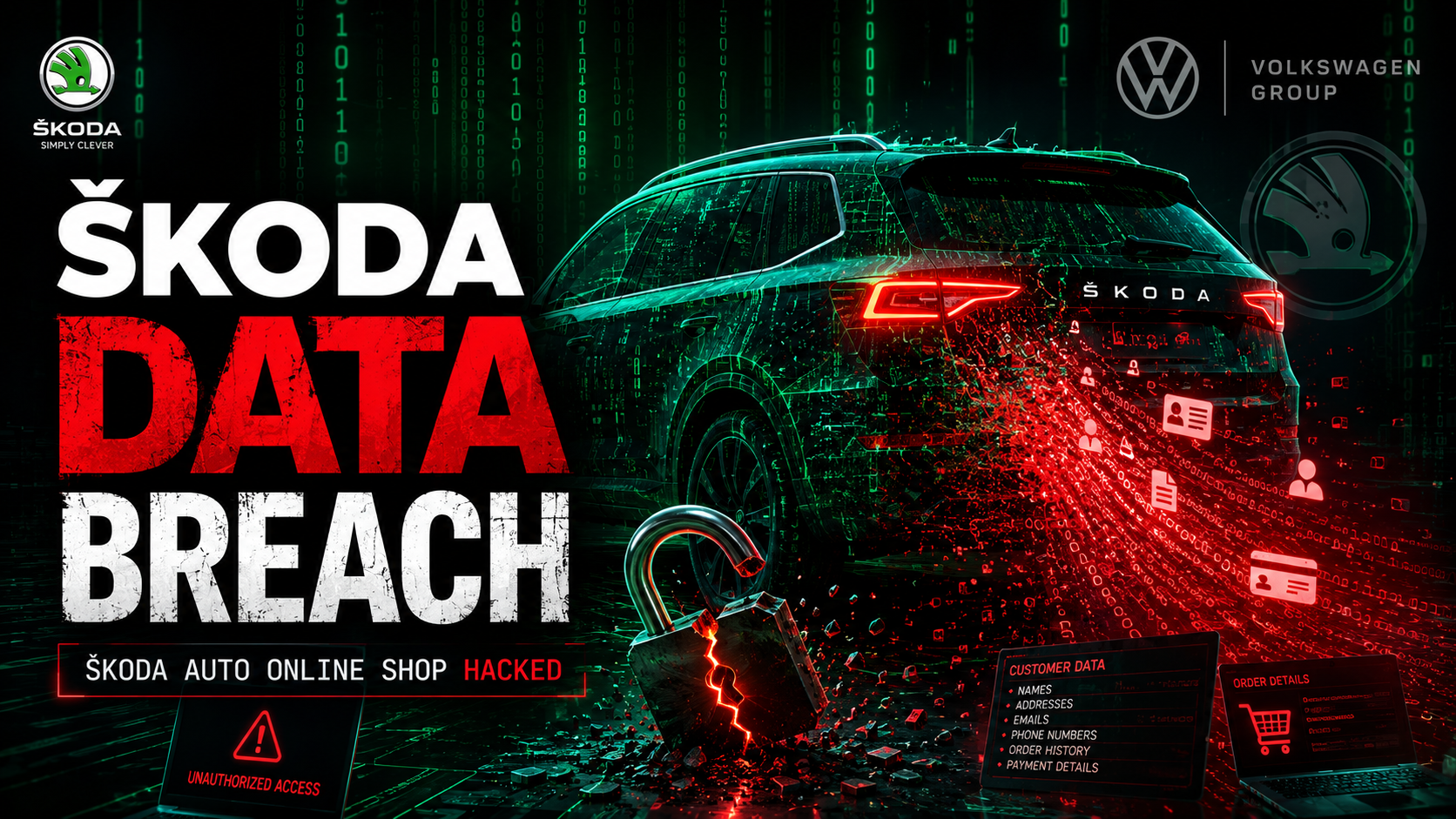
Škoda Auto, the Czech car manufacturer owned by Volkswagen Group, has confirmed a data breach affecting its online shop after hackers exploited a vulnerability in the e-commerce platform’s software. The breach exposed customer personal information including names, addresses, email addresses, phone numbers, order histories, and cryptographic password hashes — though Škoda says financial data like credit card numbers was not compromised.
The incident, disclosed in May 2026, affects the German online shop specifically and highlights a growing trend of automotive companies becoming prime targets for cyberattacks. And the most concerning part? Škoda can’t actually confirm whether the exposed data was copied or downloaded by the attackers.
What Happened
According to Škoda’s disclosure, threat actors gained unauthorized access to the company’s online shop by exploiting a vulnerability in the platform’s software. The intrusion was detected through internal security monitoring systems, which flagged anomalous access patterns to the e-commerce infrastructure.
The attack specifically targeted the Škoda Auto importer’s online shop in Germany — not the global Škoda Auto systems. This distinction is important because it suggests the breach originated in a regional e-commerce deployment rather than the core corporate infrastructure. However, for the customers whose data was stored on that platform, the distinction offers little comfort.
The vulnerability exploited by the attackers has not been publicly identified, which is standard practice during active investigations. What we know is that the flaw existed in the shop software itself, giving attackers a direct path to the customer database without needing to compromise deeper corporate networks.
What Data Was Exposed
The compromised customer information includes a combination of personally identifiable information (PII) that paints a detailed picture of each affected customer. The exposed data includes full names, physical addresses, email addresses, phone numbers, order information and purchase history, and login credentials consisting of email addresses paired with cryptographic password hashes.
That last item — password hashes — deserves special attention. While Škoda stored passwords in hashed form rather than plaintext (which is the correct security practice), the strength of that protection depends entirely on the hashing algorithm used. Modern algorithms like bcrypt or Argon2 make cracking individual hashes computationally expensive. Older algorithms like MD5 or SHA-1 can be cracked in seconds with modern hardware.
Škoda has not disclosed which hashing algorithm was used. If the hashes were generated using a weak algorithm, every affected customer’s password is effectively compromised — and anyone who reused that password on other services is at immediate risk.
What Wasn’t Compromised
The one piece of genuinely good news: financial information was not exposed. Škoda confirmed that full credit card details are not stored in the shop system but are processed exclusively by third-party payment service providers. This is a standard and smart architectural decision that limited the blast radius of this breach significantly.
The Volkswagen Connection
Škoda Auto is a wholly owned subsidiary of Volkswagen Group, one of the world’s largest automotive conglomerates. This breach adds to a concerning pattern for VW Group, which has faced multiple cybersecurity incidents across its family of brands in recent years.
The automotive industry has become an increasingly attractive target for cybercriminals. Modern cars are essentially computers on wheels, and the companies that build them maintain vast databases of customer information, supply chain data, and proprietary engineering details. Each of these represents a valuable target for threat actors motivated by financial gain, espionage, or disruption.
For Volkswagen Group, which encompasses Audi, Bentley, Lamborghini, Porsche, and several other brands alongside Škoda, a breach at one subsidiary raises questions about the security posture across the entire corporate family. If one brand’s e-commerce platform had an exploitable vulnerability, do similar platforms at other brands share the same codebase or infrastructure?
Škoda’s Response: Damage Control Mode
After discovering the breach, Škoda’s response followed the standard corporate incident response playbook. The company immediately took the online shop offline as a precautionary measure, patched the exploited vulnerability, engaged external IT forensics experts to investigate the scope and impact, reported the incident to the relevant data protection supervisory authority, and reviewed and strengthened existing security mechanisms.
Taking the shop offline was the right call — it stopped any ongoing exfiltration and prevented additional data exposure while the vulnerability was being fixed. The engagement of external forensics experts is also standard practice, as it provides both technical expertise and an independent assessment that can be presented to regulators.
Škoda has also warned affected customers to be vigilant against potential phishing attacks — a common secondary threat after data breaches, where criminals use stolen personal information to craft convincing phishing emails targeting breach victims.
The “Can’t Confirm” Problem
Here’s where the Škoda breach gets particularly concerning. The company’s technical analysis revealed that access to the stored data was “theoretically possible” during the breach window, but “due to the nature of the existing protocols, it is not possible to retrospectively determine in detail whether and to what extent data was actually copied or accessed.”
Translation: they don’t have sufficient logging to know if the attackers actually downloaded the data.
This is a significant admission. Proper security monitoring should include detailed access logs that record what data was queried, exported, or transferred during an intrusion. The fact that Škoda can’t determine whether data was exfiltrated suggests either insufficient logging was in place, logs were destroyed or tampered with during the attack, or the monitoring architecture wasn’t designed to capture data-level access events.
For affected customers, the practical implication is clear: assume your data was stolen. In the absence of evidence that data wasn’t copied, the safe assumption is that it was.
What Affected Customers Should Do
If you’ve ever made a purchase through Škoda’s German online shop, take the following steps immediately. First, change your Škoda account password and any other accounts where you used the same password. Second, enable two-factor authentication (2FA) on all important accounts, especially email and financial services. Third, watch for phishing emails that reference Škoda, your order history, or the breach itself — attackers will use this stolen data to craft convincing social engineering campaigns. Fourth, monitor your financial accounts for unusual activity, even though Škoda says financial data wasn’t compromised. Fifth, consider using a password manager to generate unique passwords for every service, preventing credential reuse vulnerabilities.
The Auto Industry Is Under Siege
The Škoda breach is part of a broader wave of cyberattacks targeting the automotive industry. Car manufacturers, dealers, and connected vehicle platforms have become increasingly attractive targets as the industry digitizes its operations and customer interactions.
The attack surface for automotive companies has expanded dramatically. Online shops sell accessories, parts, and merchandise, requiring customer databases and payment processing. Connected car platforms collect telemetry, location data, and driver behavior information. Supply chain management systems connect manufacturers with thousands of suppliers globally. And customer relationship management (CRM) systems store detailed profiles of buyers, service customers, and prospects.
Each of these systems represents a potential entry point for attackers, and the growing sophistication of cyber threats means that even well-resourced companies can be caught off guard.
For the automotive industry, the Škoda breach should serve as a wake-up call. If a subsidiary of the world’s second-largest automaker can have its e-commerce platform compromised through a software vulnerability, no automotive company should consider itself immune. The question isn’t whether your company will be targeted — it’s whether your defenses and detection capabilities are ready when it happens.
Final Thoughts
The Škoda Auto online shop breach is a textbook example of why cybersecurity needs to be a board-level priority for every company, not just tech firms. A vulnerability in an e-commerce platform — arguably the simplest digital asset a company operates — led to the potential exposure of customer names, addresses, phone numbers, order histories, and password hashes.
The fact that Škoda can’t confirm whether data was actually exfiltrated is perhaps the most damning detail. In 2026, logging and monitoring capabilities should be robust enough to provide definitive answers about data access during a breach. The inability to provide those answers suggests systemic gaps in security infrastructure that go beyond the specific vulnerability that was exploited.
For affected customers: assume the worst, change your passwords, and stay alert for phishing attempts. For everyone else: this is your reminder that every company you’ve given your data to is a potential breach vector. Act accordingly.
Have you been affected by the Škoda data breach? Share your experience in the comments below.