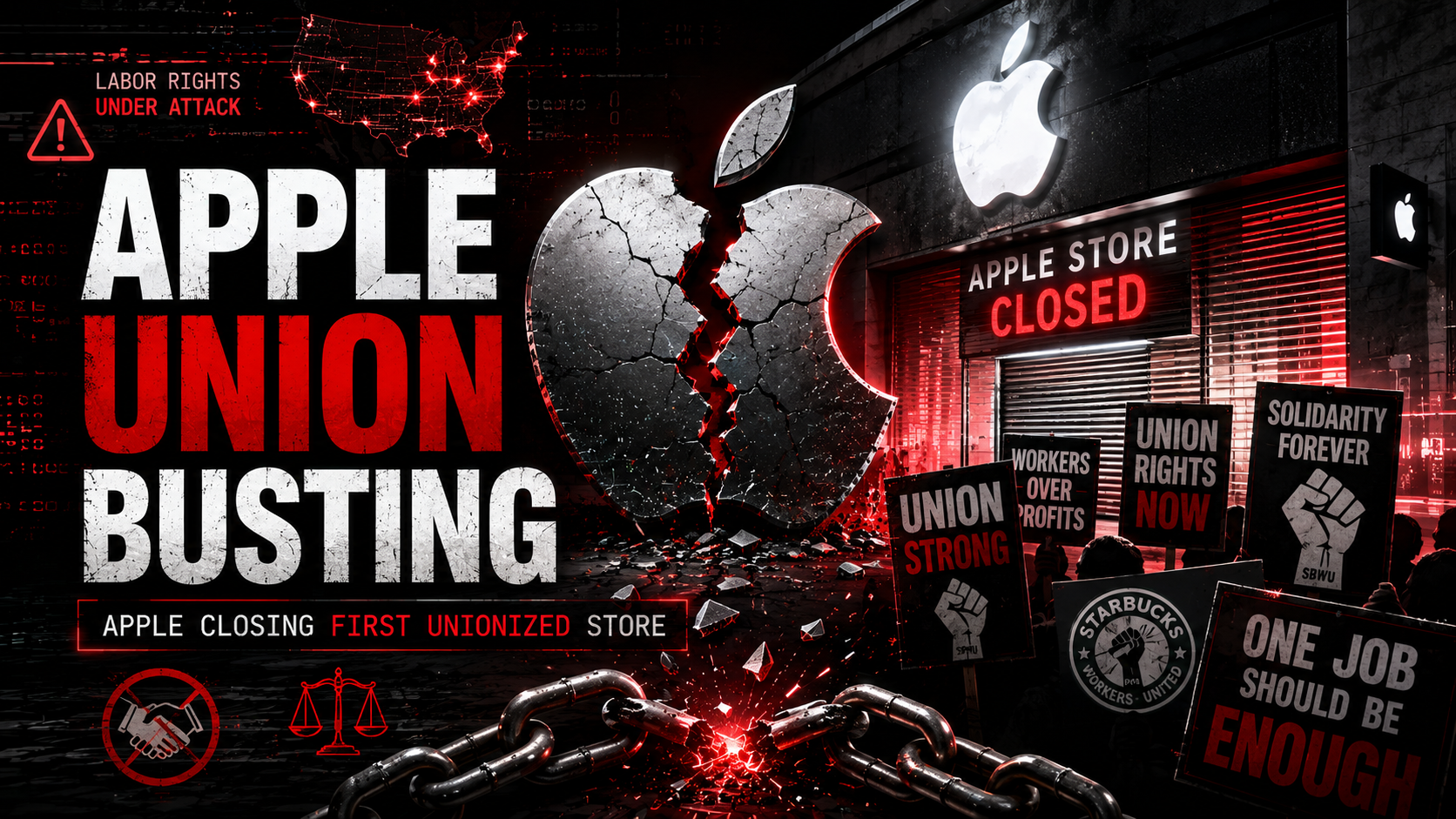
Apple Is Closing Its First Unionized Store — And Blocking Workers From Transferring
Table of Contents
Apple is shutting down the Towson Town Center store in Maryland — the first Apple Store in America to successfully unionize. And unlike workers at two other stores closing at the same time, Apple is blocking unionized Towson employees from transferring to other locations. The International Association of Machinists and Aerospace Workers (IAM) Union is calling it what it looks like: union-busting.
Nearly 90 workers at IAM Local 4538 are facing job loss. A public rally is planned for May 27, 2026, under the hashtag #DoRightApple. An Unfair Labor Practice charge has been filed with the National Labor Relations Board. And Maryland lawmakers are demanding answers from a $3 trillion company that apparently can’t find room for 90 workers at any of its other 270+ U.S. stores.
What’s Happening at Towson
Apple announced in April 2026 that it would close three retail stores in June, including the Towson Town Center location in Towson, Maryland. The Towson store holds unique significance in Apple’s retail history: in June 2022, it became the first Apple Store in the United States to vote for union representation, joining IAM with an overwhelming majority.
The store’s unionization was a landmark moment for the labor movement in tech retail. Workers organized around concerns about pay equity, scheduling practices, and working conditions — the standard grievances that drive retail unionization. Their success at Towson inspired similar efforts at other Apple locations and became a symbol of the broader push for labor rights in the tech industry.
Now, less than four years later, that symbol is being demolished. Apple says the closure is due to changes at the mall where the store is located, including rising crime rates and declining foot traffic. The union has a different interpretation.
The Transfer Double Standard
Here’s the detail that transforms this from a routine store closure into a labor rights scandal: Apple is treating its unionized Towson workers differently from employees at the other two closing stores.
At the non-union stores being shut down, Apple is offering workers the opportunity to transfer to other nearby Apple retail locations — a standard practice when retail chains close individual outlets. Workers get to keep their jobs, their seniority, and their benefits by moving to another store.
At Towson? Workers are being offered severance packages instead of transfers. Apple’s position is that the negotiated union agreement only requires the company to offer transfers within 50 miles of the Towson location, and since there aren’t enough positions at the nearest Apple stores, severance is the appropriate remedy.
The union sees this as a convenient technicality being exploited to eliminate its only unionized workforce. Apple has 270+ stores across the United States. The idea that a $3 trillion company cannot accommodate 90 workers at any of them strains credibility, especially when non-union workers at other closing stores are being offered exactly those opportunities.
Apple’s Justification: Crime and Mall Decline
Apple has cited legitimate business reasons for the Towson closure. The Towson Town Center mall has experienced increasing safety concerns and declining retail activity, making it a less viable location for Apple’s premium retail experience.
These aren’t fabricated concerns — many malls across the United States have experienced similar challenges, and retailers regularly close underperforming locations. Apple closing a store at a struggling mall wouldn’t normally raise eyebrows.
But the timing and context matter. Apple isn’t just closing a store — it’s closing its only unionized store and denying those specific workers the transfer opportunities being offered to non-union employees at other closing locations. The business justification may be real, but the discriminatory treatment of unionized workers suggests that something beyond mall foot traffic is driving the decision.
The Union-Busting Accusation
The IAM Union isn’t being subtle about its interpretation. The organization has publicly accused Apple of discriminatory treatment targeting unionized workers. Their argument is straightforward: by blocking transfers for Towson employees while offering them to non-union workers at other closing stores, Apple is punishing workers for exercising their legal right to organize.
This kind of differential treatment is exactly what the National Labor Relations Act was designed to prevent. Under U.S. labor law, employers cannot discriminate against workers based on their union membership or activity. If Apple is offering different terms to closing-store employees based on whether they’re unionized, that’s textbook discrimination under federal labor law.
Apple’s defense — that the union contract only requires transfers within 50 miles — may be technically accurate, but it misses the point. The question isn’t what the contract requires. The question is whether Apple would be blocking transfers if the Towson workers hadn’t unionized. Given that workers at the other two closing stores (neither unionized) are getting transfers, the answer seems clear.
The #DoRightApple Rally: May 27
The IAM Union has organized a public solidarity rally for May 27, 2026, at or near the Towson Town Center location. The event, branded under the hashtag #DoRightApple, is designed to bring public attention to Apple’s treatment of its unionized workforce.
The rally is expected to feature elected officials, labor allies, community leaders, and the nearly 90 IAM Local 4538 members facing job loss. It’s a deliberate effort to transform a corporate closure into a public accountability moment for one of the world’s most valuable companies.
The timing is strategic. With the stores scheduled to close in June, the rally creates a window for public pressure before the closures become final. If enough attention is generated, the union hopes Apple will reconsider its transfer policy — or at least be forced to justify why unionized workers deserve worse treatment than their non-union counterparts.
The Legal Battle: NLRB Unfair Labor Practice
Beyond the public rally, the IAM has taken formal legal action by filing an Unfair Labor Practice (ULP) charge with the National Labor Relations Board. The charge alleges that Apple’s differential treatment of unionized Towson workers constitutes discrimination based on union membership, which is prohibited under the National Labor Relations Act.
If the NLRB finds merit in the charge, it could compel Apple to offer equivalent transfer opportunities to Towson workers, provide additional remedies beyond what the union contract requires, or face penalties for discriminatory labor practices.
However, the current NLRB environment adds uncertainty to the process. The board’s composition and priorities shift with administrations, and the enforcement timeline for ULP charges can stretch for months or years — potentially long after the Towson store has already closed and workers have been terminated.
Maryland Lawmakers Push Back
The Towson closure has also attracted attention from Maryland state lawmakers, who have pressed Apple for answers about its treatment of unionized workers. Maryland legislators have a particular interest in the case because the Towson store represents jobs and economic activity in their state, and the discriminatory treatment of unionized workers raises policy concerns about corporate behavior toward organized labor.
Congressional attention adds another dimension of pressure on Apple. While lawmakers can’t directly compel Apple to change its closure plans, they can create reputational costs, request formal investigations, and use the situation to advance labor-friendly legislation that would prevent similar situations in the future.
The political dynamic is particularly relevant given Apple’s lobbying presence in Washington. A company that spends millions on government relations has to weigh the reputational damage of being publicly accused of mistreating workers by the same legislators it’s trying to influence on tax policy, antitrust regulation, and trade agreements.
The Bigger Picture: Apple and Unions
The Towson closure isn’t happening in isolation. Apple has faced a growing wave of labor organizing across its retail operations. Several other Apple Store locations have held union votes or explored organizing campaigns since Towson’s successful vote in 2022.
Critics argue that closing Towson sends a chilling message to workers at other Apple stores considering unionization: if you organize, your store might be the next one to close. Whether or not that’s Apple’s intent, the effect is clear. Workers at other locations will think twice about organizing when they see what happened to the first store that did.
This is the insidious nature of strategic store closures as a union-busting tool. The company doesn’t have to explicitly say “we’re closing this store because it unionized.” It just has to demonstrate that unionized stores face adverse consequences that non-union stores don’t. The lesson writes itself.
Apple, with its $3 trillion market cap and reputation as a progressive, worker-friendly company, is being tested on whether those values extend to workers who assert their right to collective bargaining. So far, the answer isn’t encouraging.
Final Thoughts
The Apple Towson Town Center closure is more than a business decision. It’s a test case for labor rights in the modern tech economy. A $3 trillion company is closing its only unionized store and blocking those specific workers from transferring — while offering transfers to non-union workers at other closing stores.
The facts speak for themselves. The union has filed legal charges. Maryland lawmakers are demanding answers. A public rally is planned for May 27. And 90 workers who exercised their legal right to organize are facing job loss while their non-union counterparts get to keep their careers.
Whether Apple ultimately does right by its Towson workers will say more about the company’s values than any product launch, keynote speech, or corporate responsibility report ever could. The world is watching. #DoRightApple.
What do you think about Apple’s treatment of its unionized workers? Share your thoughts in the comments below.