South Korea’s AI Warning: $1 Trillion Samsung and the Fight Over Who Gets Rich From AI
Table of Contents
South Korea just issued a warning that every tech worker, investor, and policymaker needs to hear: AI wealth must benefit the public, not just corporations. Deputy Prime Minister Bae Kyung-hoon made the statement in May 2026, days after Samsung Electronics — now approaching $1 trillion in market capitalization — narrowly avoided a massive strike by 48,000 workers who demanded a larger share of the company’s AI-driven windfall profits.
This isn’t just a South Korean problem. It’s a preview of the global reckoning that’s coming as AI generates unprecedented corporate wealth while the workers building, maintaining, and enabling that technology see their wages stagnate and their job security erode.
Samsung’s AI Goldmine: Record Profits, Angry Workers
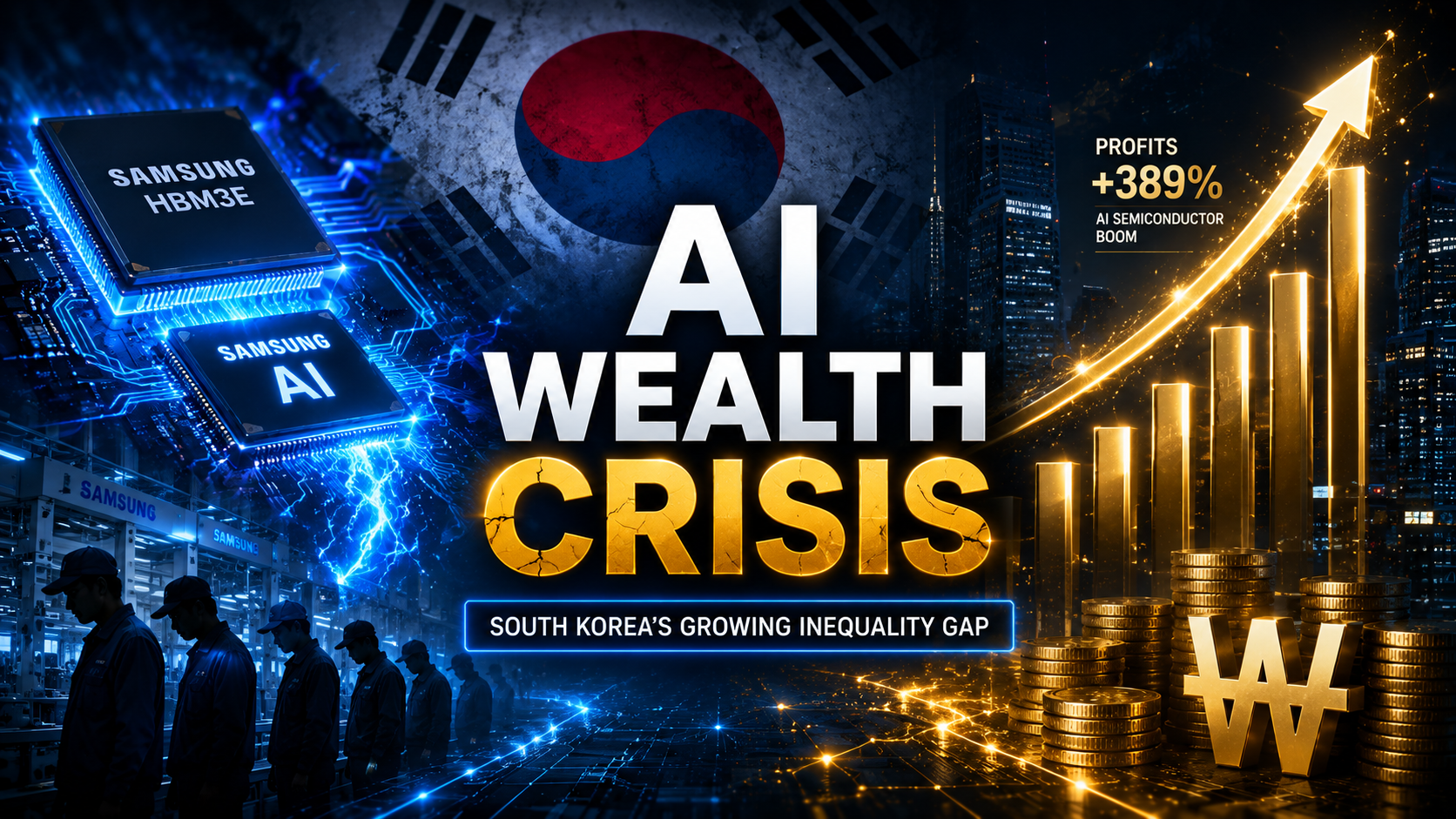
The numbers tell the story. Samsung Electronics’ Q1 2026 operating profit reached ₩57.2 trillion (approximately $42 billion) — an eightfold year-on-year increase. The driving force behind this extraordinary surge was almost entirely attributable to one thing: high-bandwidth memory (HBM) chips for AI infrastructure.
As companies like NVIDIA, Google, Microsoft, and Meta race to build massive AI data centers, the demand for specialized memory chips has exploded. Samsung, as one of only three companies in the world capable of manufacturing advanced HBM chips (alongside SK Hynix and Micron), has found itself sitting on a goldmine.
But here’s the tension: the workers who manufacture these chips, operate the fabrication plants, and maintain the infrastructure that makes Samsung’s AI windfall possible are looking at their paychecks and seeing a very different picture. While Samsung’s profits increased 800%, worker compensation didn’t remotely keep pace.
The company offered a 5.1% wage increase for 2026. The Samsung Electronics Workers’ Union (SEWU), representing approximately 48,000 members, rejected it. Their position was simple: if AI-driven demand turned Samsung into a near-trillion-dollar company, the people who build the chips should see more than a single-digit percentage raise.
The Strike That Shook South Korea
The labor dispute escalated rapidly. SEWU announced plans for a full strike — a dramatic move in South Korean corporate culture, where labor actions at major conglomerates (known as chaebols) are relatively rare and carry significant social weight.
The threat was credible: 48,000 workers walking off fabrication lines would have crippled Samsung’s ability to meet the insatiable demand for AI memory chips. In a market where every major tech company is competing for limited chip supply, even a brief production disruption could have had ripple effects across the global AI hardware ecosystem.
A key grievance was the bonus gap with SK Hynix, Samsung’s main competitor in the memory chip market. SK Hynix workers reportedly received significantly larger profit-sharing bonuses tied to the company’s HBM chip success, while Samsung workers felt they were being shortchanged despite delivering comparable results.
The strike was ultimately suspended after Samsung and SEWU reached a deal — though the specific terms haven’t been fully disclosed. The resolution suggests concessions were made, but the underlying tension hasn’t disappeared. It’s been deferred, not resolved.
Deputy PM’s AI Wealth Warning
It was against this backdrop that Deputy Prime Minister Bae Kyung-hoon made his remarkable public statement. Speaking to media, Bae said that AI-generated wealth must benefit the broader public, and warned that the Samsung labor dispute was a preview of conflicts to come.
Bae’s key message was blunt: as artificial intelligence continues to concentrate wealth in a small number of “super-large companies,” labor-management conflicts will intensify. The question isn’t whether these conflicts will happen — it’s whether governments and companies are prepared to resolve them through dialogue rather than confrontation.
For a senior government official to publicly acknowledge that AI wealth distribution is a policy problem — not just a corporate governance issue — is significant. It signals that South Korea’s government views the AI wealth gap as a potential threat to social stability, not just an economic talking point.
Bae also noted that “in the age of AI, more of these super-large companies will continue to emerge,” suggesting that the Samsung situation is the beginning of a trend, not an isolated incident. As AI capabilities expand into more industries, the companies that control critical AI infrastructure — chips, models, cloud platforms — will accumulate wealth at rates that make today’s tech giants look modest.
Hyundai and Boston Dynamics: The Robot Factory
The Deputy PM didn’t stop at Samsung. He also pointed to Hyundai Motor Company as another pressure point in the AI wealth debate. Hyundai, which acquired Boston Dynamics in 2020, is now integrating Atlas humanoid robots into its manufacturing processes.
Bae acknowledged that this deployment has generated “many concerns and worries” about the impact on workers — a diplomatic way of saying that factory workers are watching robots take positions on assembly lines and wondering when their jobs will be next.
The Hyundai-Boston Dynamics situation illustrates the dual nature of AI’s impact on employment. In the Samsung case, AI created massive new demand that workers wanted to share in. In the Hyundai case, AI (in the form of robotics) threatens to replace workers entirely. Both scenarios concentrate wealth at the corporate level while creating anxiety at the worker level.
The Global AI Inequality Problem
South Korea’s situation is a microcosm of a global phenomenon. Across the world, AI is generating enormous corporate profits while the distribution of that wealth remains deeply unequal.
In the United States, the “Magnificent Seven” tech stocks (Apple, Microsoft, NVIDIA, Alphabet, Amazon, Meta, Tesla) have seen their combined market capitalization increase by trillions of dollars, driven largely by AI expectations. Meanwhile, Big Tech has laid off hundreds of thousands of workers in the same period, often citing AI-driven efficiency as the justification.
The pattern is consistent: AI increases productivity, which increases profits, which increases stock prices, which benefits shareholders and executives. Workers, who are often the ones displaced or whose wages are compressed by AI-driven automation, see a much smaller share of the gains — if they see any at all.
This isn’t a bug in the system. It’s the predictable outcome of a technology that increases capital’s productivity relative to labor’s. Without deliberate policy intervention, AI will continue to shift wealth from workers to capital owners, exacerbating inequality in every economy where it’s deployed.
What South Korea Plans to Do About It
Bae’s statement wasn’t just rhetoric. South Korea has been developing policy frameworks to address AI’s impact on the economy and labor markets. The government has signaled several approaches including strengthened labor-management dialogue frameworks specifically for AI-impacted industries, investment in worker retraining and upskilling programs for AI-adjacent skills, regulatory scrutiny of how AI-driven profits are distributed within large corporations, and public investment in AI infrastructure to ensure the technology’s benefits aren’t captured exclusively by the private sector.
South Korea is also watching the global AI policy landscape carefully. The EU’s AI Act, China’s AI governance framework, and the ongoing policy debates in the United States all inform South Korea’s approach. As one of the world’s most AI-advanced economies — home to Samsung, SK Hynix, LG, Hyundai, and a thriving startup ecosystem — South Korea has both the expertise and the urgency to get AI policy right.
Lessons for the World
The South Korea situation offers three key lessons for the rest of the world. First, AI wealth concentration is a political problem, not just an economic one. When a deputy prime minister is publicly warning about AI wealth distribution, it’s clear that this issue has moved from academic papers to the halls of government. Other countries should take note.
Second, workers will organize around AI profits. Samsung workers didn’t strike over AI fears — they struck because AI made their employer enormously profitable and they wanted a fair share. Expect similar dynamics at every company where AI drives outsized profits while worker compensation lags behind.
Third, the robot question is coming for every manufacturer. Hyundai’s integration of Boston Dynamics robots is just the beginning. As humanoid robots become more capable and cost-effective, every manufacturer will face the choice between human workers and robotic alternatives. The social and economic consequences of those choices will define the next decade.
Final Thoughts
South Korea’s AI wealth warning isn’t just about Samsung or SK Hynix or Hyundai. It’s about the fundamental question of who benefits when transformative technology creates unprecedented wealth. The AI revolution is generating trillions of dollars in value. The question of how that value is distributed — between shareholders and workers, between corporations and communities, between the few who build AI and the many who live with its consequences — will be the defining economic debate of our generation.
Deputy PM Bae Kyung-hoon gave the world a preview of what that debate looks like when it moves from theory to practice. Samsung’s near-strike showed what happens when AI wealth gets concentrated while workers get left behind. And Hyundai’s robots showed what happens when AI doesn’t just concentrate wealth — it eliminates the need for workers entirely.
The AI wealth question isn’t coming. It’s here. South Korea is just the first country honest enough to say it out loud.
How should governments handle the AI wealth distribution challenge? Share your thoughts in the comments below.