AI Is Writing Buggy Code Faster Than Humans Can Fix It — And It Just Created the Biggest Cybersecurity Hiring Boom in History
Table of Contents
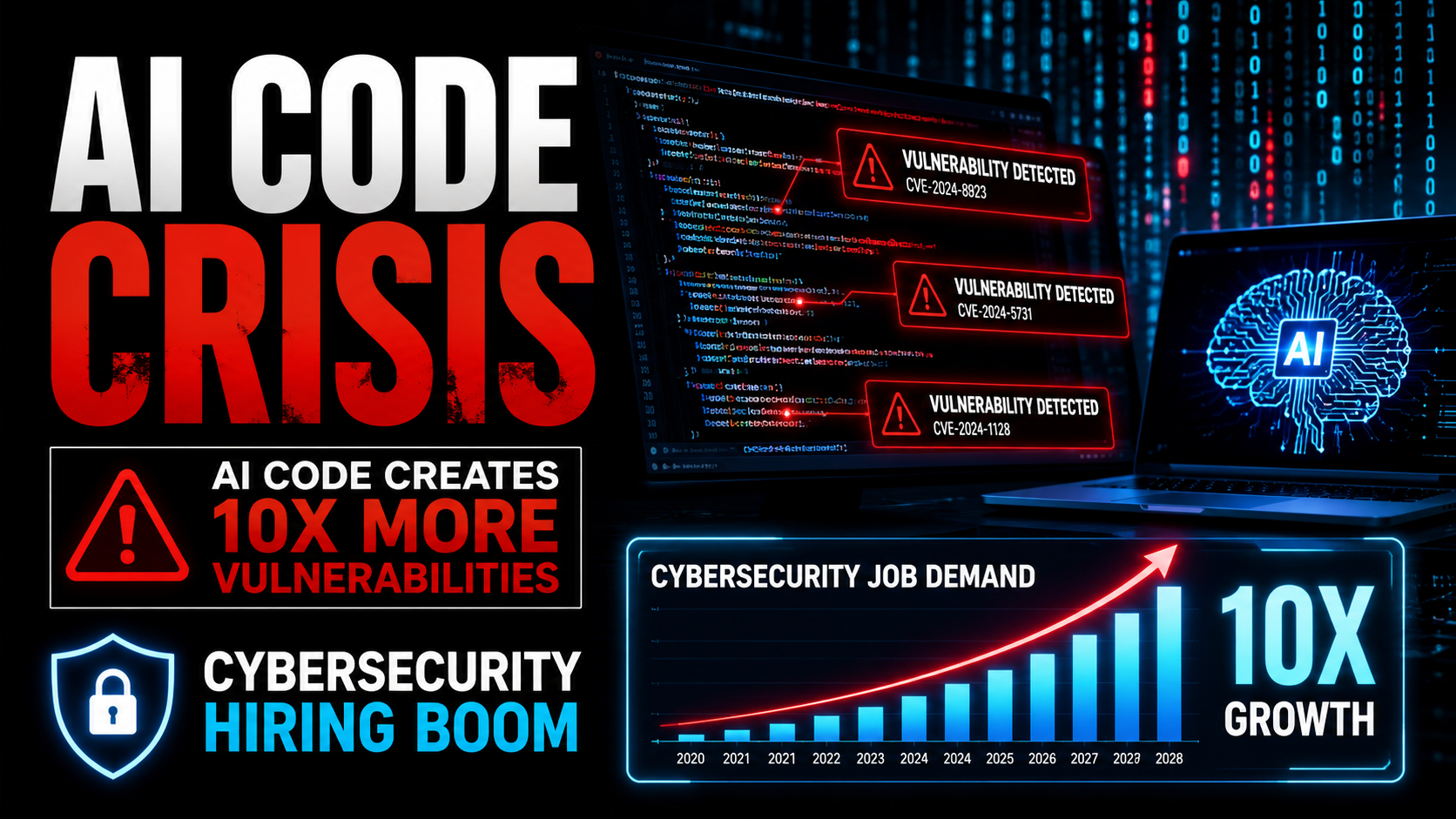
Here’s the great irony of the AI coding revolution: the technology that was supposed to replace developers is actually creating the biggest cybersecurity hiring boom in history. AI coding assistants can write code 10 times faster than humans — but nearly half of that code contains security vulnerabilities. The result? An 11% surge in cybersecurity hiring in Q1 2026, executive security packages hitting $7-8 million, and a talent shortage so severe that recruitment firms are turning away clients.
The AI revolution didn’t kill tech jobs. It just shuffled the deck — and cybersecurity drew the winning hand.
AI Code Vulnerabilities: The Paradox of Productivity
The promise of AI coding tools was simple: write code faster, ship products sooner, reduce developer costs. And they delivered on that promise. Companies using tools like GitHub Copilot, Cursor, and Claude Code report dramatic productivity gains, with some teams producing code 5-10x faster than traditional development.
But speed and security have always been at odds in software development. Human developers who rush make more mistakes. AI coding assistants, it turns out, have the same problem — they just make mistakes at machine speed.
Multiple studies in 2025 and early 2026 found that approximately 45% of AI-generated code contains security flaws, with particularly weak defenses against cross-site scripting (XSS), SQL injection, and log injection attacks. The code works — it passes functional tests, it compiles, it does what the developer asked — but it does those things insecurely.
The scale of the problem is what makes it unprecedented. When a human developer introduces a vulnerability, it’s one bug in one codebase. When an AI coding tool generates vulnerable patterns, it introduces the same vulnerability across thousands of codebases simultaneously. The same insecure pattern gets replicated everywhere the AI is used, creating systemic risk at an industrial scale.
The Numbers: 45% of AI-Generated Code Has Security Flaws
The 45% figure comes from multiple independent studies examining the security quality of code produced by major AI coding assistants. The most common vulnerability categories include insufficient input validation, where AI models frequently generate code that doesn’t properly sanitize user inputs, creating injection attack surfaces. Insecure default configurations are another common issue, where AI-generated code often uses permissive settings that work in development but are dangerous in production.
Hardcoded credentials appear in AI-generated examples with disturbing regularity. And missing authentication checks are common, where AI models generate functional code that accomplishes the requested task but doesn’t verify that the requesting user has permission to perform that action.
These aren’t obscure edge cases — they’re the fundamental security errors that every security textbook warns about. The problem is that AI models optimize for functionality, not security. They’re trained to write code that works, not code that’s safe.
Cybersecurity Hiring Boom by the Numbers
The cybersecurity job market in 2026 looks nothing like what anyone predicted two years ago. According to Glassdoor data, cybersecurity positions rose by 11% during the first quarter of 2026 compared to the previous year. But that headline number understates the actual demand.
Roles that used to open once a year are now appearing every week. Recruitment firms specializing in cybersecurity are turning down clients because they don’t have enough candidates to fill existing positions. A 2026 IT Talent Survey found that 91% of organizations are prioritizing AI skills, with cybersecurity engineers ranked among the hardest roles to fill globally — cited by 38% of senior executives as their most challenging hire.
Compensation has exploded accordingly. Seven to eight million dollar packages are now standard for senior security executives — a figure that would have been extraordinary even five years ago. Mid-level security engineers with AI-related expertise are commanding salaries 40-60% higher than their non-AI counterparts.
The irony is thick enough to cut with a knife. Big Tech companies that laid off thousands of workers in the name of AI efficiency are now desperately hiring security professionals to deal with the vulnerabilities that AI-generated code introduced.
Why AI Code Is Creating More Security Jobs, Not Fewer
Two forces are driving the cybersecurity hiring boom simultaneously, and they’re both directly tied to AI.
The first is volume. AI coding tools enable developers to produce dramatically more code in less time. More code means more potential vulnerabilities. Even if the vulnerability rate per line were identical to human-written code (it’s not — it’s worse), the sheer increase in code volume would require more security professionals to review, test, and remediate.
The second is AI-specific threat intelligence. The rise of AI models capable of discovering and exploiting vulnerabilities has created demand for security professionals who understand both AI and traditional security. When Anthropic released Mythos, demonstrating that AI could identify weaknesses in critical infrastructure software, the demand for security leaders with AI expertise increased five to seven times virtually overnight.
Companies aren’t just hiring more security people — they’re hiring a different kind of security person. The traditional security engineer who knows firewalls and SIEM tools is still needed, but the premium is now on professionals who can evaluate AI-generated code, understand AI-specific attack vectors, and deploy AI-powered defensive tools effectively.
The Mythos Effect: AI That Finds Vulnerabilities Too
The hiring boom isn’t just about AI creating vulnerabilities. It’s also about AI finding them. When Anthropic demonstrated that Claude Mythos could identify exploitable weaknesses in software running power grids, banks, and enterprise systems, it triggered a fundamental reassessment of security risk across every major organization.
If an AI can find vulnerabilities in critical infrastructure, then every organization running critical systems needs security teams capable of using these AI tools defensively — before attackers use them offensively. This is a new skill set that barely existed a year ago, and the talent pool is vanishingly small.
The result is a bidding war for talent that’s pushing compensation to unprecedented levels. Organizations aren’t just competing with other companies for security talent — they’re competing with the accelerating pace of AI capabilities. Every new AI advancement that could be used for offensive security purposes creates immediate demand for defensive expertise.
What This Means for Your Career
For aspiring cybersecurity professionals, the current market is the best entry point the industry has ever seen. The combination of insatiable demand, premium compensation, and a skills gap that’s widening rather than narrowing creates opportunities at every level.
The highest-value skills in 2026 are at the intersection of AI and security: understanding how AI models generate vulnerable code, knowing how to use AI tools for automated security testing, and being able to assess whether an AI-powered defense tool actually works or just creates a false sense of security.
For existing developers, the message is clear: security skills are no longer optional. As AI coding tools handle more of the code generation workload, the human value shifts increasingly toward review, testing, and security validation. Developers who can write secure code — and validate that AI-generated code is secure — are commanding significant premiums.
For organizations, the math is straightforward: the money you save by using AI coding tools needs to be reinvested in security. The productivity gains from AI-assisted development are real, but so are the security costs. Ignoring the latter doesn’t make them go away — it just makes the eventual breach more expensive.
The Bottom Line
AI didn’t eliminate tech jobs — it created a massive new category of them. The cybersecurity hiring boom of 2026 is a direct consequence of AI coding tools producing vulnerable code at unprecedented scale, combined with AI security tools raising the stakes for everyone.
For an industry that spent 2024 and 2025 panicking about AI replacing workers, this is a plot twist nobody predicted. AI is generating more code than ever, creating more vulnerabilities than ever, and consequently driving more demand for the human security expertise needed to keep it all from imploding.
The AI revolution didn’t kill the tech job market. It just made cybersecurity the most important — and most lucrative — career in technology. If you were wondering whether to learn security in 2026, the seven-figure executive packages should make the answer pretty clear.