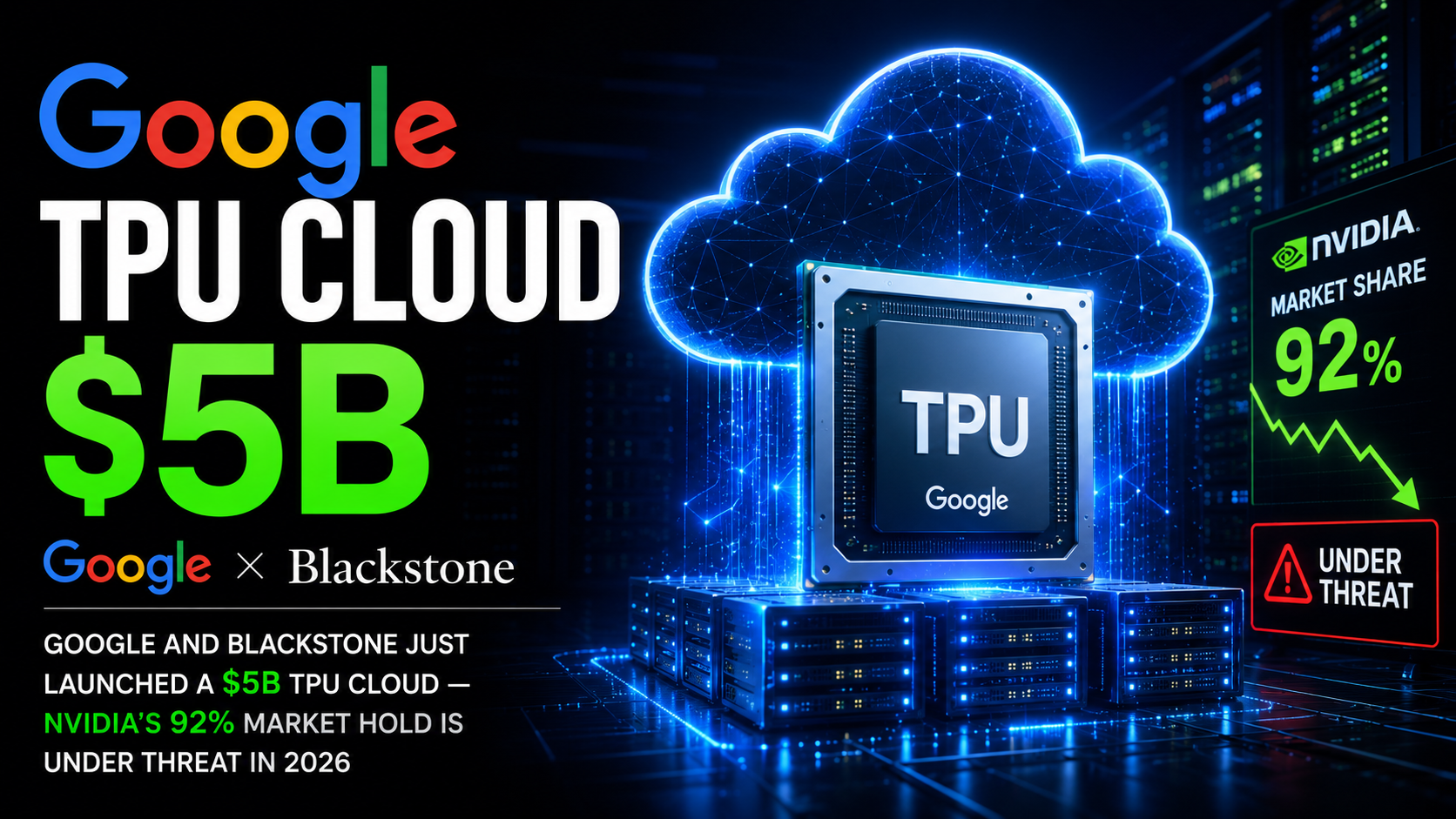
Google and Blackstone Just Launched a $5B TPU Cloud — Nvidia’s 92% Market Hold Is Under Threat in 2026
Google and Blackstone Just Announced Something That Could Break Nvidia’s AI Grip
Nvidia controls roughly 92% of the AI chip market. That number is so dominant it barely registers as a “market share” — it’s more accurately described as a monopoly. Every major AI lab, cloud provider, and enterprise AI deployment is built on H100s, H200s, or Blackwell chips.
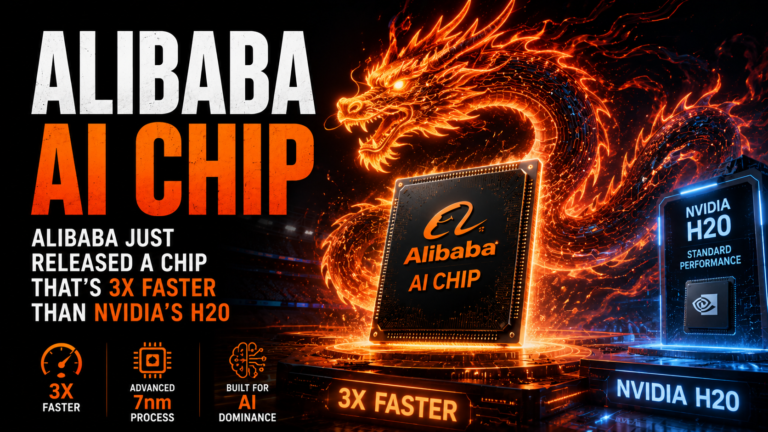
Google has spent years trying to change that with its Tensor Processing Units (TPUs) — custom AI chips designed specifically for the training and inference workloads that power models like Gemini. But until now, those chips have been locked inside Google Cloud, available only to customers willing to buy into the full Google Cloud ecosystem.
That just changed. In a major announcement tied to Google I/O 2026, Google and Blackstone announced a joint venture to create a new U.S.-based company that will offer Google TPUs as a standalone compute-as-a-service offering — completely independent of the Google Cloud software stack. Blackstone is committing an initial $5 billion in equity to bring 500 megawatts of data center capacity online by 2027.
What the Joint Venture Actually Offers
The new company — which doesn’t yet have a publicly announced name — will function as a compute utility. Customers will be able to access Google’s latest TPU hardware along with data center capacity, networking infrastructure, and operational support, without being required to use Google Cloud’s managed services, APIs, or software layer.
Think of it as buying a GPU cluster from a neutral third party, except the chips are Google’s TPUs rather than Nvidia’s GPUs. The separation from Google Cloud matters enormously: many enterprise customers, particularly those in finance, government, and healthcare, are wary of becoming too dependent on any single hyperscaler’s software ecosystem. A hardware-only offering with Blackstone’s backing as a neutral financial partner lowers that concern significantly.
According to Blackstone’s announcement, the structure includes:
- 500 MW of capacity coming online in 2027 — enough to power a significant portion of U.S. AI workloads
- $5 billion initial equity commitment from Blackstone, with the potential for additional tranches as capacity expands
- Google supplying TPU hardware, software tooling, and operational expertise
- Blackstone contributing project finance, power procurement, and institutional relationships
- Open to AI training and inference customers — not restricted to any single industry or use case
Why This Is a Direct Threat to Nvidia’s Dominance
Google’s TPUs have always been technically competitive with Nvidia’s best hardware, sometimes superior for specific workloads. The reason Nvidia has maintained its dominance isn’t just chip performance — it’s the CUDA software ecosystem, which gives developers a familiar programming environment and years of optimized libraries that work across all Nvidia hardware.
By making TPUs available as a standalone cloud service, Google is taking a different approach to the adoption problem. Instead of asking developers to rewrite their CUDA code for TPUs, the joint venture will likely offer managed deployment environments where customers bring their models and Google handles the hardware-level optimization. This is the “cloud service” approach to hardware adoption — less friction than asking for code rewrites.
For AI companies trying to reduce dependence on Nvidia — and many are, as Cerebras’s IPO earlier this year demonstrated, there’s strong investor appetite for alternatives — this joint venture offers a credible compute option with the backing of one of the world’s largest asset managers and one of tech’s most powerful companies.
Nvidia currently trades at a valuation reflecting its near-monopoly status. Any credible erosion of that position — even at the margins — could have massive consequences for Nvidia’s stock and the entire AI infrastructure investment thesis.
Blackstone’s AI Infrastructure Bet Gets Bigger
For Blackstone, this deal represents a continuation of an aggressive strategy to position the firm at the heart of AI infrastructure investment. Blackstone manages over $1 trillion in assets and has been systematically acquiring or building data center capacity, power infrastructure, and now compute assets across the United States and Europe.
The firm already has extensive investments in data center real estate through its QTS Realty and Vantage Data Centers portfolios. Partnering with Google to put TPU compute inside those facilities creates a vertically integrated AI infrastructure stack: land, building, power, cooling, and compute — all under a single economic framework.
From Blackstone’s perspective, the return thesis is straightforward: AI compute demand is growing faster than supply can be built, and long-term contracts with anchor customers (AI labs, enterprises, government agencies) provide predictable cash flows that support the kind of financing structures Blackstone excels at structuring.
This isn’t Blackstone’s first AI infrastructure partnership. The firm previously announced substantial capital commitments to multiple AI infrastructure plays in 2026. But the Google partnership is qualitatively different — it’s not just real estate, it’s a compute product.
The Hyperscaler AI Infrastructure Arms Race
This deal also reflects a broader pattern: hyperscalers are no longer content to offer AI infrastructure solely through their own cloud platforms. The market has become too large and too competitive for any single distribution channel.
Microsoft Azure offers Nvidia H100 and H200 clusters. Amazon Web Services offers both Nvidia GPUs and AWS Trainium chips through Bedrock. Google Cloud offers TPUs. But all three have primarily made these chips available only within their own managed software environments — requiring customers to adopt their respective cloud stacks.
The Google-Blackstone venture breaks that model. If successful, it will create demand for a fourth path: neutral compute utilities that are hardware-agnostic from the customer’s perspective but hardware-specific at the infrastructure level. Other hyperscalers may feel compelled to follow with their own hardware-as-a-service joint ventures.
For customers navigating AI agent deployments and other compute-intensive workloads, the arrival of credible alternatives to Nvidia’s dominance and single-cloud lock-in is genuinely good news. More competition, more choice, and potentially lower prices — the textbook outcome when monopoly power gets contested.
2027 Timeline and What to Watch
The joint venture’s 500 MW of capacity is targeted for 2027. That’s significant because 2027 is widely projected to be the year AI model training and inference costs reach enterprise budget levels — the point at which AI becomes a line-item decision for every company rather than a bleeding-edge experiment.
Watch for early customer announcements: which AI labs, enterprises, or government agencies will be anchor tenants of the new TPU cloud? Those names will signal whether this joint venture is primarily a Google enterprise play (existing Google Cloud customers migrating workloads) or a genuinely new market entrant attracting customers who wouldn’t previously have considered Google hardware.
Also watch Nvidia’s response. Pat Gelsinger’s Intel, AMD’s MI300 series, and a range of AI chip startups have all tried and largely failed to dent Nvidia’s position. But a Google-Blackstone joint venture with $5 billion in capital, 500 MW of capacity, and institutional distribution is a different caliber of competitor than any individual chip company.
The AI chip war just got its most credible challenger yet.