Samsung Just Shipped the World’s First HBM4E Memory Chip — And Its Stock Exploded 6.5% in a Single Day
Table of Contents
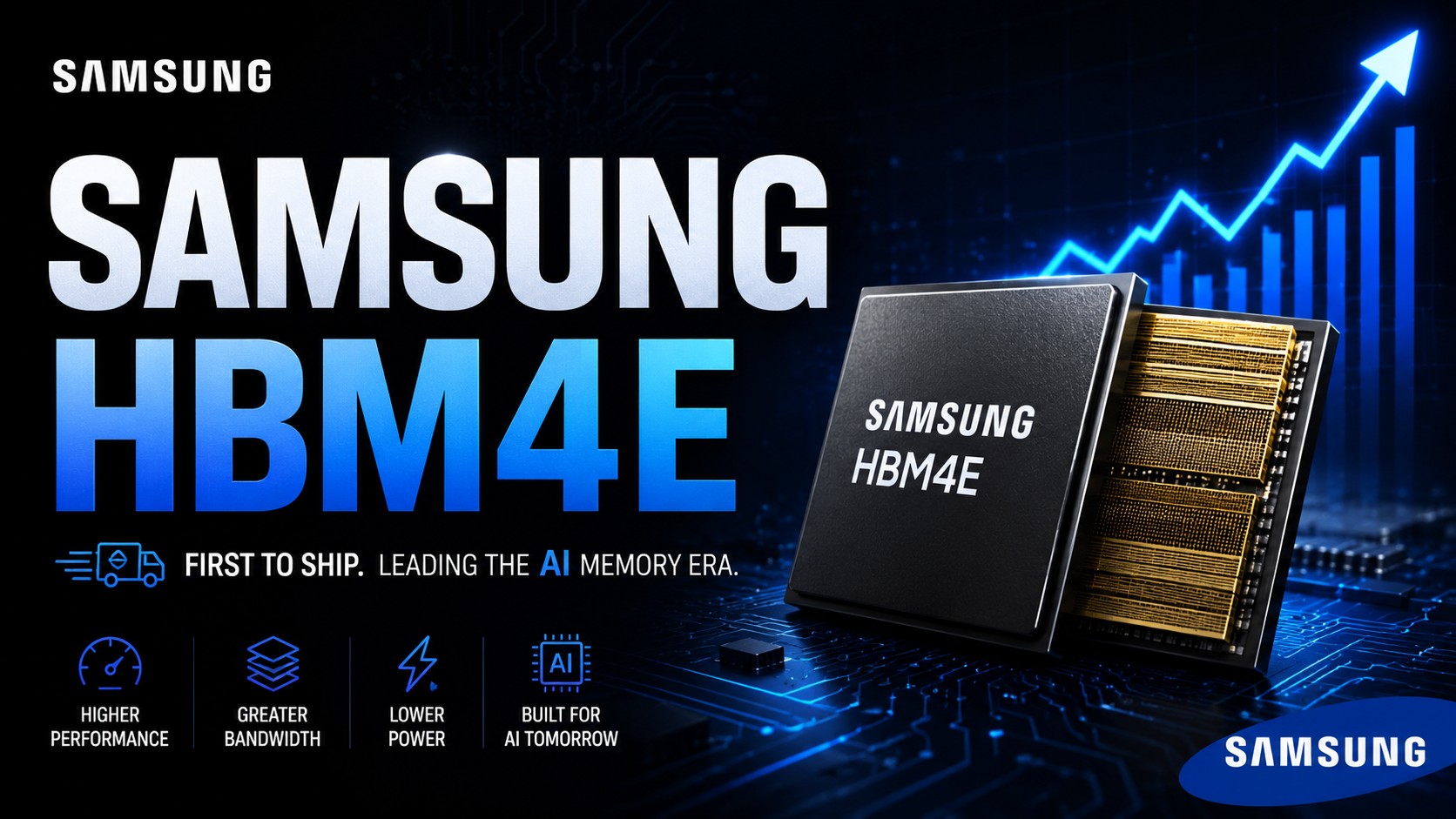
Samsung HBM4E just changed the AI hardware landscape. On May 28, 2026, Samsung Electronics began shipping samples of its 12-layer HBM4E high-bandwidth memory chip to major customers worldwide, becoming the first company in the world to deliver the next-generation AI memory product. Samsung’s stock surged as much as 6.51% on the announcement — adding roughly $25 billion in market capitalization in a single trading session.
This isn’t just a faster memory chip. This is the component that will power the next generation of AI training clusters, the hardware that companies like Nvidia, AMD, and Google need to build systems capable of training models that are orders of magnitude more powerful than anything that exists today.
Samsung HBM4E: What Just Shipped
The Samsung HBM4E is a 12-layer high-bandwidth memory chip that represents the seventh generation of HBM technology. Samsung described it as an “industry first” — no other company has shipped HBM4E samples to customers. The company confirmed that samples have been sent to global customers including Nvidia, AMD, and Google, positioning Samsung at the front of the race to supply memory for next-generation AI accelerators.
HBM (High Bandwidth Memory) is the specialized memory technology that sits on top of AI accelerator chips, providing the enormous data throughput needed for training and inference. Unlike standard DRAM, HBM chips are stacked vertically and connected to the processor through silicon interposers, enabling bandwidth that would be impossible with traditional memory architectures.
The “E” in HBM4E stands for “Extended,” indicating enhanced performance beyond the baseline HBM4 specification. Samsung’s decision to skip directly to HBM4E — rather than shipping HBM4 first and then upgrading — is a competitive move designed to leapfrog rivals in the AI chip supply chain.
The Specs That Matter
The Samsung HBM4E delivers specifications that represent a significant leap from the current generation. The chip achieves a stable pin speed of 14 gigabits per second, with performance scalable to 16 Gbps — representing more than a 20% increase over Samsung’s HBM4 specification. Memory bandwidth reaches up to 3.6 terabytes per second per stack, a figure that enables the massive data throughput required for frontier AI model training.
Capacity stands at 48 gigabytes per stack, a greater than 30% increase from the previous generation. For AI training clusters that use thousands of accelerators, this capacity increase translates into the ability to train larger models or process larger batch sizes without running into memory limitations.
Energy efficiency has also been improved, though Samsung hasn’t disclosed specific power consumption figures. Thermal performance — a critical concern when stacking 12 layers of active silicon — has been enhanced through what Samsung describes as advanced thermal management solutions integrated into the chip package.
Why the Stock Surged 6.5%
Samsung Electronics shares jumped as much as 6.51% on the day of the announcement, and the reasons are straightforward. Being first to ship HBM4E gives Samsung a potential time-to-market advantage that could translate into months of exclusive supply to major customers. In the AI chip market, where demand consistently outstrips supply, being the only source for the latest memory technology creates pricing power and margin expansion.
The announcement also signals that Samsung has resolved some of the manufacturing challenges that plagued its earlier HBM generations. Samsung has historically trailed SK Hynix in HBM yield rates and qualification with key customers like Nvidia. Shipping HBM4E first — before SK Hynix has announced its own HBM4E timeline — suggests Samsung’s manufacturing capabilities have caught up or even surpassed its rival.
For investors, the HBM4E announcement validates Samsung’s massive capital expenditure program. The company has invested tens of billions of dollars in memory fabrication facilities, and HBM4E shipments demonstrate that this investment is producing commercially viable products at the leading edge.
The Memory War: Samsung vs SK Hynix
The Samsung HBM4E announcement is a direct shot at SK Hynix, which has dominated the HBM market for the past two years. SK Hynix was the first to qualify HBM3E with Nvidia and has been the primary memory supplier for Nvidia’s data center GPUs, including the H100, H200, and Blackwell families.
SK Hynix recently surpassed $1 trillion in market capitalization, driven largely by its HBM leadership. Samsung’s goal with HBM4E is clear: reclaim the technology lead that it lost to SK Hynix during the HBM3 generation and establish itself as the preferred memory supplier for the next wave of AI accelerators.
The competitive dynamics are intensified by the fact that both Samsung and SK Hynix are now investors in Anthropic, which just closed a $65 billion funding round. Both companies are betting that AI demand for their memory products will continue to grow, and both want to be the preferred supplier when that demand materializes.
Micron, the third major HBM manufacturer, has not yet announced HBM4E timelines, putting it at risk of falling further behind in the technology race. The HBM market is increasingly becoming a two-horse race between Samsung and SK Hynix, with Micron competing primarily on price in the trailing-edge segments.
Nvidia, AMD, and Google: The First Customers
The customer list for Samsung’s HBM4E samples reads like a who’s who of AI computing. Nvidia needs HBM4E for its upcoming Vera Rubin platform, which Jensen Huang has teased as delivering 3.5x the training performance and 5x the inference performance of Blackwell. AMD needs it for its MI-series accelerators. Google needs it for its TPU chips.
Receiving samples is just the first step — these customers will need to test and qualify Samsung’s HBM4E before committing to volume production orders. The qualification process typically takes 2-4 months, meaning volume production could begin in late Q3 or Q4 2026.
Nvidia’s needs are particularly important because it represents the largest share of the HBM market. If Samsung’s HBM4E qualifies successfully with Nvidia for the Vera Rubin platform, it could shift billions of dollars in memory purchases from SK Hynix to Samsung — exactly the market share gain that investors are pricing in with the 6.5% stock surge.
What HBM4E Means for AI Training
The practical impact of Samsung HBM4E on AI development is significant. Memory bandwidth has been one of the primary bottlenecks in AI training — models can only be trained as fast as data can be moved between processors and memory. A 20%+ improvement in bandwidth directly translates into faster training times and lower training costs.
The 48GB per-stack capacity also matters. Larger models require more memory to hold their parameters during training, and the capacity increase from HBM4 allows training of larger models without requiring additional accelerator cards. Given that each AI accelerator costs thousands of dollars and consumes hundreds of watts, reducing the number of cards needed for a given training job has enormous economic implications.
For inference — the process of running trained models to generate outputs — HBM4E’s improved bandwidth enables serving more users simultaneously on the same hardware. As AI agents become more prevalent, the demand for inference computing is growing even faster than demand for training, making HBM4E’s performance improvements commercially critical.
The Supply Chain Implications
Samsung’s HBM4E shipment also has implications for the global semiconductor supply chain. HBM manufacturing requires advanced packaging technology — specifically, the ability to stack 12 layers of memory dies with precision and manage the heat generated by such dense configurations. Samsung’s ability to do this at a level sufficient for customer sampling suggests its packaging capabilities have matured significantly.
The geographic dimension matters too. Samsung’s HBM fabrication is primarily in South Korea, with some capacity in China (for non-cutting-edge products). As geopolitical tensions continue to shape technology supply chains, having a Korean-based supplier for the most critical AI components provides a degree of supply chain diversification for Western AI companies.
Why This Is Bigger Than a Chip Announcement
The Samsung HBM4E announcement matters beyond the immediate technology. It signals that the AI hardware race is accelerating, with memory manufacturers matching the pace of GPU innovation from companies like Nvidia. Each generation of AI accelerators demands more bandwidth, more capacity, and better energy efficiency from memory, creating a virtuous cycle where advances in one area enable advances in the other.
For the AI industry broadly, HBM4E means that the physical infrastructure needed to train the next generation of frontier models is coming online. The models that will be trained on HBM4E-equipped hardware in 2027 and 2028 will be meaningfully more capable than today’s models — and Samsung just put the first piece of that hardware puzzle into its customers’ hands.
Samsung’s stock knows it. A 6.5% surge on a sample shipment announcement is the market saying: the AI memory war has a new leader, and Samsung intends to win it.