The AI Coding Startup That Just Raised $1 Billion Has a $26 Billion Problem — Cognition’s Devin Explained
Table of Contents
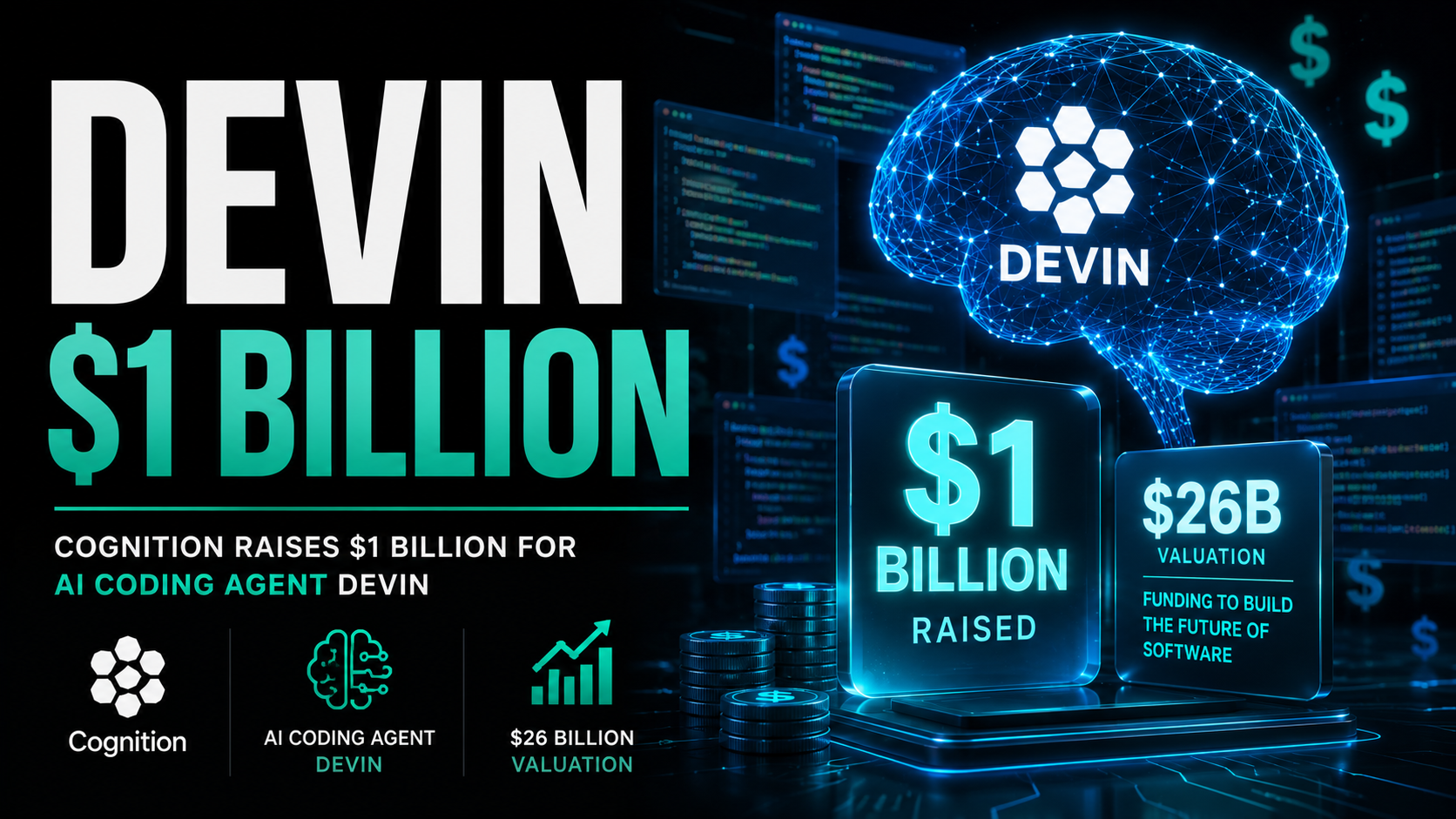
Cognition Devin funding just hit a new milestone that would have been unthinkable two years ago. The startup behind Devin, the world’s first fully autonomous AI software engineer, has raised more than $1 billion at a $26 billion post-money valuation — a number that would make it worth more than companies like Cloudflare, Datadog, or Palantir when they first went public.
The round, announced on May 27, 2026, represents a 155% jump from Cognition’s $10.2 billion post-money valuation when it closed a $400 million round just eight months ago. In a market where AI companies are regularly raising billions, this round stands out for what it implies: investors believe that autonomous AI coding agents aren’t just tools — they’re the future of how software gets built.
Cognition Devin Funding: The Billion-Dollar Round
The Cognition Devin funding round exceeded $1 billion at a $25 billion pre-money valuation, resulting in $26 billion post-money. The specifics of the investor syndicate haven’t been fully disclosed, but previous Cognition rounds were led by Founders Fund, with participation from Khosla Ventures, and other tier-one Silicon Valley firms.
To put the number in perspective: Cognition was founded in late 2023 and launched Devin in March 2024. In roughly two and a half years, it has gone from a stealth-mode startup to a $26 billion company. That’s a trajectory that makes even the most aggressive SaaS growth curves look pedestrian.
The speed of the valuation increase is particularly notable. Going from $10.2 billion to $26 billion in eight months means Cognition added $15.8 billion in enterprise value — approximately $66 million per day. For a company that builds an AI that writes code, the meta-irony is hard to ignore: the fastest value creation in software history is happening at a company trying to automate software creation.
What Devin Actually Does
Devin isn’t a code autocomplete tool like GitHub Copilot or a chatbot that answers programming questions. It’s an autonomous agent that can take a software engineering task, break it into steps, write code, debug it, test it, and deploy it — with minimal human intervention. The distinction matters because it positions Devin not as a tool for developers but as a replacement for entire categories of development work.
Cognition describes Devin as an AI that can handle “the full lifecycle of software engineering tasks,” from reading documentation to writing production-ready code to fixing its own bugs. In demos, Devin has shown the ability to complete multi-step engineering tasks on platforms like Upwork, passing real-world coding assessments and delivering working software.
The product has evolved significantly since its initial launch. Early versions drew criticism for overpromising and underdelivering on complex tasks. But recent iterations have shown marked improvements in reliability, with Cognition claiming that Devin can now handle a substantial percentage of routine software engineering tasks without human intervention.
From $10 Billion to $26 Billion in Eight Months
The velocity of Cognition’s valuation growth reflects the broader explosion in AI agent capabilities. When the company raised at $10.2 billion in September 2025, autonomous AI agents were still largely conceptual. By May 2026, they’re being deployed in production environments at major enterprises.
The Cognition Devin funding round also reflects competitive pressure. Multiple companies are building AI coding agents, and being well-capitalized is essential for maintaining a lead in a market where the underlying AI models improve every few months. With $1 billion in fresh capital, Cognition can invest aggressively in model improvements, enterprise features, and the kind of reliability engineering that separates demo-worthy products from production-ready ones.
The AI Coding Agent Market Explosion
Cognition isn’t operating in a vacuum. The AI coding agent market has exploded in 2026, with multiple well-funded competitors pursuing variations on the same thesis. OpenAI’s Codex has evolved from a code completion tool into an increasingly autonomous coding agent. Anthropic’s Claude Code has become the preferred tool for many professional developers. Google’s Gemini Code Assist is deeply integrated with the Google Cloud ecosystem.
What differentiates Cognition is its single-minded focus. While OpenAI, Anthropic, and Google build coding tools as one product among many, Cognition’s entire company is built around making Devin the best autonomous software engineer possible. This specialization allows for deeper investment in the specific capabilities that matter for code generation: understanding codebases, managing dependencies, handling edge cases, and producing reliable, maintainable code.
The market dynamics have also been shaped by the Big Tech layoff cycle. As major companies have cut engineering headcount while maintaining or increasing output expectations, AI coding agents have moved from “nice to have” to “essential infrastructure.” Companies that laid off 10% of their engineering teams need AI tools that can fill the gap.
Why Investors Are Betting So Big
The investment thesis behind the Cognition Devin funding comes down to market size. Global spending on software development is estimated at over $1 trillion annually. If an AI agent can handle even 10-20% of routine development work, the addressable market is enormous — easily justifying a $26 billion valuation if Cognition captures a meaningful share.
There’s also a winner-take-most dynamic at play. AI coding agents benefit from network effects: the more code they write and debug, the better they get at writing and debugging code. Early market leaders have an advantage that compounds over time, which incentivizes investors to bet big early rather than wait for the market to mature.
The cybersecurity implications add another dimension. AI-generated code can introduce new vulnerability patterns, and companies that can generate code while simultaneously ensuring its security will command a premium. Cognition has been investing in security-aware code generation, positioning Devin as not just faster than human developers but potentially more consistent about avoiding common security pitfalls.
The $26 Billion Dollar Question
The obvious question: is a coding AI startup actually worth $26 billion? The answer depends on what you think happens next in software development. If autonomous AI agents become the primary way software is built — handling everything from initial development through testing, deployment, and maintenance — then $26 billion is cheap. If they remain sophisticated assistants that help human developers work faster but never fully replace them, the valuation looks stretched.
The reality will probably fall somewhere in between. AI coding agents are already good enough to handle many routine tasks: writing boilerplate code, implementing well-defined features, writing tests, and fixing straightforward bugs. They struggle with ambiguous requirements, novel architectures, and the kind of creative problem-solving that defines senior engineering work. As models improve, the line between “routine” and “creative” will shift, but it’s unlikely to disappear entirely.
What Devin Means for Software Developers
The rise of AI coding agents has sparked legitimate anxiety in the developer community. If an AI can write code autonomously, what happens to the millions of software engineers whose jobs involve writing code?
The optimistic view is that AI coding agents will augment developers rather than replace them, handling tedious work while humans focus on architecture, design, and creative problem-solving. The pessimistic view is that a significant percentage of coding jobs — particularly junior and mid-level positions — will be automated within the next 3-5 years.
OpenAI CEO Sam Altman recently admitted he was wrong about the near-term social and economic impact of AI on white-collar jobs, backing away from earlier predictions of widespread displacement. But the Cognition Devin funding tells a different story: investors are pouring a billion dollars into a company explicitly designed to do the work that software engineers currently do.
The Competition Is Everywhere
Cognition’s $26 billion valuation will attract even more competition. Every major AI lab is investing in code generation capabilities, and the barrier to entry is lower than in many other AI applications because code is structured, testable, and relatively easy to evaluate for correctness.
Open-source alternatives are also gaining traction. Projects that run locally and integrate with existing development workflows offer a free alternative to Cognition’s paid service. For individual developers and small teams, these tools may be good enough, limiting Cognition’s addressable market to enterprise customers who need the reliability, security, and support that come with a commercial product.
The competitive landscape also includes Google’s deepening investment in AI-assisted development through Gemini Code Assist and its integration with Android Studio, Cloud Shell, and other Google development tools. Microsoft’s GitHub Copilot, powered by OpenAI’s models, has the advantage of being embedded in the world’s most popular code hosting platform.
The Bottom Line
The Cognition Devin funding of $1 billion at a $26 billion valuation is either a bet on the inevitable future of software development or the latest example of AI hype inflating valuations beyond reason. The truth is probably both. AI coding agents are real, they’re getting better quickly, and they will fundamentally change how software is built. Whether Cognition specifically captures enough value to justify a $26 billion price tag is a separate question — one that depends on execution, competition, and whether the AI coding revolution happens on the timeline investors are pricing in.
For now, one thing is certain: the era of autonomous AI software engineers has arrived, and a billion dollars says it’s not going away.