The OnlyFans ‘340 Million User Leak’ Is Fake — But the Privacy Nightmare It Created Is Very Real
Table of Contents
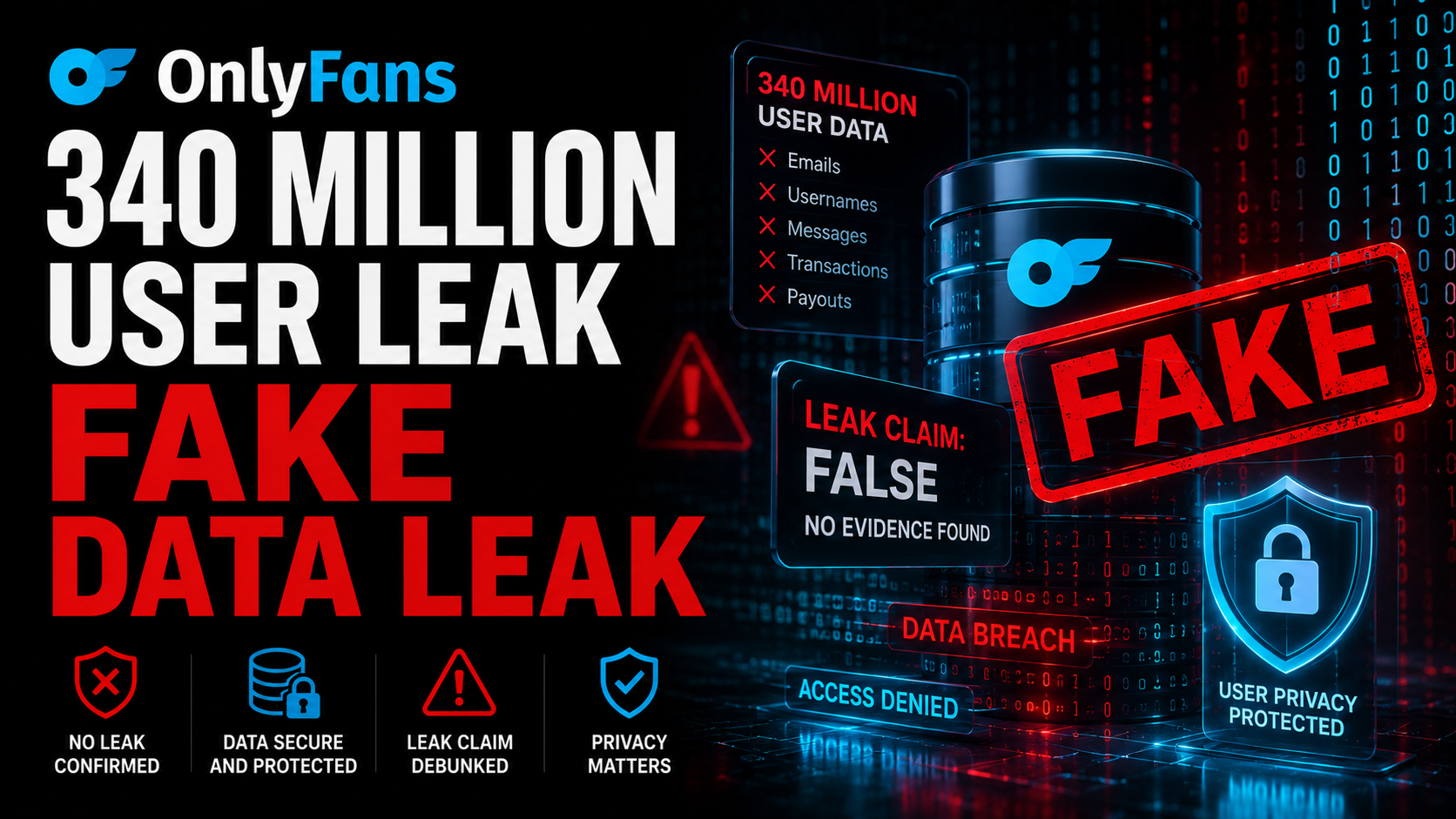
The OnlyFans data leak headline has gone viral: “340 Million User Records Exposed.” It’s the kind of number that triggers immediate panic. But here’s what every report failed to tell you first — OnlyFans was never actually breached. The database being sold on a cybercrime forum for roughly $76,000 in Bitcoin was stitched together from older leaks of completely different platforms, cross-referenced with publicly available OnlyFans profile data.
The breach is fake. The danger to 340 million people is not.
The OnlyFans Data Leak Claim
On May 28, 2026, a threat actor using the alias “Euphoric_Reply_5727” posted a listing on a well-known cybercrime forum offering what they described as “340 Million OnlyFans User Records.” The listing priced the database at 0.313 BTC — approximately $76,000 at the time of posting.
The listing immediately went viral. News outlets, social media influencers, and security researchers all amplified the claim, with many headlines suggesting that OnlyFans had suffered a catastrophic data breach. Given the sensitive nature of the platform — OnlyFans is primarily known for adult content, and many users rely on the platform’s discretion to protect their privacy — the potential for harm seemed enormous.
But the reality is more nuanced and, in some ways, more concerning than a straightforward breach would be.
What the Seller Is Offering
The OnlyFans data leak listing includes sample records that contain a range of data fields: usernames, email addresses, phone numbers, join dates, follower counts, likes, uploaded content metrics, linked social media profiles, account types (creator vs. subscriber), and in some cases, a field labeled “card” that allegedly contains the last four digits of a payment card.
At first glance, this looks like the output of a database dump — the kind of structured data you’d expect from an actual server breach. But security researchers who examined the sample data noticed several red flags. Many entries contain placeholder values like “None.” The formatting is inconsistent, more like stitched-together data from multiple sources than a clean export from a single database. And much of the information — follower counts, content metrics, linked social profiles — is already publicly visible on OnlyFans profiles.
The Twist: It’s Not a Real Breach
According to research published by HackRead, the person behind the listing eventually acknowledged that the data was never pulled from OnlyFans servers at all. Instead, it was assembled by cross-referencing older breaches from other platforms — including data dumps from Twitter, Instagram, and Spotify that have circulated in cybercrime forums for years — and matching those records to publicly visible OnlyFans profile information.
OnlyFans has also denied any breach of its systems. The company’s position is that its infrastructure was not compromised and that the data being sold does not come from its platform. Both the seller and the platform agree on this point, which is unusual in the world of cybersecurity incidents where claims and counter-claims are the norm.
This makes the OnlyFans data leak a “composite breach” or “Frankenstein database” — a dataset assembled from multiple sources rather than obtained through a single intrusion. And this is becoming an increasingly common tactic in cybercrime.
How the Frankenstein Database Was Built
The technique used to create the OnlyFans data leak database follows a well-established pattern. First, the attacker collects leaked databases from previous breaches of major platforms. Billions of records from Twitter, LinkedIn, Facebook, Instagram, Spotify, and dozens of other services are freely available or cheaply purchasable on cybercrime forums.
Second, the attacker scrapes publicly available data from the target platform — in this case, OnlyFans. Profile information including usernames, bio text, linked social media accounts, and content metrics are all publicly accessible on OnlyFans profiles.
Third, the attacker uses matching algorithms to connect records across datasets. If the same email address appears in both a leaked Twitter database and a scraped OnlyFans profile, those records get merged. The result is a composite record that contains private data (email, phone number, password hash) from the older breach combined with OnlyFans-specific data (username, account type, follower count) from the scrape.
The process is automated and scalable. With existing tools and computational resources, an attacker can match hundreds of millions of records across multiple leaked databases in a matter of hours. The result looks like a breach database but was created entirely from previously available data.
Why Fake Breaches Are Still Dangerous
The fact that OnlyFans wasn’t breached doesn’t make the OnlyFans data leak harmless. Quite the opposite. The composite database creates several serious risks for the individuals whose data appears in it.
Credential stuffing attacks become more targeted. If an attacker knows that a specific email address is associated with an OnlyFans account, they can attempt to log in using passwords from older breaches. People who reuse passwords across services — which research consistently shows is the majority of users — are immediately vulnerable.
Phishing campaigns gain credibility. An email that says “Your OnlyFans account has been compromised” and includes the recipient’s actual username, join date, and linked social accounts is far more convincing than a generic phishing attempt. The inclusion of real data makes the scam feel legitimate.
But the most concerning risk is the one that’s hardest to quantify: social engineering, harassment, and blackmail.
The Blackmail and Sextortion Angle
OnlyFans occupies a unique position in the data breach landscape because of the sensitive nature of its content. For many users — both creators and subscribers — their OnlyFans activity is something they prefer to keep private. The composite database makes it possible to connect real identities (from email addresses and phone numbers in older breaches) to OnlyFans accounts (from the scrape).
This creates a direct path to sextortion — threatening to reveal someone’s OnlyFans activity to their employer, family, or social network unless they pay a ransom. Sextortion has been a growing cybercrime category, and a database that links real identities to OnlyFans accounts is essentially a sextortion toolkit.
The damage extends beyond individual victims. The existence of such a database chills participation on the platform. Content creators who depend on OnlyFans for income face the prospect of being identified against their will. Subscribers who value their privacy face the same risk. The trust that makes the platform viable is undermined even though OnlyFans itself did nothing wrong.
OnlyFans Official Response
OnlyFans has denied any breach of its systems, and the available evidence supports this denial. The company has not been compelled to issue data breach notifications, which would be required under most privacy laws if actual user data had been exfiltrated from their servers.
However, OnlyFans faces a communication challenge. Saying “we weren’t breached” is technically accurate but doesn’t address the harm to users whose data appears in the composite database. Users don’t care whether their data was stolen from OnlyFans directly or assembled from other sources — the result is the same: their OnlyFans activity is now linked to their real identity in a database being sold to criminals.
What Users Should Do Right Now
Whether you’re an OnlyFans creator, subscriber, or someone who once created an account out of curiosity, there are immediate steps you should take. Change your OnlyFans password immediately and ensure it’s unique — not reused from any other service. Enable two-factor authentication if you haven’t already. Review your linked social media accounts and consider unlinking any that could be used to identify you.
More broadly, check whether your email addresses appear in known data breaches using services like Have I Been Pwned. If your email has been compromised in previous breaches, change passwords on all services where you used that email. Consider using a dedicated email address for sensitive accounts that isn’t connected to your real identity.
Be extremely suspicious of any communication that references your OnlyFans account. Legitimate companies don’t send emails threatening to expose your activity. If you receive a sextortion message, report it to law enforcement and do not pay.
The Bigger Problem: Data-Stitching Attacks
The OnlyFans data leak represents a growing trend in cybercrime: data-stitching attacks that combine information from multiple sources to create databases more dangerous than any single breach. As more platforms get breached and more data circulates in cybercrime forums, the raw material for these composite databases grows exponentially.
The defense against traditional breaches is clear: companies need to secure their servers, encrypt their data, and respond quickly when breaches occur. The defense against data-stitching attacks is far harder because the attack doesn’t target a single company’s infrastructure. Instead, it exploits the accumulated debris of years of data breaches across the entire internet.
The OnlyFans data leak is fake. But it works because we live in a world where billions of real data points from real breaches are freely available to anyone who knows where to look. That’s the real story — and it’s one that no single company can solve alone.