71% of Americans Oppose AI Data Centers Near Their Homes — The Industry Has a Problem
Table of Contents
Table of Contents
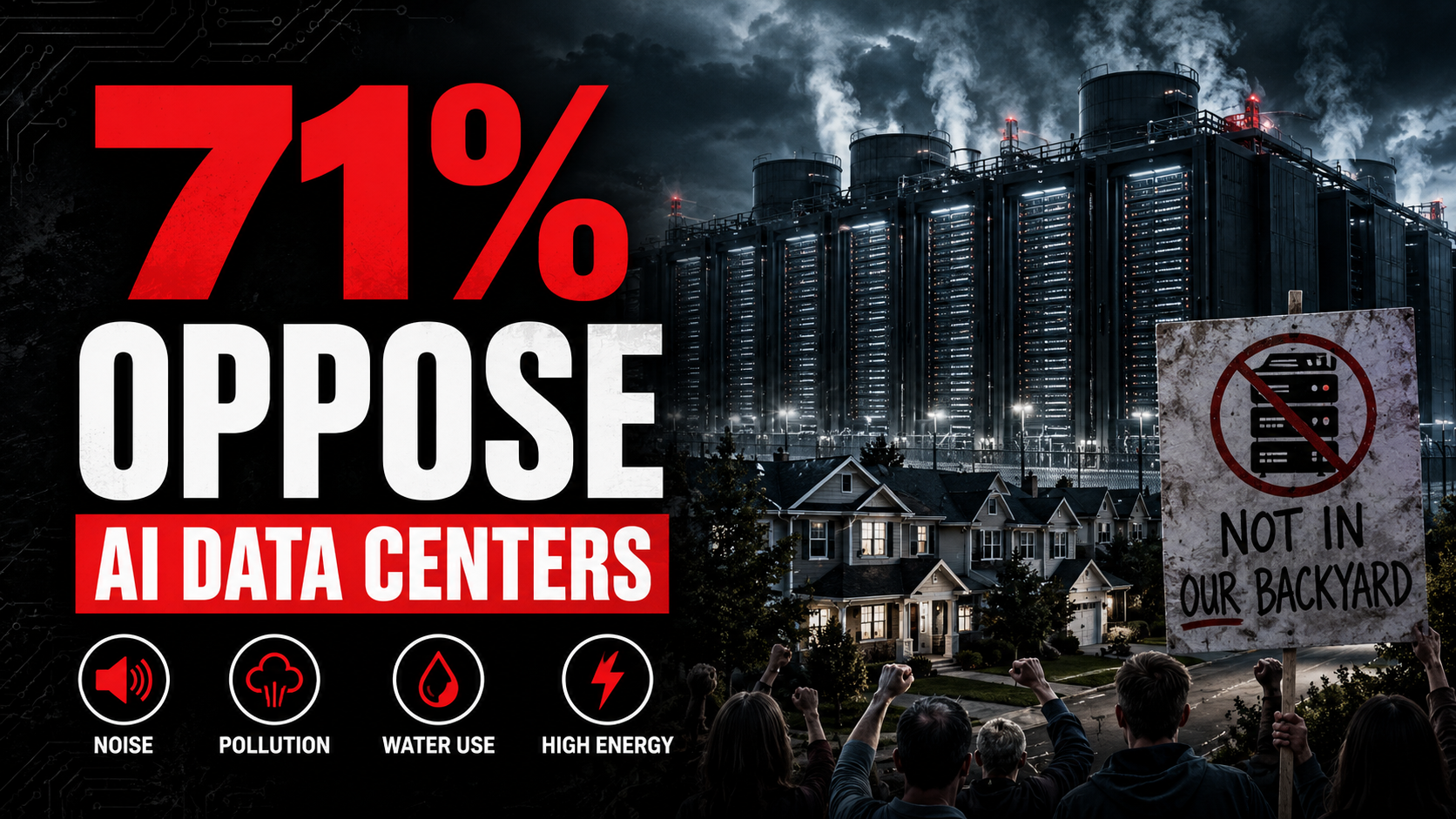
Every tech CEO, venture capitalist, and government official is racing to build more AI data centers. But someone forgot to ask the people who actually live near them. A new Gallup survey has found that 71% of U.S. adults oppose having an AI data center in their local area. Not somewhere else — in their neighborhood, their town, their county. And the gap between what the AI industry wants to build and what communities want to host may be the most underreported conflict in tech right now.
As AI companies pour hundreds of billions of dollars into compute infrastructure — Google, Microsoft, Amazon, and Meta have all announced multi-year, multi-billion-dollar data center expansion plans — a grassroots resistance movement is forming in the communities being asked to host these facilities. And the Gallup numbers suggest it runs much deeper than a few vocal NIMBY protesters.
What the Gallup Poll Found
The finding is stark: 7 in 10 Americans don’t want an AI data center near their home. That’s not a marginal result — it’s a supermajority. And it cuts across demographics, geographies, and political affiliations in ways that should alarm anyone planning major data center expansion.
The opposition is driven by a cluster of concrete concerns:
- Water consumption: Modern AI data centers use enormous amounts of water for cooling. A single hyperscale facility can consume millions of gallons per day — in regions already facing drought stress, this is a genuine resource conflict.
- Energy demand: AI data centers are among the most power-hungry facilities on earth. Communities near data centers often experience pressure on local power grids, rising electricity rates, and increased demand for fossil fuel backup generation.
- Noise: The constant hum of cooling systems and backup generators creates low-frequency noise that residents within miles can find disruptive.
- Traffic: Construction and ongoing operations bring significant truck traffic to what are often semi-rural areas selected precisely because of their cheap land and available power.
- Property values: Proximity to large industrial facilities — which is what data centers effectively are — tends to depress residential property values.
- Security concerns: Data centers housing critical AI infrastructure are potential targets. Communities near such facilities may be subject to security restrictions, surveillance, or become targets themselves.
The Disconnect: What the Industry Needs vs. What Communities Will Accept
AI companies need compute. More compute than currently exists. The leading AI labs and cloud providers have made this clear repeatedly — the constraint on AI development isn’t algorithms or data, it’s raw compute capacity. And compute capacity means data centers. Lots of them. Everywhere.
The scale of planned expansion is staggering. Microsoft announced a four-year, $10 billion AI investment in Japan. Nebius Group secured up to 1.2 GW of power and land for a new AI factory in Pennsylvania — that’s enough electricity for a small city. Google, Amazon, and Meta are making comparable commitments globally.
The economics make rural and semi-rural areas particularly attractive for these facilities: cheap land, available power (often from nearby power plants), and lower construction costs than urban areas. But the communities in those areas have needs and interests that don’t automatically align with hosting a 500,000-square-foot server warehouse.
The 71% opposition figure suggests that community buy-in — which the AI industry has largely assumed would be manageable through standard permitting processes — is going to be much harder to achieve than anticipated.
Real Conflicts Already Emerging Across the U.S.
The Gallup numbers reflect something already playing out in community after community:
Virginia’s Data Center Corridor: Northern Virginia hosts the highest concentration of data centers on earth — and residents in communities like Gainesville and Loudoun County have been pushing back against new developments for years, citing noise, traffic, and strain on the electrical grid. The conflict has reached state legislative chambers, with bills introduced to limit data center expansion in certain zones.
Water wars in the Southwest: Data centers being built in water-stressed regions of Nevada, Arizona, and New Mexico are drawing fierce opposition from local water authorities and environmental groups. When an AI company wants to build a facility that consumes as much water as a small town, in a region already rationing water, the conflict is predictable.
Rural grid strain: In several Midwestern and Southern states, agricultural communities near new data center sites have complained that the massive power draw is straining local distribution infrastructure, causing voltage fluctuations and outages for farms and homes that were there long before the servers arrived.
The Environmental Equation: Is AI’s Infrastructure Footprint Sustainable?
Beyond local NIMBY concerns, there’s a larger environmental question that the Gallup survey implicitly captures: the AI industry’s infrastructure footprint is growing faster than its ability to make that footprint sustainable.
Major AI companies have made ambitious net-zero pledges, and renewable energy procurement has accelerated. But the math is challenging. A frontier AI model training run can consume as much electricity as thousands of homes use in a year. Inference at scale — serving ChatGPT’s 900 million weekly users — requires continuous, always-on compute that renewable energy alone, given current grid storage limitations, cannot always reliably provide.
The gap between AI companies’ environmental commitments and their actual infrastructure growth rates is real, measurable, and growing. Communities that are being asked to host data centers are, in many cases, also being asked to absorb the environmental costs of AI expansion while the financial benefits flow primarily to shareholders in distant cities.
What the AI Industry Needs to Do Differently
The 71% opposition figure isn’t just a political problem for data center developers — it’s a practical one. Zoning battles, permitting delays, and community opposition can add years and hundreds of millions of dollars to data center projects. The AI companies that figure out how to build community relationships, not just data centers, will have a significant operational advantage.
Several approaches are showing early promise:
- Community benefit agreements: Formal commitments to hire locally, fund community projects, and cap water/power usage — negotiated with community representatives before construction begins.
- Aggressive renewable energy integration: Building on-site renewable capacity or purchasing local renewable power, rather than drawing from the general grid.
- Advanced cooling technology: Investing in water-free or water-minimal cooling systems, even where water-cooled systems would be cheaper, to reduce community conflict over water resources.
- Genuine community engagement: Not just legal public comment processes, but active outreach and dialogue before sites are selected — giving communities real input rather than a fait accompli.
The broader point is that the AI industry is in danger of treating its infrastructure buildout as a purely technical and financial problem, when it’s also fundamentally a social and political one. The Gallup survey is a warning shot: 71% of Americans are already opposed. As data center development accelerates, that opposition will become harder to ignore — and easier to organize.
The pattern of tech industry profit concentration without broad community benefit is already generating political backlash in other domains. Data center opposition may be where that backlash becomes most concrete and consequential for AI’s physical infrastructure plans.
Conclusion: 71% Is Not a Rounding Error
Seventy-one percent is not a fringe position. It’s not NIMBYism confined to wealthy enclaves. It’s a majority of Americans — across income levels, geographies, and political affiliations — saying they don’t want AI’s infrastructure in their backyard. The AI industry would be making a serious strategic error to dismiss this as sentiment that permitting processes can work around.
The companies that are going to build the compute infrastructure the AI revolution requires are going to need community consent to do it. That consent is not currently available by default. It has to be earned — through genuine engagement, genuine benefit-sharing, and a genuine commitment to minimizing the costs that local communities bear for global AI ambitions.
The AI boom is real. The infrastructure demand is real. The community opposition is also real. The next decade of AI development will be shaped, at least in part, by how well — or how badly — the industry handles that conflict.