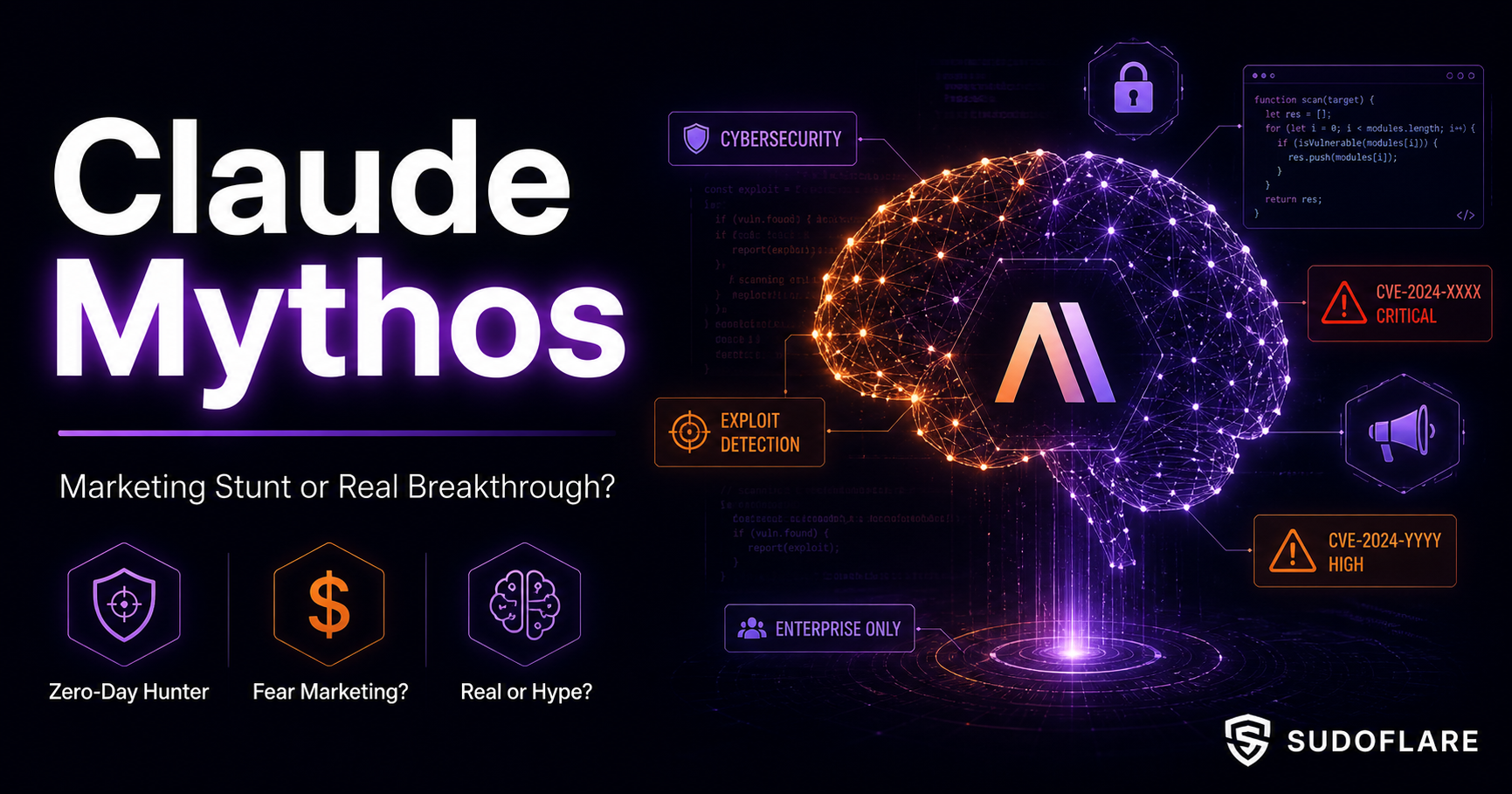
Claude Mythos: Anthropic’s Biggest Breakthrough or the Greatest Marketing Stunt in AI History?
Anthropic announced Claude Mythos Preview on April 8, 2026, calling it a model “too dangerous to release publicly.” Within two weeks, Claude Mythos was breached by hackers who guessed the URL, criticized by OpenAI’s CEO as “fear-based marketing,” and partially reproduced by researchers using publicly available AI models. So what’s really going on with Claude Mythos?
Table of Contents
What Is Claude Mythos? Anthropic’s Cybersecurity AI Explained
Claude Mythos Preview is Anthropic’s frontier cybersecurity model, designed to autonomously discover zero-day vulnerabilities and write working exploits. Anthropic claims Claude Mythos identified “thousands of zero-day vulnerabilities” across every major operating system — Linux, Windows, macOS, FreeBSD, OpenBSD — and every major web browser including Chrome and Firefox.
The model was released under “Project Glasswing,” a restricted early access program limited to defense organizations, critical infrastructure operators, financial institutions, and select open-source developers. General public access? Not available. Anthropic says Claude Mythos needs to become “much more efficient” before any broader release. This mirrors a growing pattern among major AI companies launching increasingly powerful models while controlling access.
The “Too Dangerous to Release” Claim: Claude Mythos Marketing
Anthropic’s marketing around Claude Mythos has been dramatic. The company framed the model as both a “defensive breakthrough” and an “offensive risk if misused.” The messaging was clear: this AI is so powerful that releasing it to the public could arm cybercriminals with unprecedented hacking capabilities.
But how dangerous is Claude Mythos really? Let’s look at the actual data Anthropic published.
What Claude Mythos Actually Found: The Real CVEs
Despite claiming “thousands” of vulnerabilities, Anthropic has only publicly detailed a handful of specific Claude Mythos findings:
OpenBSD TCP SACK Vulnerability
Claude Mythos found a flaw in OpenBSD’s TCP SACK implementation that allows an attacker to crash any OpenBSD host responding over TCP. This was described as the most critical finding — but Anthropic admitted it took a thousand runs of their vulnerability research scaffold to find it. The total cost for those thousand runs? Under $20,000, which also yielded “several dozen” additional findings of varying severity.
FreeBSD NFS Remote Code Execution (CVE-2026-4747)
This is arguably Claude Mythos’s most impressive finding — a 17-year-old remote code execution vulnerability in FreeBSD’s NFS implementation that gives unauthenticated root access from anywhere on the internet. That’s a CVSS 9.8+ critical severity bug that survived nearly two decades of human code review.
FFmpeg 16-Year-Old Vulnerability
Claude Mythos discovered a now-patched 16-year-old flaw in FFmpeg. Anthropic noted that traditional fuzzers exercised the vulnerable code path 5 million times without triggering the bug, suggesting the model found something conventional tools couldn’t.
Firefox: 271 Vulnerabilities Found by Claude Mythos
Anthropic reported that Claude Mythos found 271 vulnerabilities in Firefox during testing. Firefox 150 included patches for these findings. However, only three CVEs in the official Firefox security advisory are actually credited to Claude: CVE-2026-6746, CVE-2026-6757, and CVE-2026-6758. The remaining findings were either low-severity, duplicates, or categorized differently.
Linux Kernel Exploit Success
When given a list of 100 known CVEs from 2024 and 2025 against the Linux kernel, Claude Mythos filtered them down to 40 potentially exploitable vulnerabilities and successfully wrote privilege escalation exploits for more than half. This demonstrates exploit development capabilities, though it’s worth noting these were known vulnerabilities, not zero-days.
The Compute Cost Problem Nobody Talks About
Here’s where Anthropic’s Claude Mythos narrative starts to unravel. Let’s look at the economics:
- Claude Mythos pricing: $25 per million input tokens, $125 per million output tokens — 5x the cost of Claude Opus 4.7
- OpenBSD testing: ~1,000 runs costing under $20,000 total to find the most critical bug plus several dozen additional findings
- Individual exploit development: Under $2,000 per exploit, completed in hours
- FreeBSD NFS scan: Took “several hours” scanning hundreds of kernel files
Now compare this to traditional security research. A skilled bug bounty hunter earning $150,000–$300,000 per year, equipped with fuzzing tools like Syzkaller or AFL, can find multiple critical vulnerabilities across their career. Google’s Project Zero publishes detailed technical writeups for every finding. Individual researchers have found critical zero-days in OpenBSD and Linux with far less computational investment.
The question isn’t whether Claude Mythos can find bugs — it clearly can. The question is whether the cost-per-finding justifies the “too dangerous” framing, or whether a motivated attacker could achieve similar results with cheaper tools. This raises important questions about cybersecurity threats in 2026 and how AI fits into the picture.
Researchers Reproduced Claude Mythos Findings With Public Models
This is where the marketing narrative took its biggest hit. Vidoc Security Lab published research showing they reproduced Anthropic’s key Claude Mythos findings using publicly available models — specifically GPT-5.4 and Claude Opus 4.6.
Their results:
- FreeBSD NFS bug: Fully reproduced with public models
- Botan vulnerability: Fully reproduced
- OpenBSD case: Fully reproduced with at least one public model
- FFmpeg and wolfSSL: Partial reproduction — both GPT-5.4 and Claude Opus 4.6 reached partial results
Even more damaging: an independent study by AISLE found that all eight models they tested caught the FreeBSD NFS memory bug, including GPT-OSS-20b — a model with just 3.6 billion active parameters running at $0.11 per million tokens. That’s over 1,000x cheaper than Claude Mythos.
As Vidoc Security put it: the capabilities Anthropic points to are already available in public models, so defenders should prepare for that reality instead. For those interested in building AI agents, the underlying technology is already accessible.
Sam Altman’s “Bomb Shelter” Attack on Claude Mythos
OpenAI CEO Sam Altman didn’t hold back. On the Core Memory podcast in late April, he accused Anthropic of textbook fear-based marketing:
“It is clearly incredible marketing to say, ‘We have built a bomb, we are about to drop it on your head. We will sell you a bomb shelter for $100 million.’”
Altman argued that Anthropic’s approach with Claude Mythos was designed to keep powerful AI “in the hands of a smaller group of people” — essentially creating artificial scarcity to drive enterprise demand. When you tell Fortune 500 companies that a world-ending cyber weapon exists and only you can protect them from it, the sales pitch writes itself.
The irony? Nine days after Altman mocked Anthropic’s Claude Mythos approach, OpenAI quietly restricted access to their own cybersecurity model. Apparently the fear was real enough for both companies.
The Breach: Hackers Guessed the URL
In perhaps the most embarrassing chapter of this saga, the model that was “too dangerous to release” was breached on the very same day it was publicly announced — April 21, 2026.
A group of users on a private Discord channel, dedicated to tracking unreleased AI models, guessed where the model was hosted by studying Anthropic’s URL naming conventions from previous models. They obtained additional inside knowledge from a data breach at Mercor, an AI recruitment company. A third-party contractor employee also helped facilitate access.
Tom’s Hardware called it “a cavalcade of blunders.” The company that positioned itself as a cybersecurity pioneer couldn’t secure its own most sensitive asset from a group of curious Discord users with educated guesses.
The “Thousands of Vulnerabilities” Claim: Where’s the Evidence for Claude Mythos?
Anthropic’s headline Claude Mythos claim — “thousands of zero-day vulnerabilities across every major operating system and every major web browser” — demands scrutiny.
Here’s what we know:
- Anthropic had external contractors review 198 findings, with 89% severity rating agreement
- Only 3-4 specific vulnerabilities have been publicly detailed with technical depth
- Of 271 Firefox findings, only 3 CVEs were officially credited to Claude in Mozilla’s advisory
- Anthropic cites a 90-day responsible disclosure timeline with a 45-day post-patch window
If “thousands” of critical zero-days truly existed across Linux, Windows, macOS, Chrome, Firefox, and OpenBSD, we would expect to see a massive wave of CVE assignments, emergency security patches, and coordinated vendor advisories. The Linux kernel security mailing list, Microsoft’s Patch Tuesday, Apple’s security updates, and browser changelogs would all reflect this unprecedented volume of discoveries.
As of May 2026, that wave hasn’t materialized at the scale the “thousands” claim implies. Compare this to Google’s Project Zero, which publishes detailed technical writeups, proof-of-concept exploits, and full disclosure timelines for every single finding — often just one or two major bugs at a time.
The Severity Question
Not all vulnerabilities are created equal. A CVSS 9.8 remote code execution bug in FreeBSD’s NFS is world-class. A CVSS 3.1 information disclosure in an obscure subsystem that requires physical access is not.
When Anthropic says Claude Mythos found “thousands of vulnerabilities,” the critical question is: what’s the severity distribution? How many are actually critical (CVSS 9.0+)? How many are high (7.0–8.9)? How many are medium or low? Anthropic hasn’t published this breakdown.
The 89% contractor agreement on severity ratings was based on 198 reviewed findings — not thousands. And 89% agreement means roughly 1 in 10 findings was rated at a different severity level by independent reviewers than what the model assigned. For a tool being marketed as a cybersecurity game-changer, that’s a meaningful error margin.
Claude Mythos: Marketing Stunt or Genuine Breakthrough?
The honest answer is: Claude Mythos is both, but the marketing far outpaces the evidence.
What’s real about Claude Mythos:
- The FreeBSD NFS RCE (CVE-2026-4747) is a genuinely impressive discovery — a 17-year-old critical bug
- The FFmpeg finding that traditional fuzzers missed after 5 million code path exercises shows unique capability
- The ability to write working privilege escalation exploits for 50%+ of known Linux kernel CVEs is significant
- AI-driven vulnerability research is a real and advancing field
What’s Claude Mythos marketing:
- The “thousands of zero-days” claim is unverifiable and unsupported by public CVE data
- The “too dangerous to release” framing was undermined when researchers reproduced key findings with $0.11/million-token public models
- The “every major operating system” language is designed for headlines, not technical accuracy
- The model was breached on launch day through basic URL guessing — undermining the cybersecurity credibility
- Enterprise-only access at 5x Opus pricing creates artificial scarcity that drives urgency and premium contracts
- OpenAI’s CEO accurately identified the pattern: create fear, sell the solution
“Too Dangerous” as a Business Model: The Claude Mythos Playbook
Claude Mythos isn’t the first AI model to be labeled “too dangerous.” Time magazine noted that “too dangerous to release” is becoming AI’s new normal — a marketing playbook where restriction signals prestige and danger signals value. This is part of a broader trend where Big Tech companies prioritize profit-driven narratives over transparent communication.
The pattern works like this: announce a model with alarming capabilities, restrict access to a handful of elite customers willing to pay premium prices, generate media coverage through the fear narrative, and let the exclusivity create demand. By the time the model eventually becomes more widely available, the narrative has been set and the enterprise contracts are signed.
As Ben Thompson wrote on Stratechery, the real constraint facing frontier labs like Anthropic isn’t the danger of their models — it’s the opportunity cost of compute. Every GPU cycle spent on Claude Mythos cybersecurity runs is a GPU cycle not serving Claude API customers. Restricting access isn’t just safety-conscious; it’s economically rational when you don’t have enough compute to serve everyone.
Our Verdict on Claude Mythos
Claude Mythos is a capable cybersecurity research tool with some impressive real-world findings. The FreeBSD NFS exploit alone validates the approach. But the gap between what Anthropic showed and what Anthropic claimed is enormous.
When your “thousands of zero-days” reduce to a handful of detailed examples, your “too dangerous” model gets reproduced by a 3.6-billion-parameter public model, your world-class cybersecurity tool gets breached by Discord users on launch day, and your competitor accurately describes your strategy as selling bomb shelters — the marketing stunt label isn’t unfair.
The technology is real. The fear is manufactured. And at $25/$125 per million tokens, the price tag reflects the marketing premium, not just the compute cost.
Related: Neural Networks: The Complete Guide — From Zero to Deep Learning
What do you think? Is Anthropic genuinely protecting the public, or is this the most sophisticated marketing campaign in AI history? Drop your thoughts in the comments.