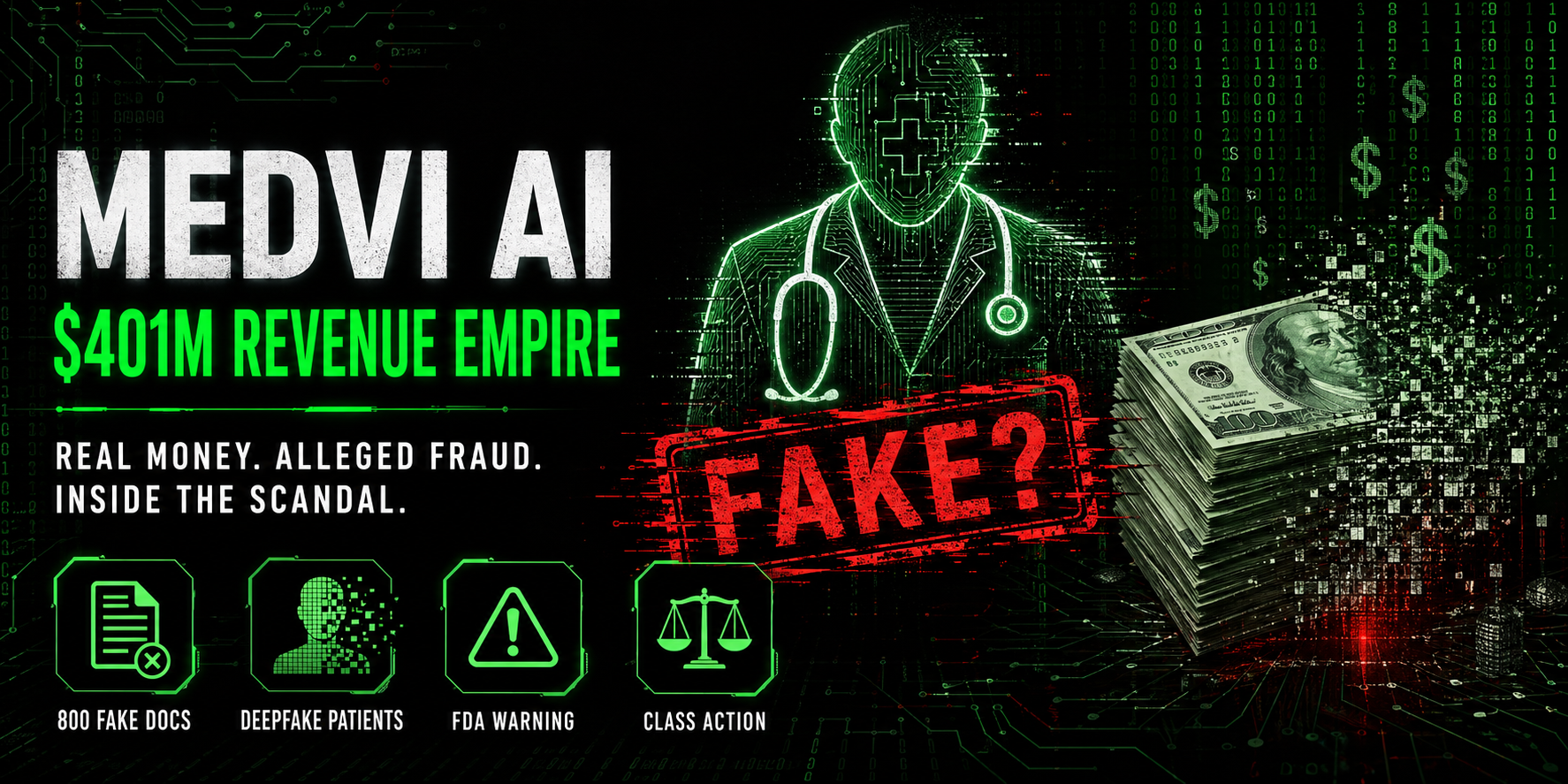
Medvi Made $401M With AI — So Why Is Everyone Calling It Fraud?
Medvi is a US telehealth startup that sold prescription weight-loss drugs through what it called the most efficient AI marketing operation in healthcare. They generated $401 million in 2025 revenue, projected $1.8 billion for 2026 on a run rate basis, and the founders called themselves “the fastest-growing company in history.”
Then journalists started looking at the marketing.
What they found turned the story from a business success into one of the biggest healthcare-AI scandals of 2026: 800+ allegedly fake Facebook doctor accounts, deepfaked patient testimonials, identity theft of a real physician, an FDA warning letter, a class action lawsuit, and a $401M empire that runs on just two employees.
Here is what is actually verified, what is alleged, and what every founder building with AI right now should learn from it.
The verified parts: yes, the revenue is real
Before getting into allegations, the financial side has to be acknowledged honestly. According to financial documents reviewed by The New York Times, Medvi’s 2025 revenue was approximately $401 million. That is real money — patients paid, payment processors cleared, banks deposited.
The widely circulated $1.8 billion figure is different. That is a projected annual run rate based on early 2026 sales extrapolated forward. It is not audited. It is not realized. There is no public audit of Medvi’s financials, which is unusual for a company of that claimed scale.
So when people ask “is the revenue fake?” — the honest answer is: 2025’s $401M is real per NYT verification. The $1.8B annualized projection has not been independently confirmed. And, more importantly, the methods used to generate that revenue are what is now under serious public and legal scrutiny.
What Medvi is allegedly accused of doing
These are allegations, drawn from public reporting and a class action lawsuit. Medvi has denied wrongdoing on several points. The legal cases are ongoing.
1. 800+ alleged fake doctors on Facebook
Independent investigators reviewed Meta’s ad library and identified roughly 800 Facebook accounts that appeared to be doctors recommending Medvi’s prescription drugs. When researchers tried to verify the doctors against US licensing databases and search results, most could not be found in any public record. The accounts had stock-photo-style profile images and inconsistent credentials.
If those doctors do not exist, the medical advice patients followed when buying drugs through these ads was not medical advice — it was marketing presented as medical advice. That is the heart of the fraud accusation.
2. AI-deepfaked patient testimonials
Multiple outlets reported that patient testimonials on Medvi’s marketing pages featured AI-generated faces. Patients reading “real reviews” from “real customers” were allegedly looking at synthetic people. This matters because health buying decisions hinge on testimonials. If the testimonials are fabricated, the consent to purchase was not informed.
3. Identity theft of a real physician
One real, licensed doctor publicly stated that Medvi had used his name and likeness in marketing materials without his permission. He had no relationship with the company. Using a real medical professional’s identity to lend authority to drug marketing is, if true, a serious civil and possibly criminal matter regardless of revenue.
4. Mass spam emails with spoofed headers
The class action filed in the Central District of California alleges Medvi (or its affiliate network) sent over 100,000 spam emails per year with spoofed sender domains and falsified headers. That is a federal CAN-SPAM Act violation. Medvi’s defense has been that affiliates sent the emails, not Medvi directly — but the affiliates were driving Medvi’s revenue.
5. FDA warning letter
The FDA issued a warning letter regarding marketing practices at a domain Medvi attributes to a third-party affiliate. FDA letters are public, and they signal regulatory attention rather than just criticism. Medvi’s position is that the affiliate’s behavior is not their responsibility. Regulators tend to see it differently when the company benefits from the affiliate’s revenue.
6. Misleading media logos
Medvi’s site allegedly displayed logos of major media outlets implying editorial coverage that those outlets did not actually provide. This is a common dark-pattern marketing tactic but it is also legally risky — outlets have sued companies for unauthorized use of their trademarks for credibility.
7. Two employees running a “$1.8B” company
This is the structural issue that has experts most concerned. According to public reporting, Medvi runs with just two employees. Healthcare at scale legitimately requires:
- Licensed pharmacists reviewing prescriptions
- Compliance officers handling FDA, HIPAA, state regulations
- Customer support for adverse event reports
- Quality control on every prescription decision
None of that is doable with two people. The math only works if most of those functions are either automated, outsourced to gig workers without proper credentials, or — as critics allege — simply not being performed at all.
How the story broke
The New York Times initially profiled Medvi as a flagship example of AI-powered business success. Within days, Techdirt, Futurism, and other outlets pushed back hard, accusing the NYT of being “played by a telehealth scam.” Investigative threads on X exposed the doctor accounts. The class action followed shortly after.
The pattern matters: Medvi’s marketing successfully fooled a major newspaper before independent researchers tore it apart. That is a story about how AI-generated marketing can scale faster than fact-checking infrastructure can keep up.
Why this is being called fraud and not just aggressive marketing
The line between “aggressive marketing” and “fraud” is not the size of the revenue. It is the presence of deception that materially affects consumer decisions. Several alleged elements cross that line:
- Fake doctors are not aggressive marketing. They are impersonation of medical professionals — a regulated category.
- Deepfake patient reviews are not aggressive marketing. They are fabricated social proof — a deceptive trade practice under FTC rules.
- Spoofed email headers are not aggressive marketing. They are explicit federal violations.
- Identity theft of real doctors is not aggressive marketing. It is a tort, possibly criminal.
Companies can have $401M in revenue and also be alleged to have committed several distinct legal violations. Theranos had real revenue. Wirecard had real revenue. Bernie Madoff “managed” $65 billion. Revenue size does not sanitize the methods used to generate it.
Medvi’s response
Medvi has publicly denied the allegations. The company’s position is that:
- The marketing practices in question were carried out by independent affiliates, not Medvi directly.
- The doctor accounts on Facebook were created by affiliates, and Medvi has worked to identify and disable any unauthorized accounts.
- The FDA warning letter targets an affiliate domain, not a domain Medvi controls.
- The company is cooperating with investigations and intends to defend itself in the class action.
Whether the affiliate-distancing defense holds up legally is for the courts to decide. Affiliate program operators have been held liable for affiliate behavior in past CAN-SPAM and FTC cases when the operator profited from the violations.
The lesson for founders building with AI right now
This story is not “AI is bad” or “telehealth is a scam.” It is a much narrower lesson for anyone reading articles about how to build “$1M/month with AI.”
Revenue tells you nothing about legitimacy. The same playbook that works at small scale — fake reviews, paid affiliates, scaled cold email, AI-generated testimonials, paid medical-looking endorsements — scales to nine figures of revenue. It also scales to nine-figure legal exposure.
If you are building an AI-marketed business in 2026, three things from the Medvi story are practical takeaways:
- Affiliate distancing is not a legal shield in regulated industries. Healthcare, finance, and supplements are heavily regulated. Affiliates acting as agents for your revenue can expose you to liability for their behavior.
- AI-generated testimonials are FTC-actionable. The FTC’s 2024 endorsement guidelines explicitly cover synthetic content. Using deepfaked testimonials is a regulatory violation, not a clever marketing hack.
- Auditable financials matter at scale. Companies that cross $100M revenue without audited statements draw scrutiny. If you want to claim “billion-dollar startup,” expect investigators to look at where the money actually came from.
Where the story goes from here
The class action is in early stages. The FDA warning letter is public record. Multiple state attorneys general have been asked to investigate. Medvi continues to operate and market. The $1.8B 2026 projection is being revised by analysts.
The most likely outcomes, based on similar cases:
- Settlement of the class action with no admission of wrongdoing (most common path)
- FTC consent decree restricting marketing practices
- State-level licensing restrictions on telehealth operations
- Possible referral to the DOJ if intentional misrepresentation can be proven
The longer-term question is whether AI-marketed telehealth as a category survives this. The model — push prescription drugs at scale through algorithmic marketing — is bigger than Medvi. If regulators clamp down hard, the entire sector contracts.
Bottom line
Medvi made real money. That is verified. The methods used to make that money are alleged to include fake doctors, deepfaked patients, identity theft, federal spam violations, and FDA-flagged marketing practices. Whether those allegations hold up in court will determine whether $401M counts as a business achievement or a precedent-setting healthcare-AI scandal.
For now, the safest read of the story is the one most experts have settled on: the revenue is real, the legitimacy is in serious doubt, and the playbook is not one you should copy.
Sources used in this article: Drug Discovery Trends, Techdirt, Futurism, The Decoder, Yahoo Finance, Viral Methods. All allegations described as “alleged” or attributed to specific reporting. Medvi has denied wrongdoing on multiple points and the class action is ongoing.