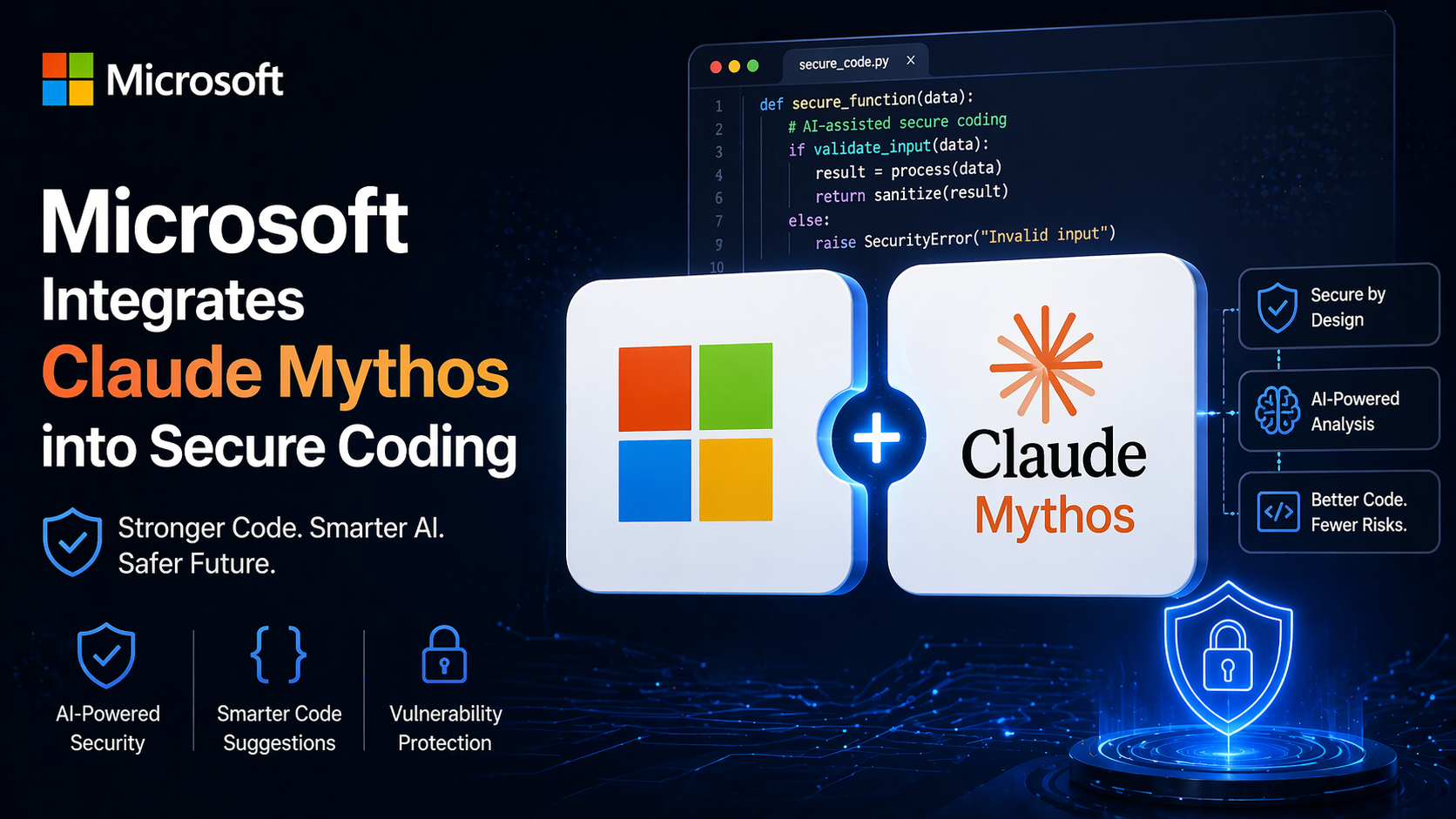
Microsoft Integrates Claude Mythos AI Into Secure Coding — And It Already Found Thousands of Zero-Days
Microsoft has announced it is integrating Anthropic’s Claude Mythos Preview into its Security Development Lifecycle — a move that signals a fundamental shift in how the software industry approaches vulnerability detection and secure coding. The integration, revealed on April 22, 2026, makes Microsoft one of the first major technology companies to embed frontier AI directly into its core security engineering process.
The announcement comes just weeks after Anthropic unveiled Claude Mythos Preview to a restricted group of organizations, having opted not to make it publicly available due to its unprecedented ability to find and exploit vulnerabilities across every major operating system and web browser. What Microsoft is now doing with that capability could reshape how enterprise software security works at scale.
What Is Claude Mythos and Why Is It Different?
Claude Mythos Preview is Anthropic’s latest frontier model, and it is unlike anything the AI security industry has seen before. According to Anthropic’s own disclosures, Mythos Preview is capable of identifying and exploiting zero-day vulnerabilities in every major operating system and every major web browser — autonomously, without human direction once given a target.
The numbers are staggering. Mythos found thousands of severe vulnerabilities across operating systems, browsers, and widely deployed software stacks. The oldest vulnerability it has uncovered so far was a 27-year-old bug in OpenBSD — a system long considered among the most security-hardened operating systems in the world. That a model could unearth a flaw that had survived nearly three decades of expert human review says something profound about the gap between human and AI-assisted security analysis.
In one documented case, Mythos Preview wrote a browser exploit that chained together four separate vulnerabilities, producing a complex JIT heap spray that successfully escaped both the renderer sandbox and the operating system sandbox. In another, it autonomously identified and exploited a 17-year-old remote code execution vulnerability in FreeBSD that allows any unauthenticated user on the internet to gain full root access to a machine running NFS. No credentials. No prior access. Complete server compromise — from a bug that had been sitting in production systems for nearly two decades.
Because of capabilities like these, Anthropic made the decision not to release Mythos Preview to the general public. Instead, it is available only to a carefully selected group of organizations operating under strict controls: Amazon Web Services, Apple, Broadcom, Cisco, CrowdStrike, Google, JPMorgan Chase, the Linux Foundation, Microsoft, NVIDIA, and Palo Alto Networks — along with Anthropic itself.
Project Glasswing: Anthropic’s Cybersecurity Initiative
The broader framework for deploying Mythos in cybersecurity contexts is called Project Glasswing — Anthropic’s initiative to channel the model’s vulnerability-finding capabilities exclusively toward defense rather than attack. The name reflects the idea of transparency: using AI to make software’s hidden weaknesses visible before malicious actors find them first.
Under Project Glasswing, participating organizations work directly with Anthropic to test Mythos Preview against their own systems, identify and mitigate vulnerabilities earlier in the development cycle, and coordinate defensive responses across the industry. The goal is to use the model’s offensive capabilities as a diagnostic tool — essentially hiring the world’s most capable hacker to audit your own code before anyone else does.
Microsoft is one of the most prominent participants, and its integration of Mythos into the Security Development Lifecycle is the most concrete deployment of the model in an enterprise security engineering context to date.
How Microsoft Is Using Claude Mythos
Microsoft’s Security Response Center has embedded Mythos Preview into what the company describes as a multi-model AI-driven scanning harness. The system works by feeding code through Mythos alongside other AI models, allowing the harness to cross-validate findings and reduce false positives while maximizing coverage of real vulnerabilities.
To measure Mythos’s effectiveness, Microsoft evaluated it using CTI-REALM — an open-source benchmark designed specifically for real-world detection engineering tasks. The results showed substantial improvements over prior models in accuracy, depth of analysis, and the ability to identify exploitable vulnerabilities rather than just theoretical weaknesses.
The integration targets the earliest possible stage of the software development lifecycle. Rather than catching vulnerabilities after code ships — the traditional model for security patching — Microsoft is using Mythos to detect and flag issues during development, before they ever reach production. This shift from reactive to proactive security is one of the most significant operational changes the company has made to its engineering process in years.
Microsoft also announced plans to productize the scanning harness and make it available to customers in preview as early as June 2026. This would extend the benefit of Mythos-powered vulnerability detection beyond Microsoft’s own codebase to any organization using Microsoft’s security platform.
Why This Matters for the Cybersecurity Industry
The implications of this integration extend far beyond Microsoft. The cybersecurity industry has operated on a fundamental asymmetry for decades: attackers only need to find one way in, while defenders need to secure everything. AI is beginning to change that equation — but not uniformly.
The same capabilities that make Claude Mythos useful for defense are, by definition, capabilities that could be used for offense. A model that can autonomously chain four browser vulnerabilities into a working sandbox escape is exactly the kind of tool that nation-state hackers and advanced threat groups would pay any price to access. Anthropic’s decision to limit Mythos to a controlled group is a direct acknowledgment of this dual-use risk.
But the flip side is equally important: if AI-powered offensive capability is inevitable — and the discovery of thousands of zero-days suggests it already is — then the organizations that integrate defensive AI fastest will have a meaningful security advantage over those that don’t. Microsoft’s move is as much a competitive decision as it is a security one.
For security researchers and penetration testers, Mythos-class AI represents both an opportunity and a disruption. Tools that previously required expert human operators — complex exploit chains, multi-stage vulnerability analysis, OS-level sandbox escapes — are becoming automatable. Bug bounty programs are already under strain from AI-generated vulnerability reports. The entry of Mythos-level capability into the mix will accelerate that trend significantly.
The Controlled Rollout Strategy
Anthropic’s approach to deploying Mythos is worth examining in detail, because it represents a new model for how AI capabilities should be released when the dual-use risks are severe. Rather than a tiered access model based on price or company size, Anthropic has selected organizations based on their ability to use Mythos responsibly and their strategic importance to securing critical infrastructure.
The list of Glasswing participants reads like a who’s-who of the organizations that underpin global digital infrastructure: AWS and Google run the cloud, Apple and Microsoft control the dominant operating systems and browsers, NVIDIA powers the AI compute stack, Cisco and Palo Alto Networks manage enterprise networking and security, CrowdStrike handles endpoint detection for thousands of companies, JPMorgan Chase represents the financial sector, and the Linux Foundation maintains the open-source kernel that runs most of the internet.
If Mythos can find and fix critical vulnerabilities in the software that all of these organizations produce, the security improvements will ripple across billions of devices and users worldwide — without the model ever being available to the threat actors who would misuse it.
What Comes Next
The preview of Microsoft’s AI-driven scanning harness is expected in June 2026. When it launches, it will mark the first time that Mythos-level vulnerability detection capability is available to organizations outside the core Glasswing group — albeit in a controlled, product form rather than direct model access.
For security teams at enterprises that rely on Microsoft’s security stack, this could be transformative. Automated vulnerability scanning that matches or exceeds what skilled human security engineers can find — running continuously, at scale, across every line of code — is a fundamentally different kind of security posture than what most organizations currently have.
The longer-term question is whether this model of controlled, defensive-first AI deployment can hold. As AI capabilities continue to advance and more organizations develop models with similar offensive potential, the window during which defensive deployment can stay ahead of malicious use will narrow. Microsoft and Anthropic are betting they can move fast enough to tip the scales toward defense before that window closes.
Final Thoughts
Microsoft’s integration of Claude Mythos Preview into its Security Development Lifecycle is one of the most significant developments in enterprise cybersecurity in recent years. The combination of Anthropic’s frontier model capabilities with Microsoft’s scale and security infrastructure creates a vulnerability detection system that was simply not possible twelve months ago.
For organizations that care about security — which is every organization — this development should be watched closely. The tools and techniques being developed under Project Glasswing today will define the baseline for enterprise security engineering within the next two to three years. Getting ahead of that curve is no longer optional; it is a strategic necessity.
The age of AI-powered cybersecurity has arrived. The only question is whether you are on the defensive side of it.
Enterprise security teams looking to evaluate AI coding tools can find Microsoft’s guidance on secure development practices at the Microsoft Security Blog, which regularly publishes research on AI-assisted vulnerability discovery and remediation workflows.
Related coverage: OpenAI GPT-5.5 Released — What Changes for Developers and Enterprises. Also see: CISA Adds 8 Actively Exploited CVEs to KEV Catalog for the vulnerabilities that AI tools are now helping detect.