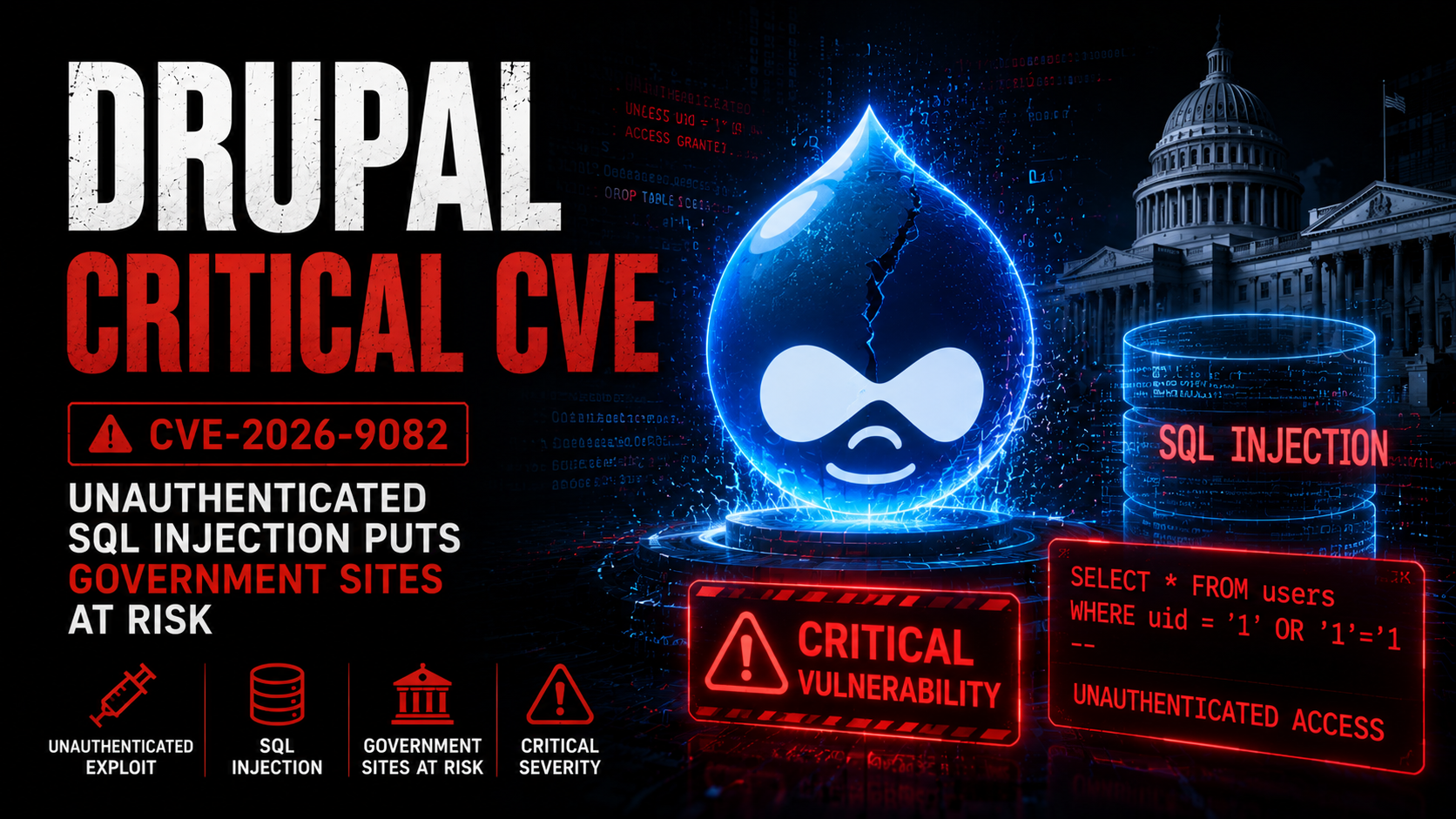
Drupal CVE-2026-9082: Unauthenticated SQL Injection in Core — Government and University Sites at Immediate Risk
Table of Contents
Table of Contents
On May 20, 2026, Drupal’s security team released an emergency patch for what it classified as a “highly critical” SQL injection vulnerability in Drupal core — scoring 20 out of 25 on Drupal’s own risk scale. The flaw, tracked as CVE-2026-9082 and advisory SA-CORE-2026-004, allows an unauthenticated attacker — no login required — to inject malicious SQL directly into your database. The result: full read access to every record, ability to modify anything, and in many server configurations, remote code execution.
Drupal’s security team issued an unusual warning alongside the patch: working exploits could emerge within hours of public disclosure. That warning was issued on May 19. The patch dropped May 20. If you’re running Drupal and haven’t patched, this article is your alarm bell.
Why This Vulnerability Is Exceptionally Dangerous
Most SQL injection vulnerabilities require some form of interaction with an authenticated user or a specific application path. CVE-2026-9082 has a scoring breakdown that makes it particularly frightening:
- Access complexity: Zero — there’s no special setup or timing required to exploit it
- Authentication required: None — any internet user can attempt the attack
- Confidentiality impact: Full — complete read access to the database
- Integrity impact: Full — ability to modify any database record
- Availability impact: Full — depending on server configuration, attackers may be able to destroy data
The vulnerability lives in Drupal’s core database abstraction layer — the code that sits between the application and the database, used by virtually every Drupal installation globally. This is not a module vulnerability or a contributed package issue; it’s in Drupal core itself.
The flaw specifically affects PostgreSQL-backed Drupal sites, though its scope on MySQL/MariaDB installations requires testing per-site. Given that many government and university deployments of Drupal use PostgreSQL for its compliance properties, this is particularly concerning for high-value targets.
Who Is at Risk: Government and University Sites
Drupal powers some of the highest-value targets on the internet. According to web platform statistics, Drupal runs approximately 1.5% of all websites — but that percentage vastly undersells its importance among enterprise and institutional deployments:
- The majority of US federal government agency websites run Drupal
- Hundreds of university and research institution websites worldwide use Drupal
- Many national health services, financial regulators, and international organizations use Drupal
- Large media organizations (the Economist, Grammy Awards, etc.) run on Drupal
An unauthenticated SQL injection in Drupal core is essentially a master key to any vulnerable government database running on Drupal — citizen data, procurement records, personnel files. Security researchers noted that the exploit surface includes sites running Drupal 10.4 through 11.3, plus EOL Drupal 8 and 9 installations that received emergency best-effort patches.
The Timeline: Patch Before Exploits Drop
Drupal’s security team handled the disclosure process carefully, using what’s known as a “pre-announcement” approach:
- May 19, 2026: Drupal publishes a pre-announcement warning administrators to “clear their calendar” and prepare for a critical patch on May 20
- May 20, 2026 (17:00–21:00 UTC): Security updates released for all supported Drupal branches
- Security team warning: Working exploits could emerge within hours or days of patch release
This pre-announcement gives administrators time to prepare for an emergency maintenance window. But it also telegraphs to attackers that a critical vulnerability is coming — creating a race between defenders patching and attackers reverse-engineering the patch to develop exploits.
The May 20 patch release date means that as of May 21, the clock is ticking for exploit development. Security researchers who specialize in vulnerability research typically can reverse-engineer a patch and develop a working proof-of-concept within 24–72 hours for a flaw of this type. That window has now opened.
How to Patch: Step-by-Step
Drupal administrators should prioritize this patch above all other maintenance tasks. Here’s the remediation path:
# Update using Composer (recommended for most installations)
composer update drupal/core drupal/core-recommended

# Or using Drush
drush updb && drush cr

# Verify your Drupal version after update
drush core-status | grep Drupal
Patched versions to target:
- Drupal 11: Update to 11.3.x latest or 11.2.x security release
- Drupal 10: Update to 10.4.x or 10.3.x security release
- Drupal 9 (EOL): Best-effort patch available — upgrade to Drupal 10 as priority
- Drupal 8 (EOL): Best-effort patch available — site is end-of-life and should be migrated urgently
Temporary Mitigations If Immediate Patching Isn’t Possible
If you cannot patch immediately due to change control requirements or complex Drupal installations, implement these mitigations as stopgaps:
- Web Application Firewall (WAF): Enable SQL injection blocking rules. Cloudflare, AWS WAF, and ModSecurity all have rulesets that can block common SQL injection patterns
- Database user privileges: Ensure your Drupal database user has minimum necessary privileges — remove DROP and ALTER permissions if not required
- Block suspicious request patterns: Monitor for unusual POST requests to Drupal endpoints with SQL-like strings in parameters
- Take the site offline: For high-security installations managing sensitive data, taking the site offline until patching is complete may be the appropriate risk decision
The Pattern: Open Source CMS Vulnerabilities Are High-Value Targets
Drupal has a strong security track record relative to WordPress — its security team is professional, disclosure processes are disciplined, and the codebase receives careful review. But no software is immune. Earlier this year, a critical WordPress plugin vulnerability allowed attackers to skim 40,000+ WooCommerce checkouts before it was patched.
The broader lesson: content management systems that power significant portions of critical infrastructure require the same security discipline as enterprise software. Automated patch monitoring, rapid deployment pipelines, and WAF coverage should be standard for any Drupal installation managing sensitive data.
If you’re running Drupal, treat CVE-2026-9082 as an immediate incident response situation. The patch is available. The exploit clock is running. Don’t wait for your monthly maintenance window.
Sources: SecurityWeek — Drupal critical patch | The Register — Drupal emergency patch | Cyber Kendra — SQL injection details | The Hacker News — Drupal security release