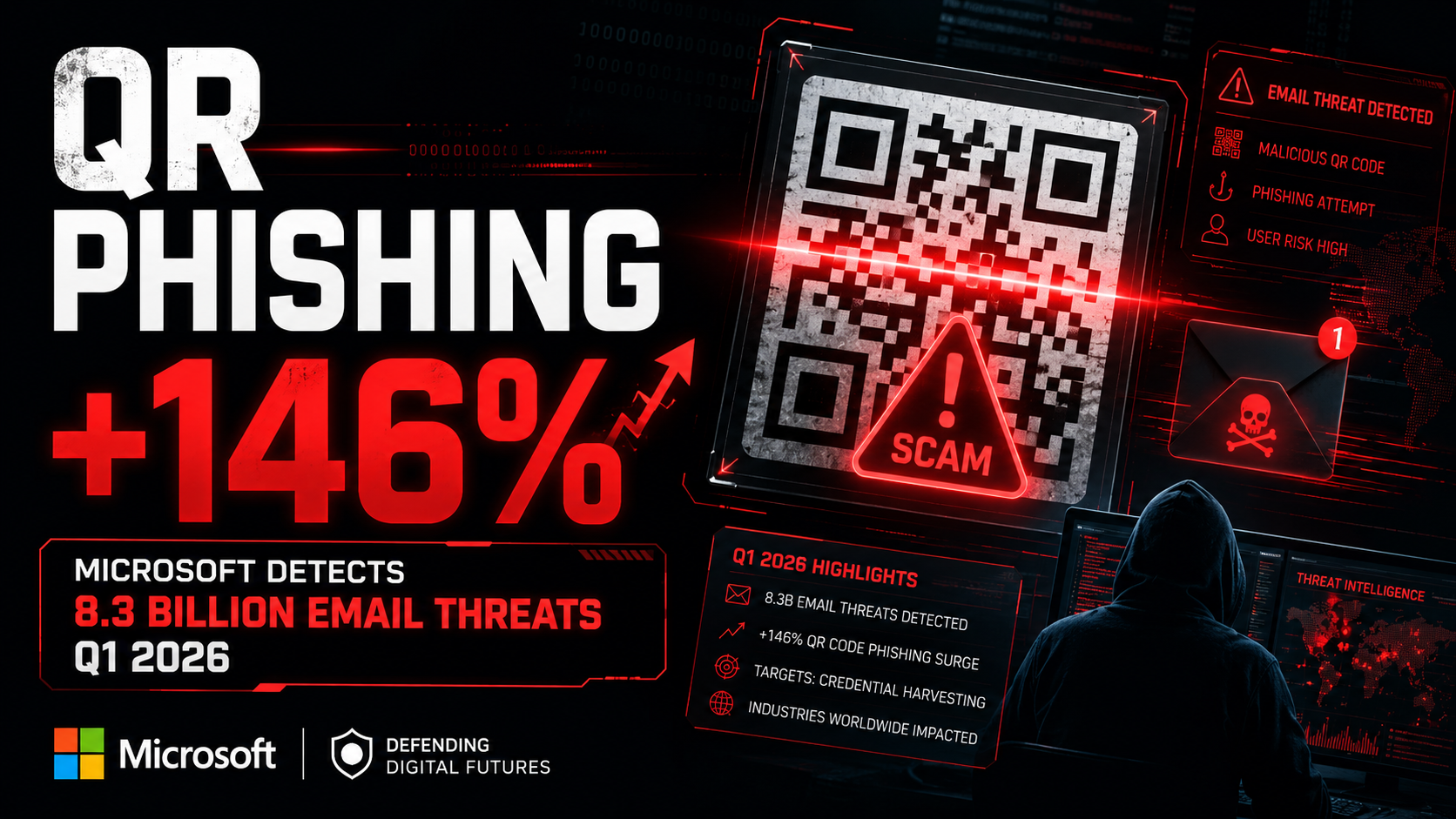
QR Code Phishing Surges 146%: Microsoft Detects 8.3 Billion Email Threats in Q1 2026
Table of Contents
Table of Contents
Microsoft’s security team just dropped a number that should make every IT administrator sit up straight: in just the first quarter of 2026, Microsoft detected and analyzed 8.3 billion email phishing threats. That’s not a typo. In three months, Microsoft’s systems processed more phishing attempts than there are humans on Earth. And buried in that staggering figure is an even more alarming trend: QR code phishing attacks surged 146% over the quarter, with a new variant emerging that bypasses virtually every traditional email security tool in existence.
The report, published in Microsoft’s Q1 2026 Email Threat Landscape analysis, documents a fundamental shift in how phishers operate — and it has major implications for organizations still relying on legacy email security approaches.
The QR Code Phishing Explosion: 146% in One Quarter
QR code phishing — also called “quishing” — attacks grew from 7.6 million in January 2026 to 18.7 million in March 2026. That’s a 146% increase in a single quarter. The trajectory suggests Q2 could be even worse.
The mechanics are simple but devastatingly effective. Instead of embedding a malicious hyperlink in an email — which security tools can scan and flag — attackers embed a QR code. The QR code is just an image. Traditional email filters that analyze text and URLs can’t decode what’s inside that image. The malicious link is invisible to the security tools sitting between the attacker and the victim’s inbox.
The victim scans the QR code with their phone. This creates a second, critical problem: mobile devices typically operate outside the protected enterprise environment. On a work laptop, a malicious link might be blocked by endpoint security. On a personal iPhone or Android device, those protections often don’t exist. The attacker has effectively moved the target from a hardened desktop environment to an unprotected mobile device — and done it invisibly.
The March Escalation: QR Codes in Email Bodies
The most alarming development in Microsoft’s report is what happened in March: QR codes embedded directly in email bodies surged 336% in a single month. While this variant represents only 5% of total QR phishing volume, the 336% monthly spike signals a deliberate tactical shift.
Previous QR code attacks typically delivered the code inside a PDF attachment, adding one layer of friction for the victim. The new approach puts the QR code directly in the email — one scan, no download required. Fewer steps means higher conversion rates for attackers.
By March 2026, 70% of QR phishing codes were being delivered via PDF attachments, with the remainder coming via email bodies, Word documents, and other vectors. The diversification of delivery methods makes detection significantly harder — security teams can’t simply block PDFs or emails with attached images without disrupting legitimate business communications.
CAPTCHA-Gated Attacks: 125% Surge in March
QR codes aren’t the only evasion technique seeing explosive growth. CAPTCHA-gated phishing — attacks where the victim must solve a CAPTCHA before reaching the malicious payload — surged 125% in March alone, reaching 11.9 million attacks. That’s the highest monthly volume in over a year.
The CAPTCHA gate serves a specific purpose: automated security scanning tools can’t solve CAPTCHAs. When a security crawler follows a suspicious link to check if it leads to a phishing page, it hits the CAPTCHA, can’t proceed, and reports the link as clean. The malicious page is only visible to human victims who actually click through.
This is a sophisticated form of evasion that treats security automation as the adversary — and it’s working. Microsoft’s Digital Crimes Unit, working with Europol, took action in early March 2026 to disrupt Tycoon2FA, one of the most prolific CAPTCHA-gated phishing-as-a-service platforms, significantly impairing its hosting capabilities. But copycat services are already filling the void.
Why Traditional Email Security Is Losing
The convergence of QR code evasion and CAPTCHA gating reveals a fundamental problem: most enterprise email security was designed to detect threats that look like threats. Malicious links that point to known bad domains. Attachments with known malware signatures. Suspicious sender addresses.
None of those detection mechanisms work when:
- The malicious URL is encoded in a QR code image that security tools can’t decode
- The phishing page is hidden behind a CAPTCHA that bots can’t bypass
- The attack moves the victim to a mobile device outside enterprise security controls
- The malicious domain was registered minutes before the attack (too new for reputation databases)
Traditional signature-based and reputation-based email security is fighting a battle it was never designed to win against these techniques. This mirrors the broader trend documented in the Mandiant M-Trends 2026 report, where AI-assisted attack automation is outpacing defensive tooling.
The Real-World Impact: What Happens When Employees Get Phished
The ultimate goal of most phishing campaigns in 2026 is credential theft for initial access. A successful QR phishing attack typically results in the victim entering their corporate credentials on a lookalike login page. Those credentials are then used by the attacker to:
- Access corporate email and exfiltrate sensitive data
- Move laterally within the corporate network using VPN or remote desktop access
- Conduct business email compromise (BEC) attacks — impersonating executives to redirect payments
- Deploy ransomware after establishing a persistent foothold
The Tycoon2FA platform that Microsoft helped disrupt was specifically designed to defeat multi-factor authentication through adversary-in-the-middle techniques — meaning even organizations with MFA enabled were vulnerable. The sophistication of modern phishing infrastructure makes it genuinely difficult for even security-conscious employees to identify attacks.
What Microsoft Recommends (and What Actually Works)
Microsoft’s Q1 2026 report includes specific defensive recommendations that security teams should prioritize immediately:
Enable Zero-Hour Auto Purge (ZAP): ZAP allows Microsoft 365 to retroactively remove phishing emails from inboxes after they’ve been delivered but before users interact with them — critical for catching QR code attacks that evade initial filtering.
Deploy QR code scanning capabilities: Legacy email security tools can’t decode QR codes. Modern security tools with image analysis and QR code decoding can extract the embedded URL for inspection before delivery. This is now an essential capability, not a nice-to-have.
Implement FIDO2 passwordless authentication: Phishing-resistant authentication using hardware security keys or passkeys cannot be stolen through a credential phishing attack — even if an employee is deceived into entering their “password” on a fake login page, there’s no password to steal.
Mobile device management for personal devices: Since QR code attacks specifically target mobile devices to escape enterprise security, extending security coverage to employee phones — through MDM enrollment or conditional access policies — is increasingly necessary.
For organizations that still haven’t implemented basic security hygiene, the phishing epidemic described in this report should be a wake-up call. Check our cybersecurity resources for practical guides on hardening your email security posture.
The Bigger Picture: Attackers Are Winning the Automation Race
8.3 billion phishing threats in 90 days works out to roughly 92 million phishing attempts per day, every day. The volume is only possible because attackers have industrialized their operations — using AI to generate convincing phishing content at scale, automation to distribute it, and criminal infrastructure services like Tycoon2FA to handle the technical complexity.
The defenders are playing whack-a-mole at a rate that’s becoming humanly impossible. Microsoft’s automated systems catch billions of these attacks — but the ones that get through are increasingly sophisticated, specifically designed to evade detection, and delivered at a volume that guarantees some percentage will reach their intended victims.
QR code phishing surging 146% in a single quarter isn’t a blip — it’s a structural shift in how attackers operate. Organizations that haven’t updated their email security to address QR code and CAPTCHA-gated attacks are operating with a significant and growing blind spot.
Sources: Microsoft Security Blog, TechRadar, SC World, SQ Magazine