Top 10 Open Source Tools Blowing Up in 2026 (You’re Missing Out)
2026 is not just another year for open source — it is the year the entire ecosystem shifted. AI agents went mainstream, self-hosting became effortless, and tools that were niche GitHub experiments a year ago now have hundreds of thousands of stars and millions of users. If you are still relying on the same stack you used in 2024, you are leaving massive productivity gains on the table.
We tracked GitHub stars, community momentum, real-world adoption, and developer sentiment to identify the 10 open source tools that are genuinely reshaping how software gets built in 2026. These are not theoretical “cool projects” — these are tools developers are actually shipping with every single day.
1. n8n — AI Workflow Automation
GitHub Stars: 188,000+ | Category: Automation | Website: n8n.io
n8n is the open source workflow automation platform that finally made tools like Zapier and Make feel outdated. While those proprietary platforms charge per task and limit what you can do, n8n lets you build unlimited workflows — including full AI agent pipelines — on your own server for free.
What made n8n explode in 2026 is its AI agent capabilities. You can build autonomous agents that read emails, summarize documents, query databases, call APIs, and take action — all through a visual drag-and-drop interface. No coding required for simple workflows, but developers can drop into JavaScript or Python nodes for complex logic.
The numbers speak for themselves: 188K+ GitHub stars, $180 million Series C at a $2.5 billion valuation, 200,000+ users, and over $40 million in ARR. n8n is not a weekend project anymore — it is enterprise-grade infrastructure that companies like Delivery Hero, Pearson, and Sentry rely on daily.
Why it is trending: AI workflow automation hit an inflection point. Every company wants to automate repetitive tasks with LLMs, and n8n is the most mature open source platform to do it. Self-host it on a $6/month VPS and save thousands compared to Zapier.
2. Ollama — Run LLMs Locally
GitHub Stars: 136,000+ | Category: AI / Local LLM | Website: ollama.com
Ollama turned running large language models on your laptop from a nightmare of dependencies, CUDA configs, and quantization scripts into a single command: ollama run llama3. That is it. You are running a 70-billion parameter model locally. No API keys, no cloud costs, no data leaving your machine.
In 2026, Ollama supports every major open model: Llama 3.2, Mistral, Gemma 2, DeepSeek, Phi-4, and dozens more. It handles model management, GPU acceleration, and an OpenAI-compatible API server out of the box. Developers use it as a drop-in local replacement for OpenAI in their applications — swap the base URL and your code works with zero other changes.
The growth has been staggering: 261% star growth and counting. Ollama crossed 136K stars and became one of the fastest-growing repositories in GitHub history. It powers local AI for everything from privacy-conscious chatbots to offline code assistants.
Why it is trending: Privacy concerns, API costs, and the desire to run AI without vendor lock-in. Ollama made local LLMs accessible to every developer, not just ML engineers.
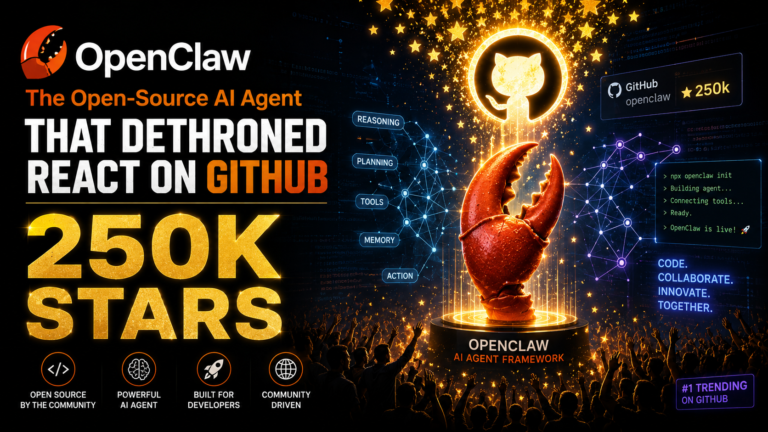
3. OpenClaw — Personal AI Assistant
GitHub Stars: 210,000+ | Category: AI Agent | Website: GitHub
OpenClaw is the breakout open source project of 2026 — arguably the fastest-growing GitHub repository in history. It went from 9,000 stars to over 60,000 in just days after going viral, and has since surpassed 210,000 stars. The concept is simple but powerful: a personal AI assistant that runs entirely on your own devices.
Unlike cloud-based assistants, OpenClaw operates as a local gateway that connects AI models to over 50 integrations: WhatsApp, Telegram, Slack, Discord, Signal, iMessage, email, calendars, and more. It can schedule meetings, draft messages, summarize conversations, manage tasks, and automate workflows — all without sending your data to a third party.
The explosive growth reflects a fundamental shift in what developers expect from AI tools: they want the power of GPT-level assistants with the privacy and control of self-hosted software. OpenClaw delivers exactly that.
Why it is trending: It hit the perfect intersection of AI capability and privacy. People want AI assistants that work across all their messaging platforms without a corporation reading every message.
4. Coolify — Self-Hosted PaaS
GitHub Stars: 40,000+ | Category: DevOps / Hosting | Website: coolify.io
Coolify is a self-hosted alternative to Heroku, Vercel, and Netlify. Point it at any VPS, connect your Git repository, and you get automatic deployments, SSL certificates, database provisioning, and monitoring — the same experience as a managed platform, but on hardware you control.
A $6/month Hetzner VPS running Coolify handles what would cost $50-100/month on managed platforms. For indie hackers, startups, and small teams, this changes the economics completely. You get unlimited projects, unlimited builds, and no per-seat pricing. The web UI is clean and intuitive — deploy a Node.js app, a PostgreSQL database, and a Redis cache in minutes through the dashboard.
Coolify supports Docker, Docker Compose, and Nixpacks for automatic build detection. It handles everything from static sites to complex multi-container applications. The community has built one-click installers for over 100 popular services including WordPress, Ghost, Plausible Analytics, and Supabase.
Why it is trending: Cloud costs keep rising and developers are tired of paying per-seat for basic hosting. Coolify gives you the DX of Vercel on a $6 VPS.
5. Appwrite — Backend as a Service
GitHub Stars: 49,000+ | Category: Backend Platform | Website: appwrite.io
Appwrite is an open source backend platform that provides authentication, databases, file storage, serverless functions, real-time subscriptions, and messaging — all in a single Docker container. Think Firebase, but self-hosted and without the vendor lock-in.
What sets Appwrite apart from competitors like Supabase and PocketBase is its breadth. Most backend-as-a-service tools excel at one thing (Supabase = Postgres, PocketBase = simplicity). Appwrite provides a complete backend with SDKs for every major platform: Web, Flutter, iOS, Android, React Native, and 12+ server-side languages.
The developer experience is polished. The admin console lets you manage users, view database collections, browse file storage, and monitor function executions through a beautiful web UI. For teams that want to move fast without building infrastructure from scratch, Appwrite is the fastest path from idea to production.
Why it is trending: The “own your backend” movement gained serious momentum. Developers want Firebase-level convenience without Google-level lock-in, and Appwrite delivers exactly that.
6. shadcn/ui — Copy-Paste Components
GitHub Stars: 40,000+ | Category: UI Components | Website: ui.shadcn.com
shadcn/ui broke the traditional component library model. Instead of installing a package that you cannot customize, shadcn/ui gives you copy-paste React components built on Tailwind CSS and Radix UI primitives. You own the code. You customize everything. No dependency to update, no breaking changes from upstream.
This approach resonated so deeply with the React community that shadcn/ui has become the de facto standard for new React projects in 2026. The component quality is exceptional — accessible by default, responsive, dark mode ready, and beautiful. Buttons, dialogs, forms, tables, dropdowns, command palettes, date pickers, and dozens more components are available and endlessly customizable.
The ecosystem around shadcn/ui has exploded: Magic UI adds animated components, Aceternity UI brings stunning visual effects, and hundreds of community-built themes and extensions exist. It changed how developers think about UI libraries.
Why it is trending: Developers were tired of fighting opinionated component libraries. shadcn/ui said “just copy the code” and that simplicity won everyone over.
7. Composio — AI Agent Integrations
GitHub Stars: 25,000+ | Category: AI / Integrations | Website: composio.dev
Composio solves the integration problem for AI agents. When you build an agent with LangChain, CrewAI, or any other framework, you inevitably need it to interact with real-world tools: GitHub, Slack, Jira, Gmail, Google Drive, Notion, Salesforce. Composio provides 100+ pre-built, production-ready integrations through a standard function-calling interface that any LLM can use.
Without Composio, connecting an AI agent to GitHub means writing OAuth flows, handling token refresh, mapping API endpoints to function schemas, and managing error handling — for one integration. Composio handles all of that. You declare which tools your agent needs, Composio provides the function schemas, and the LLM calls them naturally.
The tool handles authentication (OAuth, API keys), rate limiting, error handling, and schema generation automatically. It works with OpenAI, Anthropic, Google, and any OpenAI-compatible local model. For teams building production AI agents, Composio eliminates weeks of integration work.
Why it is trending: Everyone is building AI agents, and everyone hits the same wall: connecting agents to real tools is painful. Composio removes that pain.
8. LangChain — LLM Application Framework
GitHub Stars: 100,000+ | Category: AI Framework | Website: langchain.com
LangChain is the standard framework for building applications powered by large language models. It provides abstractions for prompt management, chain composition, memory, agents, and retrieval-augmented generation (RAG). If you are building anything beyond a simple chatbot with an LLM, you have probably used or evaluated LangChain.
In 2026, LangChain matured significantly. LangGraph — its agent orchestration framework — became the go-to solution for building multi-step, stateful AI agents. LangSmith provides observability and evaluation for LLM applications. The ecosystem is comprehensive: chains for every major LLM provider, document loaders for 200+ formats, vector store integrations, and retrieval strategies.
LangChain is available in Python and JavaScript (LangChain.js), making it accessible to both ML engineers and web developers. The JavaScript version integrates naturally with Node.js backends and can even run in the browser for lightweight applications.
Why it is trending: LangChain became the React of AI development — it is the default starting point. Whether you stick with it or eventually outgrow it, learning LangChain teaches you the patterns of LLM application development.
9. Activepieces — Open Source Zapier
GitHub Stars: 15,000+ | Category: Automation | Website: activepieces.com
Activepieces is the fastest-growing open source alternative to Zapier in 2025-2026. While n8n targets power users and developers, Activepieces focuses on simplicity — its drag-and-drop builder is clean enough for non-technical team members to build automations without help.
The platform supports 200+ integrations and growing. It connects your CRM to your email marketing, syncs form submissions to spreadsheets, posts Slack notifications when GitHub issues are created, and handles hundreds of other common automation patterns. The open source version is fully featured — no artificial limits on workflows or executions.
What makes Activepieces stand out is its approach to AI. Built-in AI actions let you add GPT-powered steps to any workflow: summarize incoming support tickets, classify emails, generate responses, extract data from documents. For teams that want workflow automation with AI capabilities but find n8n too complex, Activepieces is the answer.
Why it is trending: It is the most approachable open source automation platform. Teams that cannot justify Zapier’s pricing or n8n’s learning curve land on Activepieces.
10. Zed — Next-Gen Code Editor
GitHub Stars: 55,000+ | Category: Developer Tools | Website: zed.dev
Zed is a high-performance code editor built from scratch in Rust by the original creators of Atom. It is not just another VS Code clone — Zed is designed around two principles: speed and collaboration. Every interaction is instant. File switching, search, code completion, and rendering are faster than any other editor because Zed uses the GPU for rendering and Rust for everything else.
In 2026, Zed became the most starred open source project from a startup on GitHub. Its real-time collaboration features rival Google Docs — multiple developers can edit the same file simultaneously with zero lag. Built-in AI assistance connects to any LLM provider (OpenAI, Anthropic, local models via Ollama) for inline code generation and chat.
Zed supports VS Code extensions through a compatibility layer, TreeSitter for syntax highlighting, LSP for language support, and a growing ecosystem of native extensions. For developers frustrated with VS Code’s Electron-based sluggishness, Zed feels like stepping into the future.
Why it is trending: Developers want speed. Zed is 10x faster than VS Code for large projects, has native collaboration, and AI built in from day one. The Rust community rallied behind it hard.
Why These Tools Matter
Look at the pattern across these 10 tools. Three themes dominate 2026 open source:
AI is everywhere. Six of the ten tools are AI-related or have deep AI integration. n8n, Ollama, OpenClaw, Composio, LangChain, and Zed all center around making AI practical for real work — not demos, not toys, but production systems. The open source community is not waiting for Big Tech to decide how AI should work. They are building the tools themselves.
Self-hosting is back. Coolify, Appwrite, n8n, and Activepieces all let you run production infrastructure on your own hardware. Cloud costs are rising, privacy regulations are tightening, and the tooling for self-hosting has become genuinely excellent. A $6/month VPS with Coolify and Appwrite gives you what used to require $200/month in managed services.
Developer experience wins. shadcn/ui, Zed, Ollama, and Activepieces all gained traction by being dramatically easier to use than their alternatives. The projects that grow fastest in 2026 are the ones that respect developers’ time. Complex setup processes, poor documentation, and confusing APIs are no longer tolerated when a better alternative is one npm install or docker compose up away.
Every tool on this list is free to use, open to contribute to, and actively maintained by passionate communities. If you have not tried any of them yet, start with the one closest to a problem you are actually facing. That is the beauty of open source in 2026 — the best tools in the world cost nothing, and they are only getting better.