C++ Multiple Inheritance & Virtual Inheritance: Complete Guide
What Is Multiple Inheritance?
Multiple inheritance means a class inherits from more than one base class. C++ is one of the few mainstream languages that supports this — Java, C#, and Python (with some caveats) do not allow inheriting implementation from multiple classes.
The idea is appealing: a FlyingCar inherits from both Car and Aircraft. A TeachingAssistant inherits from both Student and Employee. But multiple inheritance introduces serious complications — ambiguity, duplication, and the infamous diamond problem. This is why most languages banned it.
C++ keeps it available because there are legitimate use cases, particularly inheriting from multiple abstract interfaces. This lesson covers the mechanics, pitfalls, and the correct way to use multiple inheritance.
Basic Multiple Inheritance
#include <iostream>
#include <string>
using namespace std;

class Printer {
public:
    void print(const string& text) const {
        cout << "[Print] " << text << endl;
    }
};

class Scanner {
public:
    void scan() const {
        cout << "[Scan] Scanning document..." << endl;
    }
};

class Fax {
public:
    void fax(const string& number) const {
        cout << "[Fax] Sending to " << number << endl;
    }
};

// MultiFunctionDevice inherits from all three
class MultiFunctionDevice : public Printer, public Scanner, public Fax {
public:
    void copyDocument() {
        scan();
        print("Scanned document");
    }
};

int main() {
    MultiFunctionDevice mfd;
    mfd.print("Hello");       // from Printer
    mfd.scan();               // from Scanner
    mfd.fax("555-0123");      // from Fax
    mfd.copyDocument();       // uses both scan and print
    return 0;
}
This works cleanly because the three base classes are completely independent — no shared state, no overlapping methods. This is the ideal case for multiple inheritance.
The Diamond Problem
The diamond problem occurs when two base classes inherit from the same grandparent:
#include <iostream>
using namespace std;

class Animal {
public:
    string name;
    Animal(string n) : name(n) {
        cout << "Animal(" << name << ")" << endl;
    }
    void eat() const { cout << name << " eats" << endl; }
};

class Bird : public Animal {
public:
    Bird(string n) : Animal(n) { cout << "Bird" << endl; }
    void fly() const { cout << name << " flies" << endl; }
};

class Fish : public Animal {
public:
    Fish(string n) : Animal(n) { cout << "Fish" << endl; }
    void swim() const { cout << name << " swims" << endl; }
};

class FlyingFish : public Bird, public Fish {
public:
    FlyingFish(string n) : Bird(n), Fish(n) {
        cout << "FlyingFish" << endl;
    }
};

int main() {
    FlyingFish ff("Nemo");
    // ff.eat();   // ERROR: ambiguous — Bird::eat or Fish::eat?
    // ff.name;    // ERROR: ambiguous — Bird::name or Fish::name?

    ff.Bird::eat();    // OK: explicitly choose
    ff.Fish::eat();    // OK: explicitly choose
    ff.fly();
    ff.swim();
    return 0;
}
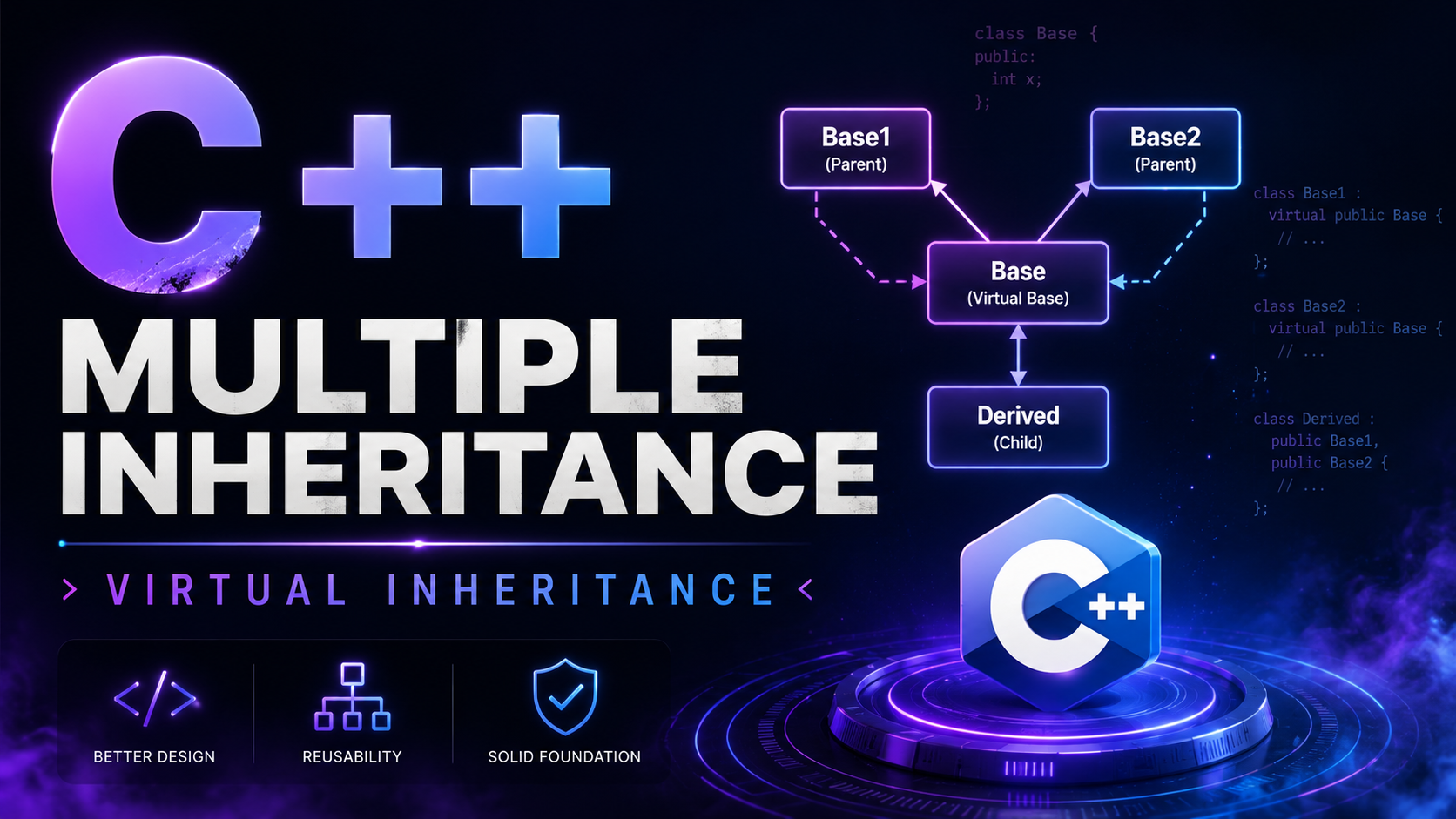
The hierarchy forms a diamond: Animal → Bird → FlyingFish and Animal → Fish → FlyingFish. The FlyingFish contains two separate copies of Animal — one from Bird and one from Fish. Calling eat() is ambiguous: which Animal‘s eat()? Which name?
The output of construction also reveals the duplication:
Animal(Nemo)     ← Bird's copy of Animal
Bird
Animal(Nemo)     ← Fish's copy of Animal
Fish
FlyingFish
Two Animal objects exist inside one FlyingFish. This is wasteful and logically wrong — a flying fish is one animal, not two.
Virtual Inheritance
Virtual inheritance solves the diamond problem by ensuring only one shared copy of the common base class exists:
#include <iostream>
using namespace std;

class Animal {
public:
    string name;
    Animal(string n = "") : name(n) {
        cout << "Animal(" << name << ")" << endl;
    }
    void eat() const { cout << name << " eats" << endl; }
};

// Virtual inheritance: only ONE Animal subobject in any diamond
class Bird : virtual public Animal {
public:
    Bird(string n) : Animal(n) { cout << "Bird" << endl; }
    void fly() const { cout << name << " flies" << endl; }
};

class Fish : virtual public Animal {
public:
    Fish(string n) : Animal(n) { cout << "Fish" << endl; }
    void swim() const { cout << name << " swims" << endl; }
};

class FlyingFish : public Bird, public Fish {
public:
    // With virtual inheritance, the MOST DERIVED class
    // must initialize the virtual base directly
    FlyingFish(string n) : Animal(n), Bird(n), Fish(n) {
        cout << "FlyingFish" << endl;
    }
};

int main() {
    FlyingFish ff("Nemo");

    ff.eat();    // No ambiguity — only one Animal
    ff.fly();
    ff.swim();
    cout << ff.name << endl;  // No ambiguity — one name

    return 0;
}
Output:
Animal(Nemo)     ← only ONE Animal now
Bird
Fish
FlyingFish
Key rules for virtual inheritance:
- Use
virtual public(orvirtual protected) in the intermediate classes (BirdandFish) - The most derived class (
FlyingFish) must directly initialize the virtual base (Animal) in its member initializer list, even though it is not a direct parent - If
FlyingFishdoes not initializeAnimal, the default constructor is called (which may not exist)
Constructor and Destructor Order
With virtual inheritance, the construction order changes. Virtual bases are always constructed first, before any non-virtual bases:
#include <iostream>
using namespace std;

class A {
public:
    A() { cout << "A "; }
    ~A() { cout << "~A "; }
};

class B : virtual public A {
public:
    B() { cout << "B "; }
    ~B() { cout << "~B "; }
};

class C : virtual public A {
public:
    C() { cout << "C "; }
    ~C() { cout << "~C "; }
};

class D : public B, public C {
public:
    D() { cout << "D "; }
    ~D() { cout << "~D "; }
};

int main() {
    D d;
    cout << endl;
    return 0;
}
// Construction: A B C D
// Destruction:  ~D ~C ~B ~A
Virtual base A is constructed once, before B and C. Without virtual inheritance, A would be constructed twice (once for B, once for C).
Ambiguity Resolution
When two base classes have methods with the same name, you must resolve the ambiguity:
#include <iostream>
using namespace std;

class Screen {
public:
    void draw() const { cout << "Drawing to screen" << endl; }
    void refresh() const { cout << "Refreshing screen" << endl; }
};

class Audio {
public:
    void play() const { cout << "Playing audio" << endl; }
    void refresh() const { cout << "Refreshing audio buffer" << endl; }
};

class MediaPlayer : public Screen, public Audio {
public:
    // Option 1: Override to resolve ambiguity
    void refresh() const {
        Screen::refresh();   // explicitly call both
        Audio::refresh();
    }

    // Can also expose specific versions
    using Screen::draw;     // bring draw into scope
    using Audio::play;      // bring play into scope
};

int main() {
    MediaPlayer mp;
    mp.draw();              // from Screen
    mp.play();              // from Audio
    mp.refresh();           // calls both
    mp.Screen::refresh();   // explicit: only screen
    return 0;
}
Three strategies for resolving ambiguity: qualify with Base::, use a using declaration to bring one version into scope, or override the function to combine both behaviors.
Multiple Interfaces (the Safe Use Case)
The safest and most common use of multiple inheritance is implementing multiple interfaces (abstract classes with only pure virtual functions):
#include <iostream>
#include <string>
#include <vector>
#include <memory>
using namespace std;

// Pure interfaces — no data, no state conflicts
class Drawable {
public:
    virtual void draw() const = 0;
    virtual ~Drawable() = default;
};

class Clickable {
public:
    virtual void onClick() = 0;
    virtual bool containsPoint(int x, int y) const = 0;
    virtual ~Clickable() = default;
};

class Resizable {
public:
    virtual void resize(int w, int h) = 0;
    virtual ~Resizable() = default;
};

// Implements all three interfaces
class Button : public Drawable, public Clickable, public Resizable {
    string label;
    int x, y, w, h;

public:
    Button(string lbl, int x, int y, int w, int h)
        : label(lbl), x(x), y(y), w(w), h(h) {}

    void draw() const override {
        cout << "[Button: " << label << "] at (" << x << "," << y
             << ") " << w << "x" << h << endl;
    }

    void onClick() override {
        cout << "Button '" << label << "' clicked!" << endl;
    }

    bool containsPoint(int px, int py) const override {
        return px >= x && px <= x + w && py >= y && py <= y + h;
    }

    void resize(int newW, int newH) override {
        w = newW; h = newH;
        cout << "Button resized to " << w << "x" << h << endl;
    }
};

// Functions work with specific interfaces
void render(const vector<const Drawable*>& items) {
    for (const auto* item : items) item->draw();
}

void handleClick(Clickable& item, int x, int y) {
    if (item.containsPoint(x, y)) item.onClick();
}

int main() {
    Button btn("Submit", 10, 20, 100, 40);

    btn.draw();
    handleClick(btn, 50, 30);  // inside button → clicks
    handleClick(btn, 200, 200); // outside → nothing
    btn.resize(150, 50);

    return 0;
}
This is clean and safe. Each interface defines a capability. Button is Drawable, Clickable, and Resizable. No diamond problem because interfaces have no data. This is the pattern Java and C# adopted with their interface keyword.
Mixins
A mixin is a class that adds functionality through inheritance without being a standalone type. It is a reusable building block:
#include <iostream>
#include <string>
#include <chrono>
using namespace std;

// Mixin: adds timestamp tracking
class Timestamped {
protected:
    string createdAt;
    string updatedAt;
public:
    Timestamped() {
        createdAt = updatedAt = "2026-06-12T14:00:00Z";
    }
    void touch() { updatedAt = "2026-06-12T15:30:00Z"; }
    string getCreatedAt() const { return createdAt; }
    string getUpdatedAt() const { return updatedAt; }
};

// Mixin: adds tagging
class Taggable {
protected:
    vector<string> tags;
public:
    void addTag(const string& tag) { tags.push_back(tag); }
    bool hasTag(const string& tag) const {
        for (const auto& t : tags) if (t == tag) return true;
        return false;
    }
    void printTags() const {
        for (const auto& t : tags) cout << "[" << t << "] ";
        cout << endl;
    }
};

// Mixin: adds serialization ID
class Identifiable {
    static int nextId;
    int id;
public:
    Identifiable() : id(nextId++) {}
    int getId() const { return id; }
};
int Identifiable::nextId = 1;

// Combine mixins with a domain class
class BlogPost : public Timestamped, public Taggable, public Identifiable {
    string title, content;
public:
    BlogPost(string t, string c) : title(t), content(c) {}

    void print() const {
        cout << "Post #" << getId() << ": " << title << endl;
        cout << "Created: " << getCreatedAt() << endl;
        cout << "Tags: ";
        printTags();
    }
};

int main() {
    BlogPost post("C++ Multiple Inheritance", "A deep dive...");
    post.addTag("c++");
    post.addTag("oop");
    post.addTag("tutorial");
    post.touch();
    post.print();

    return 0;
}
Each mixin adds one orthogonal capability. BlogPost gains timestamps, tags, and a unique ID without any of those mixins knowing about each other. This is a practical and safe use of multiple inheritance.
When to Use Multiple Inheritance
Safe uses:
- Implementing multiple interfaces (abstract classes with no data)
- Mixins that add orthogonal capabilities without shared state
- Combining independent utility classes (like
Printer+Scanner)
Avoid:
- Inheriting from two classes that share a common base (diamond problem)
- Using multiple inheritance when composition would work
- Deep hierarchies with multiple paths to the same base
Red flags that suggest composition instead:
- You are using multiple inheritance to reuse code, not to model “is-a” relationships
- The base classes have overlapping method names or state
- You need virtual inheritance — it adds complexity and performance overhead
Alternatives to Multiple Inheritance
Composition: Instead of inheriting from multiple classes, hold them as members:
// Instead of: class FlyingCar : public Car, public Aircraft { };

class FlyingCar {
    Car car;        // has-a Car
    Aircraft jet;   // has-a Aircraft
public:
    void drive() { car.drive(); }
    void fly() { jet.fly(); }
};
CRTP (Curiously Recurring Template Pattern): Static mixins without virtual overhead:
template<typename Derived>
class Printable {
public:
    void print() const {
        cout << static_cast<const Derived*>(this)->toString() << endl;
    }
};

class Name : public Printable<Name> {
public:
    string toString() const { return "John"; }
};
// Name n; n.print(); → "John"
std::variant (C++17): Type-safe union as an alternative to polymorphic hierarchies for closed type sets.
Real-World Example: Stream Classes
The C++ standard library uses multiple inheritance with virtual inheritance for its stream hierarchy. Here is a simplified version:
#include <iostream>
#include <string>
#include <sstream>
using namespace std;

// Simplified stream hierarchy (mirrors std library design)
class StreamBase {
protected:
    bool good_ = true;
    int position_ = 0;
public:
    bool good() const { return good_; }
    int tellg() const { return position_; }
    virtual ~StreamBase() = default;
};

class InputStream : virtual public StreamBase {
public:
    virtual string read(int bytes) = 0;
    virtual string readLine() = 0;
};

class OutputStream : virtual public StreamBase {
public:
    virtual void write(const string& data) = 0;
    virtual void flush() = 0;
};

// iostream inherits from BOTH — diamond on StreamBase
class IOStream : public InputStream, public OutputStream {
    string buffer;
    int readPos = 0;
public:
    string read(int bytes) override {
        string result = buffer.substr(readPos, bytes);
        readPos += bytes;
        position_ = readPos;  // ONE shared position (virtual inheritance)
        return result;
    }

    string readLine() override {
        auto pos = buffer.find('\n', readPos);
        if (pos == string::npos) pos = buffer.size();
        string result = buffer.substr(readPos, pos - readPos);
        readPos = pos + 1;
        position_ = readPos;
        return result;
    }

    void write(const string& data) override {
        buffer += data;
        position_ = buffer.size();
    }

    void flush() override {
        cout << "[Flushed: " << buffer.size() << " bytes]" << endl;
    }

    string getBuffer() const { return buffer; }
};

int main() {
    IOStream stream;
    stream.write("Hello\nWorld\nC++\n");
    stream.flush();

    cout << "Line 1: " << stream.readLine() << endl;
    cout << "Line 2: " << stream.readLine() << endl;
    cout << "Position: " << stream.tellg() << endl;  // ONE position, not two
    cout << "Stream good: " << boolalpha << stream.good() << endl;

    return 0;
}
This mirrors how std::iostream inherits from both std::istream and std::ostream, which both virtually inherit from std::ios_base. Virtual inheritance ensures there is only one set of stream state (position, error flags) shared between input and output operations.
Practice Exercises
Exercise 1: Create a diamond hierarchy: Vehicle → LandVehicle and WaterVehicle → AmphibiousVehicle. First implement without virtual inheritance and observe the duplication. Then fix it with virtual inheritance.
Exercise 2: Create three interface classes: Loggable (virtual log()), Configurable (virtual configure()), and Monitorable (virtual healthCheck()). Implement a WebServer class that inherits all three. Write functions that accept each interface type.
Exercise 3: Build a mixin system: Cacheable (stores cached results), Retryable (retries failed operations), Measurable (tracks execution time). Create an ApiClient class that combines all three mixins.
Exercise 4: Refactor the FlyingCar diamond example to use composition instead of multiple inheritance. Compare the two approaches in terms of code clarity and flexibility.
Summary
Multiple inheritance lets a class inherit from more than one base. It is powerful but introduces the diamond problem — duplicate base subobjects when two parents share a grandparent. Virtual inheritance solves this by creating one shared copy of the common base, but adds complexity (the most derived class must initialize the virtual base). The safest use of multiple inheritance is implementing multiple interfaces (abstract classes with no data). Mixins are another practical pattern. When in doubt, prefer composition over multiple inheritance. In the next lesson, you will learn about exceptions — C++’s mechanism for handling errors by unwinding the call stack.