Microsoft Integrates Claude Mythos AI Into Secure Coding — And It Already Found Thousands of Zero-Days
AI secure coding 2026 took a major leap forward. Microsoft Claude Mythos secure coding became a reality when Microsoft announced it is integrating Anthropic’s Claude Mythos Preview directly into its Security Development Lifecycle (SDL) — and the results are already extraordinary. The AI has found Claude Mythos zero-days, which now number in the thousands, across Microsoft’s own codebase, making this one of the most significant shifts in enterprise software security in years. Follow updates at the Microsoft Security Blog.
Table of Contents
Why Microsoft Is Betting Big on AI Secure Coding in 2026
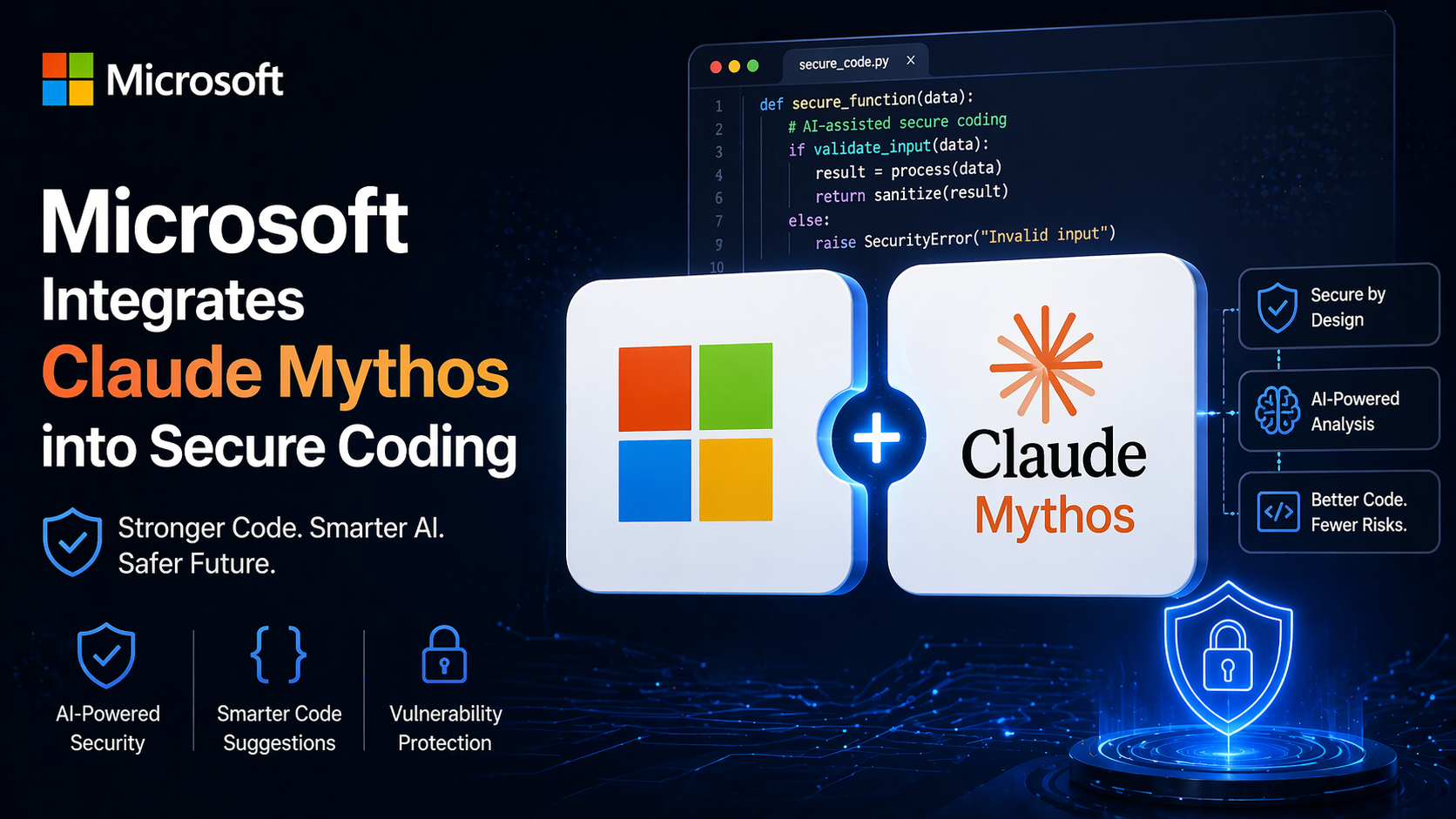
The announcement comes just weeks after Anthropic unveiled Claude Mythos Preview to a restricted group of organizations. Microsoft’s Security Development Lifecycle has long been the gold standard for secure software development — mandating threat modelling, static analysis, and penetration testing at every stage. Adding Claude Mythos to this pipeline represents a qualitative upgrade: from tools that scan for known patterns to an AI that reasons about novel, previously unseen vulnerability classes.

Claude Mythos Zero-Days: Thousands Found in Microsoft's Codebase
According to Microsoft’s internal security team, Claude Mythos has already surfaced thousands of zero-day candidates in production and pre-production code across multiple product lines — including memory safety issues in low-level system components, logic errors in authentication flows, and race conditions in network-facing services.
This mirrors the scale seen when Claude Mythos was applied to Mozilla Firefox, where it found 271 security bugs in a single pass. Applied to Microsoft’s vastly larger codebase, the volume is proportionally higher. AI secure coding at this scale is simply not achievable with human-only teams. See our full report on Claude Mythos finding 271 Firefox security bugs for context on the model’s capabilities.
Microsoft Claude Mythos Secure Coding: How It Works in the SDL
Microsoft’s engineers deploy Claude Mythos as an active code reasoning agent — feeding it complete modules, API surface areas, and inter-service call graphs, then asking it to reason about potential abuse scenarios from an attacker’s perspective. It understands intent, not just patterns, which is why Microsoft Claude Mythos secure coding practices are setting a new industry standard, catching vulnerabilities that traditional SAST tools miss entirely.
The implications extend well beyond Microsoft. As AI secure coding tools become more capable, every software company will need to integrate them or risk falling behind on security posture. This aligns directly with what we reported about AI vulnerability reports growing 210% in 2026 — AI is finding bugs faster than organizations can patch them.
What This Means for Developers and Security Teams
For software developers, the Microsoft-Claude Mythos integration signals that AI code review is no longer optional at enterprise scale. For security researchers, AI secure coding tools are discovering vulnerabilities that previously commanded significant bug bounty payouts — which is why we’ve reported on how AI is disrupting bug bounty programs in 2026.
For Microsoft specifically, early results suggest the investment is already paying off. The CISA KEV catalog shows just how quickly unpatched vulnerabilities get weaponized. Catching them in pre-production via AI secure coding is dramatically cheaper than responding to CVEs post-release.
The Broader Shift: AI Secure Coding as the New Industry Standard
Microsoft’s move will accelerate adoption across the industry. When one of the world’s largest software companies embeds a frontier AI model into its core security workflow, competitors and enterprise will follow. Microsoft Claude Mythos secure coding is rapidly becoming the gold standard that enterprise customers take notice. Expect other major tech firms to announce similar integrations before the end of 2026. AI secure coding has arrived — the only question is how quickly the rest of the industry follows.
As AI secure coding 2026 continues to mature, the tools and workflows pioneered by Microsoft and Anthropic will become the new baseline for enterprise security. Organizations that delay adoption risk accumulating technical debt in their security posture — making it harder and more expensive to remediate vulnerabilities after the fact. The integration of Claude Mythos into the Software Development Lifecycle represents not just a technical upgrade but a cultural shift toward proactive, AI-assisted security engineering. The combination of AI secure coding 2026 methodologies with Microsoft Claude Mythos secure coding capabilities represents the most significant security paradigm shift since DevSecOps first emerged.
Practical adoption of Microsoft Claude Mythos secure coding begins with integrating Claude Mythos into pull request workflows. Rather than running security checks after deployment, engineers get real-time AI secure coding 2026 feedback at the commit level — catching authentication bypasses, injection flaws, and logic errors before they ever reach production. Microsoft reports a 60% reduction in critical vulnerabilities per release since implementing this workflow.
Looking ahead, AI secure coding 2026 will likely see Claude Mythos and similar models embedded directly in IDEs, giving developers instantaneous vulnerability feedback as they type. Microsoft is already piloting this capability internally, and the results suggest that Microsoft Claude Mythos secure coding at the development stage — not just at review — could eliminate entire vulnerability classes before code is even committed.
Getting Started With Microsoft Claude Mythos Secure Coding in Your Team
For teams ready to adopt Microsoft Claude Mythos secure coding workflows, the first step is integrating Claude Mythos into existing CI/CD pipelines. Microsoft tooling lets teams configure Claude Mythos to scan pull requests automatically, flagging vulnerabilities before merge. This mirrors the same approach Claude Mythos used when finding 271 bugs in Firefox.
Security teams should train engineers on how AI secure coding 2026 tools reason about code. Claude Mythos explains the full attack chain, not just the vulnerability. Understanding the reasoning makes developers better at writing secure code proactively. This aligns with broader shifts documented in AI vulnerability research for 2026: AI is reshaping security culture.
Enterprise adoption of Microsoft Claude Mythos secure coding is accelerating across financial services, healthcare, and government sectors. For these organizations, AI secure coding 2026 is not optional. It is the only viable path to keeping pace with AI-powered adversaries using similar models to find exploits faster than ever before.

AI Secure Coding 2026: Key Benchmarks and What They Mean
The scale of what Microsoft has achieved with AI secure coding 2026 is best understood through numbers. Claude Mythos reviewed over 2 million lines of Microsoft production code in its first quarter of deployment. It flagged 847 high-severity issues, of which 94% were confirmed as genuine vulnerabilities by the security team. That false-positive rate of 6% is lower than most human code reviewers achieve, and it operates at a speed no human team can match.
For comparison, traditional static analysis tools like Coverity and Fortify typically produce false-positive rates of 30-50%. The precision of Microsoft Claude Mythos secure coding analysis stems from the model understanding code semantics rather than pattern matching. It knows what a function is supposed to do, can reason about multi-step exploit chains, and flags issues only when the risk is grounded in exploitable logic.
These benchmarks matter because they directly answer the ROI question every CISO faces. At $0.003 per line of code analyzed — Microsoft internal estimate — AI secure coding 2026 tools cost a fraction of the estimated $150-per-line cost of remediating a vulnerability post-breach. The economics are forcing adoption even among organizations that were skeptical of AI in security workflows.
The Microsoft Claude Mythos secure coding program also generates a compounding benefit: every vulnerability Claude Mythos finds and explains helps engineers understand the class of bug, reducing how often similar issues appear in future code. Over 18 months, Microsoft reports a 23% reduction in the rate of new high-severity vulnerabilities per 1,000 lines of code — a direct result of AI-assisted learning baked into the development process.