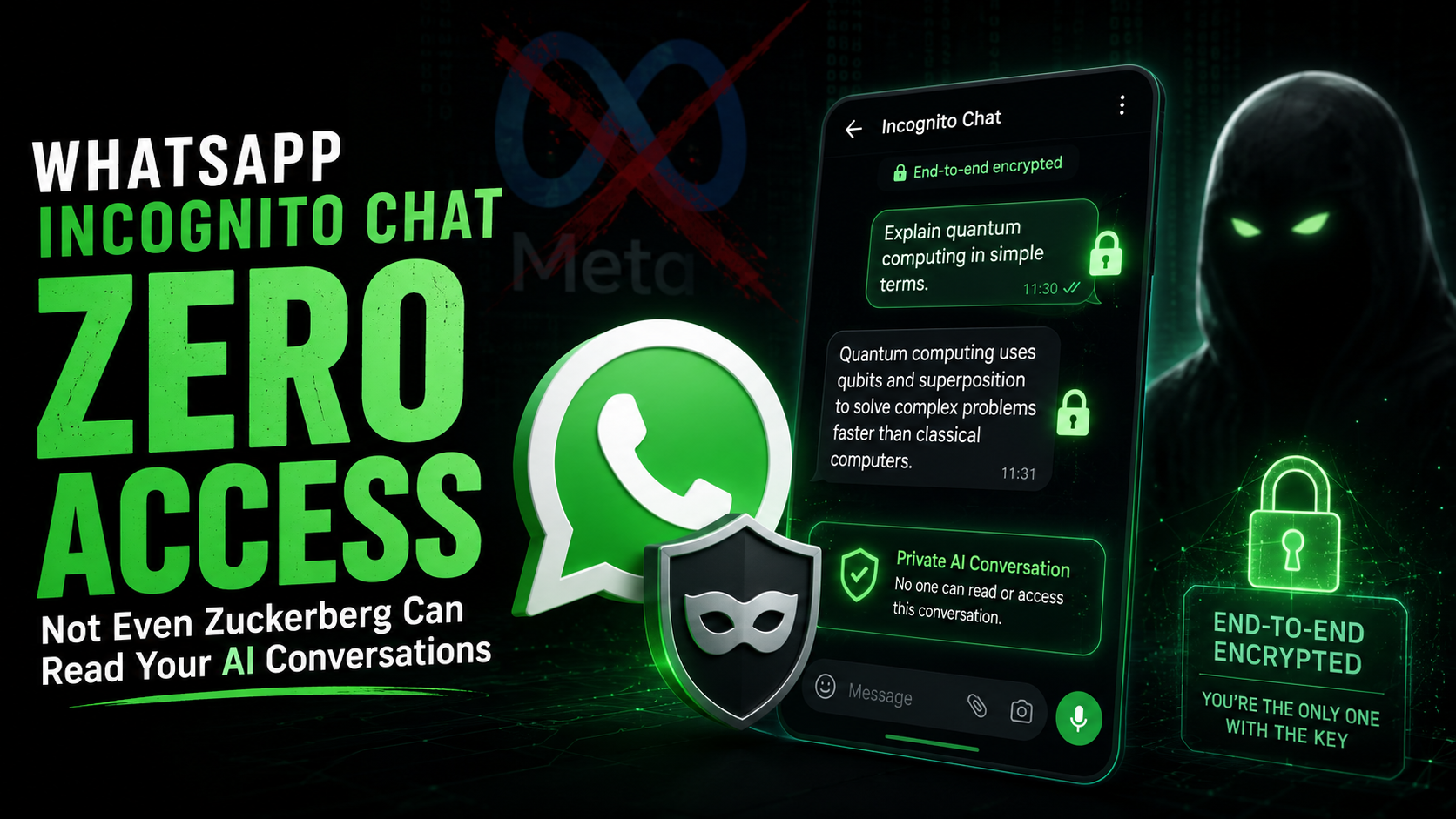
Meta’s WhatsApp Incognito Chat: Not Even Zuckerberg Can Read Your AI Conversations in 2026
Table of Contents
Table of Contents
Meta just did something remarkable: it built an AI chat mode that even Meta itself cannot read. WhatsApp Incognito Chat, announced on May 13, 2026, is a fully private conversation mode for Meta AI that processes your queries in a secure enclave, stores nothing permanently, and disappears the moment you close the chat. In an era when every AI company is mining conversation data for model training, Meta — the company best known for data collection — is now offering the most private AI experience in the mainstream market. That’s either a genuine privacy breakthrough or a masterful PR move. Possibly both.
The WhatsApp Incognito Chat launch is directly tied to what Meta calls “Private Processing” — a confidential computing architecture that the company says makes it technically impossible for Meta employees to access the contents of your AI conversations. The timing is significant: Meta is rolling this out just as Apple is opening iOS 27 to third-party AI providers, creating a competitive landscape where privacy credentials matter more than ever.
What Is WhatsApp Incognito Chat?
Incognito Chat is a new mode within WhatsApp’s Meta AI integration that creates a temporary, private conversation session. When you activate it, you’re entering a fundamentally different data environment than a regular Meta AI chat. Here’s what makes it different:
- No storage: Your messages are not saved by Meta. The moment you close the Incognito Chat window, the conversation is gone.
- No training: Your Incognito Chat messages are never used to train Meta’s AI models.
- Session termination: The session ends automatically if you close the app, lock your phone, or switch to another app.
- Secure enclave processing: Queries are processed inside a confidential computing environment that Meta says even its own engineers cannot access.
- Text-only: Incognito Chat is text-only — you cannot upload images or files in this mode.
The rollout began on May 13-14, 2026, with Incognito Chat available on WhatsApp and the Meta AI standalone app. Meta has indicated it will expand to Facebook Messenger and Instagram in the coming months, making Incognito Chat available across Meta’s full AI ecosystem.
How Private Processing Technology Actually Works
The technical foundation of Incognito Chat is a system Meta calls Private Processing, which leverages confidential computing hardware — specifically, trusted execution environments (TEEs) that create hardware-level isolated enclaves. When your Incognito Chat message arrives at Meta’s servers, it enters one of these enclaves for processing. The AI model runs inside the enclave, the response is generated inside the enclave, and the entire process happens without the underlying computation ever being accessible to Meta’s software infrastructure or personnel.
Think of it as a locked room where a highly capable assistant answers your question, then burns the note. Meta built the room, but once the door closes, even Meta can’t get in. The architecture relies on hardware attestation — a cryptographic proof that the code running in the enclave is exactly what Meta says it is, and hasn’t been tampered with. Independent security researchers can audit this attestation to verify the claim.
This is meaningfully different from a software-only privacy promise, where “we don’t read your data” could always be overridden by a policy change or a government order. With hardware-enforced confidential computing, the technical architecture itself enforces the privacy guarantee. That’s a genuinely higher bar than what most AI companies offer — including OpenAI, Google, and Anthropic in their standard products.
The privacy landscape in AI has been evolving rapidly. We’ve seen significant debate about how AI companies handle training data, and as we’ve documented with discussions around Claude’s Mythos initiative, transparency in AI data practices has become a major battleground. Meta’s move represents a concrete technical response to those concerns.
What WhatsApp Incognito Chat Cannot Do
The limitations of Incognito Chat are worth understanding because they reveal the technical tradeoffs involved in genuine privacy protection. Because no context is stored, Incognito Chat cannot:
Remember previous sessions. Every Incognito Chat starts from zero. The AI has no memory of what you discussed yesterday, last week, or five minutes ago in a previous session. This makes it excellent for sensitive, one-off queries but unsuitable for ongoing projects where context matters.
Access your WhatsApp history. Regular Meta AI on WhatsApp can (with permission) reference your conversation history to provide context-aware assistance. Incognito Chat cannot — it’s deliberately isolated from your broader messaging environment.
Handle media. The text-only restriction is a direct consequence of the confidential computing architecture. Processing images and files within a TEE is technically possible but significantly more complex and computationally expensive. Meta has chosen to launch with text-only and presumably expand capabilities over time.
Guarantee government compliance exceptions. Meta has been careful not to claim that Incognito Chat is immune to lawful government requests. In jurisdictions where Meta could be compelled to provide data, the company would need to comply — but with Private Processing, there may genuinely be no data to provide. This is importantly different from traditional encrypted messaging, where metadata can still be collected even when content is protected.
Side Chat: The Other Feature Nobody’s Noticed Yet
Buried in the Incognito Chat announcement is a second feature that hasn’t gotten nearly enough attention: Side Chat. Meta is introducing Side Chat as a way to get private AI assistance within an existing WhatsApp conversation — without the other person in the conversation knowing you’re consulting AI.
Here’s how it works: you’re in a conversation with a friend or colleague, and you want AI help drafting a response or fact-checking something they said. You activate Side Chat, which opens a private AI session alongside your main conversation. Meta AI can see the context of the current conversation (with your permission) and help you respond, but the other party never knows you consulted AI. The Side Chat session is protected by Private Processing — no storage, no training data, gone when you close it.
Side Chat is a genuinely novel UX concept that nobody else has shipped at this scale. It raises interesting questions about conversational authenticity — are you being deceptive if you use AI to craft your side of a conversation? — but from a pure user utility perspective, it’s extraordinarily useful. Side Chat is expected to roll out in the coming months after Incognito Chat’s initial release.
Why Is Meta Doing This Now?
The timing of Incognito Chat isn’t accidental. Meta is under enormous pressure from multiple directions simultaneously. European regulators have been increasingly aggressive about Meta’s AI data practices. Users in privacy-conscious markets have been slow to adopt Meta AI due to concerns about how their conversations are used. And competitors — particularly Apple with its “what happens on iPhone stays on iPhone” messaging — have been hammering Meta on privacy.
Incognito Chat is Meta’s answer to all three problems at once. By making the privacy guarantee technically verifiable rather than just a policy claim, Meta can point to the architecture itself as evidence that user concerns have been addressed. This is significantly more credible than “trust us” — it’s “verify us.”
There’s also a competitive dimension in the AI market itself. As AI becomes increasingly integrated into daily life, the question of what happens to your AI conversations is becoming more prominent. Users who might choose not to use Meta AI due to privacy concerns are exactly the users Meta most wants to capture — and Incognito Chat removes their primary objection.
Should You Actually Trust WhatsApp Incognito Chat?
The honest answer: more than you should trust most AI products, but with eyes open. Meta’s Private Processing architecture is based on established confidential computing technologies that independent researchers can audit. The TEE approach has solid cryptographic foundations. This isn’t a vague “we protect your privacy” claim — it’s a specific technical architecture with verifiable properties.
However, the trust model still requires trusting Meta to have implemented the architecture correctly, to not have introduced backdoors, and to maintain the system’s integrity over time. It requires trusting that Meta’s attestation claims accurately reflect the running code. And it requires accepting that even with hardware-enforced privacy, there may be metadata — when you sent queries, how many, how large — that Meta can still observe at the network level.
For most users, Incognito Chat represents a genuine improvement over standard AI chat products when dealing with sensitive topics — medical questions, legal situations, financial decisions, relationship advice. For users in high-risk situations — journalists, activists, whistleblowers — the risk model still warrants careful evaluation rather than blind trust.
What’s undeniable is that Meta has raised the bar. If Incognito Chat succeeds, expect every major AI provider to build similar private processing modes within the year. That’s a good outcome for users regardless of how you feel about Meta.
Sources: Meta Newsroom | TechCrunch | WhatsApp Blog | Dataconomy | Eastern Herald