Ted Turner Dies at 87: The Original Tech Disruptor Who Invented 24/7 News
Table of Contents
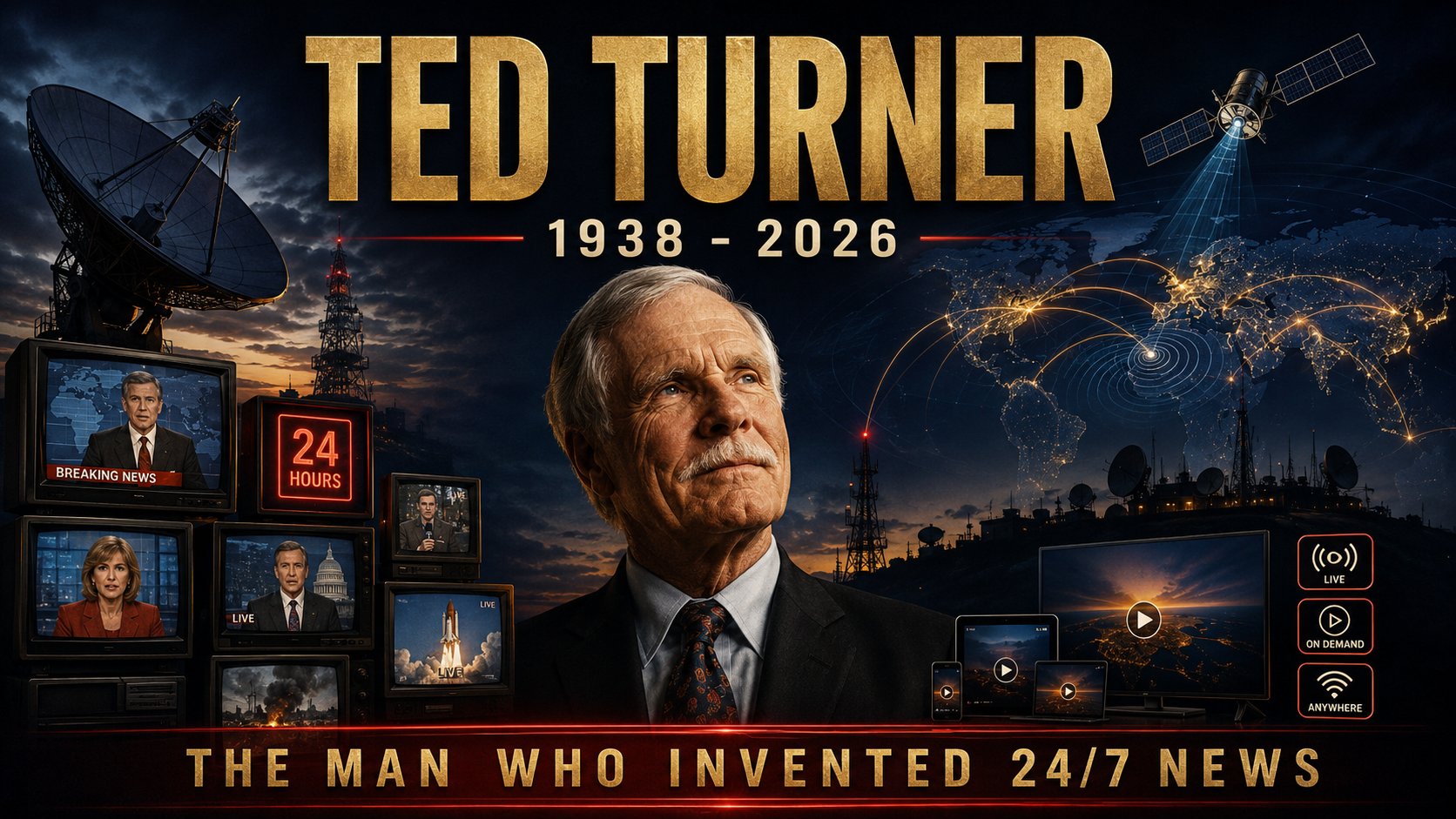
Ted Turner, the media mogul who founded CNN and invented 24-hour television news, died on May 6, 2026, at the age of 87. Most obituaries will remember him as a broadcasting pioneer. But if you strip away the media industry framing, Ted Turner was one of the earliest tech disruptors in American history — a man who understood satellite distribution, real-time data delivery, and platform economics decades before Silicon Valley adopted the same playbook.
Here’s why the tech world should be paying attention to Ted Turner’s legacy — and what today’s founders, engineers, and AI developers can learn from a man who disrupted an entire industry with a satellite dish and an audacious bet.
Who Was Ted Turner?
Robert Edward Turner III was born on November 19, 1938, in Cincinnati, Ohio. After his father’s death in 1963, Turner inherited a struggling billboard advertising company. He pivoted to broadcasting, acquiring a small UHF station in Atlanta — WTCG Channel 17 — and turned it into the foundation of a media empire.
Turner was nicknamed “The Mouth of the South” and “Captain Outrageous” for his brash personality, bold business moves, and willingness to bet everything on ideas that established players dismissed as impossible. He won the America’s Cup sailing race in 1977, owned the Atlanta Braves and Atlanta Hawks, created the Goodwill Games during the Cold War, and donated $1 billion to the United Nations — the largest single charitable gift in history at the time.
But his most consequential move was something far more technical than most people realize.
Satellite Distribution: The Original Tech Disruption
On December 17, 1976, Ted Turner did something that would fundamentally change how content reaches audiences. He beamed WTCG Channel 17’s signal via satellite to cable systems in four small markets: Grand Island, Nebraska; Newport News, Virginia; Troy, Alabama; and Newton, Kansas.
This was the birth of the superstation — and in technology terms, it was the equivalent of launching the first content delivery network (CDN).
Before Turner, television was local. Broadcast signals traveled through the air and reached homes within a limited geographic radius. If you were a TV station in Atlanta, your audience was Atlanta. Turner looked at satellite technology — the same technology that defense contractors and telecommunications companies were using — and asked a fundamentally different question: What if I could use this to distribute entertainment content nationally?
The broadcast establishment dismissed it. The technology was expensive. The regulatory landscape was uncertain. Cable TV itself was considered a niche curiosity — a way for rural homes to get basic reception, not a platform for national distribution.
Turner didn’t care. He leased satellite transponder time and beamed his signal across the country. Within years, WTBS (as it was renamed) was reaching millions of homes that had never been able to watch Atlanta programming before.
Former Turner Broadcasting CEO Terry McGuirk put it bluntly: “What Ted made happen was just as important as the Internet revolution.”
CNN: The Real-Time Data Stream Before the Internet
Turner’s superstation proved that satellite distribution worked. His next move proved that real-time information delivery could reshape society.
On June 1, 1980, CNN launched from Atlanta. The concept was simple but radical: a television channel that broadcast news 24 hours a day, 7 days a week, 365 days a year.
The three broadcast networks — ABC, NBC, and CBS — controlled television news. They delivered fixed 30-minute evening newscasts to mass audiences at scheduled times. If something happened at 2 AM, you found out from your morning newspaper. If a crisis unfolded on the other side of the world, coverage might take days to materialize.
Turner’s idea was architecturally different. In software engineering terms, he replaced a batch processing system (scheduled newscasts) with a real-time streaming pipeline (continuous live coverage). The underlying infrastructure — satellites, cable distribution, remote uplink trucks — was the hardware layer. The editorial operation was the application layer. And the audience was the consumer of a continuous data stream.
Critics called it the “Chicken Noodle Network.” Advertisers were skeptical. Industry executives said nobody would watch news all day.
They were wrong. CNN became the default source for breaking news worldwide. The network became so synonymous with live coverage that “CNN” became almost generic for breaking news — the way Kleenex became generic for tissues or Xerox for photocopying.
The Superstation Model: Content Delivery at Scale
What made Turner’s approach technically innovative wasn’t just the content — it was the distribution architecture.
Turner understood something that wouldn’t become conventional wisdom in tech for another 20 years: the platform that controls distribution controls the market. He didn’t just create content. He built the infrastructure to deliver it at scale.
His superstation model worked like this: acquire cheap content (old movies, reruns, live sports), distribute it via satellite to cable systems nationwide, and monetize through advertising to a national audience. The content was the commodity. The distribution was the competitive advantage.
This is exactly the model that streaming platforms like Netflix, YouTube, and Spotify would later adopt — acquire or produce content, distribute it through internet infrastructure, and monetize at scale. Turner just did it with satellites instead of fiber optics.
From WTBS, Turner expanded into an empire of cable networks:
- CNN (1980) — 24-hour news
- CNN Headline News (1982) — short-form news cycles (the predecessor to Twitter’s news feed)
- TNT (1988) — movies and original programming
- Cartoon Network (1992) — animated content
- Turner Classic Movies (1994) — film preservation and curation
Each channel was a different content vertical distributed through the same satellite and cable infrastructure. In modern terms, Turner was running a multi-tenant platform with vertical-specific applications — decades before that phrase entered the tech lexicon.
Ted Turner vs. Silicon Valley: Same Playbook, Different Era
The parallels between Ted Turner’s strategy and modern tech disruption are striking:
| Turner’s Move | Silicon Valley Equivalent |
|---|---|
| Satellite distribution to cable systems | Cloud infrastructure (AWS, Azure) |
| WTBS superstation (national reach via satellite) | Netflix (global reach via internet) |
| CNN (real-time news stream) | Twitter/X (real-time information feed) |
| CNN Headline News (30-min news loops) | TikTok news (short-form content cycles) |
| Multiple cable channels on one platform | Multi-app ecosystems (Google, Meta) |
| Turner-Time Warner merger ($7.5B) | Microsoft-Activision ($69B), Google-YouTube ($1.65B) |
| Buying Atlanta Braves for content | Amazon buying MGM for Prime Video content |
| $1B UN donation (philanthropy at scale) | Gates Foundation, Chan-Zuckerberg Initiative |
Turner identified new distribution infrastructure (satellites + cable) before incumbents took it seriously, built a platform on top of it, acquired content to feed the platform, scaled nationally, and then consolidated through M&A. That’s the exact sequence that every successful tech company has followed since.
The Time Warner Merger: Big Tech M&A Before Big Tech
In 1996, Turner Broadcasting merged with Time Warner in a deal valued at $7.5 billion. It was one of the largest media mergers in history, combining Turner’s cable networks with Time Warner’s film studios, magazines, and cable systems.
Turner became Time Warner’s largest individual shareholder and vice chairman. The merger gave Turner’s content access to Time Warner’s distribution infrastructure — and gave Time Warner access to Turner’s cable networks.
This was vertical integration at scale — owning both the content and the pipes that deliver it. It’s the same strategy that drove AT&T’s acquisition of Time Warner (2018), Disney’s acquisition of 21st Century Fox (2019), and Amazon’s acquisition of MGM (2022). Turner pioneered the template.
The later AOL-Time Warner merger in 2000 — which Turner called “the biggest mistake in corporate history” — also serves as a cautionary tale for tech M&A. The $164 billion deal collapsed spectacularly when the dot-com bubble burst, destroying shareholder value and costing Turner personally an estimated $8 billion.
Ted Turner’s Impact on Today’s Tech Landscape
Ted Turner’s innovations didn’t just change media — they created the foundational expectations that the entire digital economy is built on:
Real-time information delivery. Before CNN, information was batched and scheduled. Turner proved that audiences wanted continuous access to live information. Every push notification on your phone, every live-updating dashboard, every real-time analytics platform — they all trace their conceptual lineage to Turner’s bet that people wanted news when it happened, not when a network executive decided to air it.
Global content distribution. Turner used satellites to turn a local Atlanta station into a national brand. That same principle — using technology to eliminate geographic barriers to content distribution — drives every streaming service, social platform, and cloud application operating today.
Platform economics. Turner didn’t just create one channel. He built a platform — satellite distribution infrastructure — and launched multiple content verticals on top of it. That’s the app store model, the cloud marketplace model, and the SaaS platform model, all prefigured by a man who was working with analog satellites and coaxial cable.
The attention economy. By creating 24-hour news, Turner effectively invented the modern attention economy. The idea that media should compete for continuous audience attention — not just during primetime slots — is the operating principle behind every algorithm-driven feed on YouTube, Instagram, TikTok, and X.
What Tech Founders Can Learn From Ted Turner
Turner’s career offers several lessons that are directly applicable to today’s tech landscape:
Bet on infrastructure shifts early. Turner saw cable TV and satellite distribution as transformative infrastructure before the establishment did. Today’s equivalent might be edge computing, decentralized networks, or AI-native applications. The founders who build on new infrastructure before it becomes mainstream capture the most value.
Ignore the experts when the data supports you. Every broadcast executive said 24-hour news would fail. Turner launched anyway because he understood the underlying demand for real-time information. In tech, the most transformative products — the iPhone, AWS, Bitcoin — were all dismissed by industry experts before they succeeded.
Distribution beats content. Turner’s competitive advantage was never the quality of his content — it was his control over distribution infrastructure. This is the same lesson that tech giants have learned: Google controls search distribution, Apple controls the app store, Amazon controls e-commerce logistics. Whoever controls the pipes wins.
Vertical integration creates moats. By owning both content (CNN, TNT, Cartoon Network) and distribution (satellite, cable partnerships), Turner created a business that was extremely difficult to compete with. Modern tech companies pursue the same strategy — Apple making its own chips, Google building its own data centers, Anthropic developing its own AI models and infrastructure.
Ted Turner by the Numbers
| Metric | Detail |
|---|---|
| Born | November 19, 1938 — Cincinnati, Ohio |
| Died | May 6, 2026 — age 87 |
| CNN Launch | June 1, 1980 |
| WTBS Satellite Launch | December 17, 1976 |
| Time Warner Merger | 1996 — $7.5 billion |
| UN Donation | $1 billion (1997) |
| Peak Net Worth | ~$10 billion |
| Land Ownership | ~2 million acres (largest private landowner in US) |
| Cable Networks Built | CNN, TBS, TNT, Cartoon Network, TCM, CNN Headline News |
| Sports Teams Owned | Atlanta Braves, Atlanta Hawks |
| America’s Cup | Won 1977 (yacht Courageous) |
The Final Broadcast
Ted Turner died peacefully on May 6, 2026, surrounded by his family. He had been living with Lewy body dementia, a progressive brain disorder, since revealing his diagnosis in 2018.
He is survived by his five children, grandchildren, and great-grandchildren. His legacy extends far beyond the media companies he built — it lives in the fundamental architecture of how the modern world consumes information.
Before Ted Turner, news was something you watched at 6 PM. Information was batched, scheduled, and controlled by three networks. After Turner, news never stopped. Information became a continuous stream. And the distribution infrastructure he pioneered became the template for every platform economy that followed.
The tech industry owes more to Ted Turner than it realizes. The man who bet everything on a satellite dish in Atlanta didn’t just change television — he rewrote the rules of distribution, attention, and real-time information delivery that the entire digital economy now runs on.
The original disruptor has signed off. The 24/7 world he invented never will.