Parag Agrawal’s Parallel Web Systems Hits $2B — The Hidden Gem Powering AI Agents’ Search Layer
Table of Contents
Table of Contents
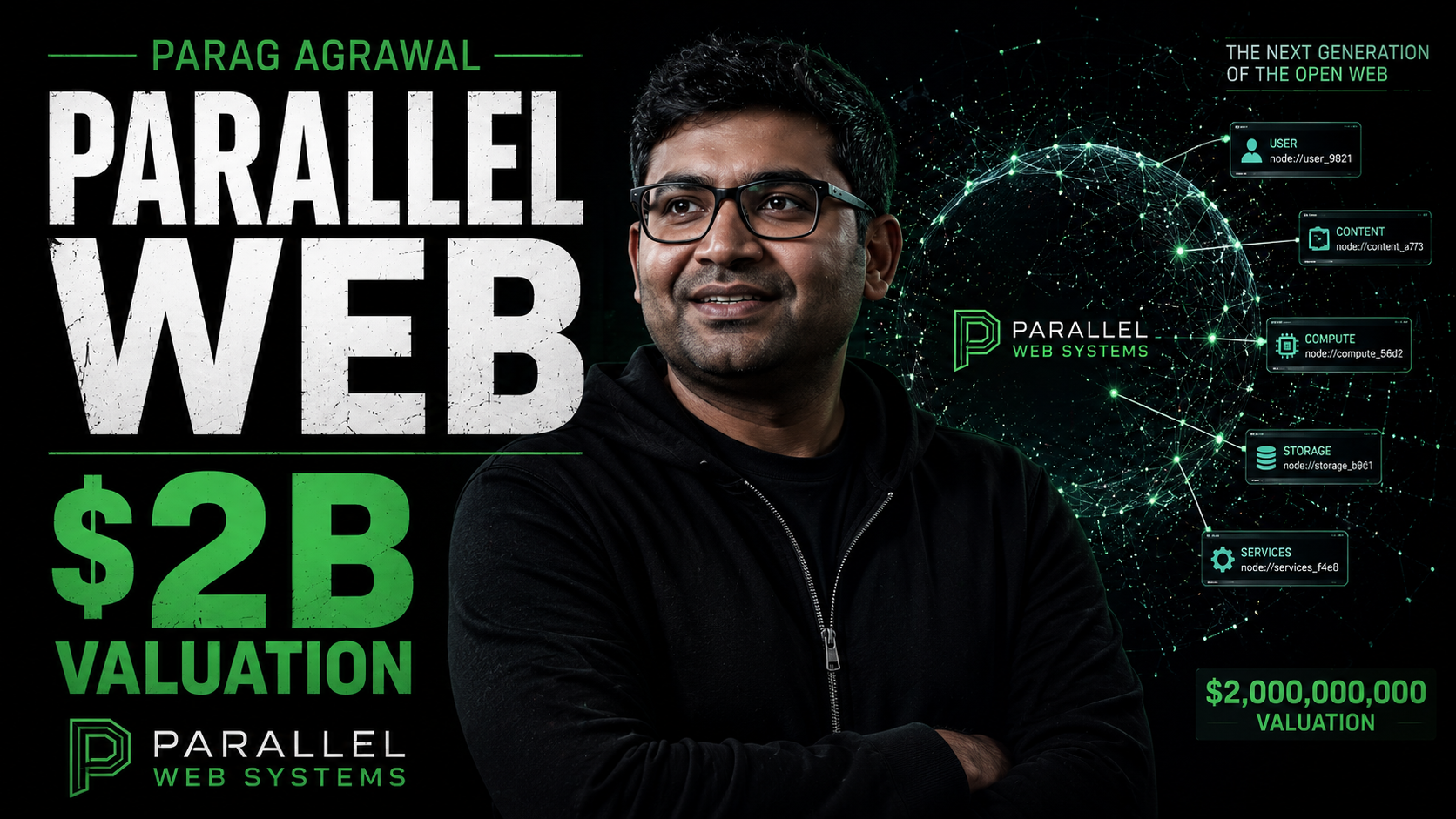
There’s a company you’ve probably never heard of that is quietly becoming the plumbing of the AI agent revolution — and it just hit a $2 billion valuation in under two years. Parallel Web Systems, founded by former Twitter CEO Parag Agrawal, raised a $100 million Series B led by Sequoia Capital in late April 2026, bringing its total funding to $230 million and confirming it as one of the fastest-growing infrastructure startups of the AI era.
Here’s why you should care: if the AI agent revolution is real — and increasingly, it looks like it is — then every AI agent needs a way to search the web. Parallel Web Systems is betting it can own that layer. And with 100,000 developers already using its APIs, it’s further along than most people realize.
What Does Parallel Web Systems Actually Do?
The company’s core product is a suite of web search and research APIs built specifically for AI agents — not for humans. This distinction matters enormously. When a human searches Google, they can interpret ambiguous results, follow multiple links, and form context-rich judgments. When an AI agent searches the web, it needs structured, clean, reliable data that can be programmatically consumed without the noise of ads, popups, paywalls, and SEO-spam that plagues conventional search.
Parallel’s APIs give AI agents exactly that: clean web content retrieval, structured data extraction, real-time web search with high accuracy, and research synthesis capabilities that let agents chain searches together into coherent investigations. Think of it as a web that was rebuilt from scratch with AI agents as the first-class user — not humans, not ad networks, not social media algorithms.
Its customers include Clay (the AI-powered sales intelligence platform), Harvey (legal AI), Notion, and Opendoor. These are high-growth AI-native companies that need to connect AI agents to live web data at scale. The fact that Parallel already counts them as customers before most people have heard of it suggests strong product-market fit that Sequoia clearly spotted.
Why Parag Agrawal? The Unlikely Second Act
Parag Agrawal has had one of the most dramatic careers in tech. He joined Twitter as a developer and worked his way up to Chief Technology Officer, where he oversaw the company’s shift toward AI-powered recommendations. When Jack Dorsey stepped down as CEO in 2021, Agrawal was elevated to the role — only to be fired by Elon Musk less than a year later when Musk completed his $44 billion acquisition and immediately terminated the entire executive team.
Agrawal, along with the other fired executives, sued Musk for $128 million in allegedly withheld severance. That lawsuit is still unresolved, adding a delicious subplot to his startup success: as the Musk v. Altman trial dominates headlines, Agrawal is building a $2 billion company while his own legal dispute with Musk quietly ticks forward.
Parallel’s story is also a redemption narrative that Silicon Valley loves: a CEO whose tenure was defined by someone else’s acquisition is now proving his technical vision on his own terms. Investors who backed Parallel’s Series A at a $740 million valuation in late 2025 have already seen their investment more than double in five months.
The Market Parallel Is Targeting
The timing for Parallel’s infrastructure play is nearly perfect. The AI industry is in the early stages of a massive shift from chatbots to agents — from AI systems that answer questions to AI systems that take actions, conduct research, and complete multi-step tasks autonomously. This shift is exactly what tools like AI agent frameworks are enabling for developers right now.
But agents need data. Real-time, reliable, structured data about the world. Google’s search index is optimized for human browsing patterns and monetization through ads — it’s architecturally hostile to programmatic agent access. Bing’s API has existed for years but was built in the pre-agent era. A purpose-built search and research layer for AI agents is genuinely new infrastructure that doesn’t yet have an entrenched dominant player.
According to TechCrunch, Parallel has over 100,000 developers using its products — a critical mass that creates defensible network effects. The more developers build on Parallel’s APIs, the richer the feedback data that lets Parallel improve its search quality, which attracts more developers.
The Competitive Landscape: Who’s Trying to Own AI Search?
Parallel is not alone in this race. Several well-funded startups are competing for the “search API for AI agents” market:
- Exa: Offers a semantically-focused web search API popular with AI researchers, emphasizing document relevance over keyword matching.
- Tavily: A search API optimized specifically for LLM-based agents, with a free tier that has driven broad developer adoption.
- Brave Search API: Backed by Brave’s independent web index, which is not derived from Google or Bing, offering a privacy-preserving alternative.
- Perplexity API: The consumer AI search darling has opened its underlying technology to enterprise customers.
What distinguishes Parallel’s position is its enterprise customer base, its Sequoia imprimatur, and — critically — its founder’s technical credibility. Agrawal is not a marketing hire who pivoted to AI; he built Twitter’s core machine learning infrastructure from scratch. He understands at a deep level what AI systems need from search infrastructure in a way that generic API product teams often don’t.
Why Developers Should Be Paying Attention
If you’re building AI agents in 2026 — and if you followed our tutorial on building AI agents in Python, you probably are — then the search and research layer is one of the most important architectural decisions you’ll make. The quality of your agent’s outputs is directly bounded by the quality of the data it can access.
Parallel Web Systems’ APIs are worth evaluating if you’re hitting the limitations of existing search solutions: poor structured data extraction, rate limiting at scale, paywalled content that AI agents can’t navigate, or search results polluted by SEO-optimized content that confuses LLMs.
The $2 billion valuation tells you what sophisticated investors think this infrastructure is worth. The 100,000 developer figure tells you adoption is real, not hypothetical. This is one of the more credible hidden-gem stories in AI infrastructure right now — a company solving a real problem, building real traction, and doing it quietly enough that most people in tech haven’t noticed yet.