Trump and Xi Finally Talk AI Guardrails — But Is It Too Little, Too Late?
Table of Contents
Table of Contents
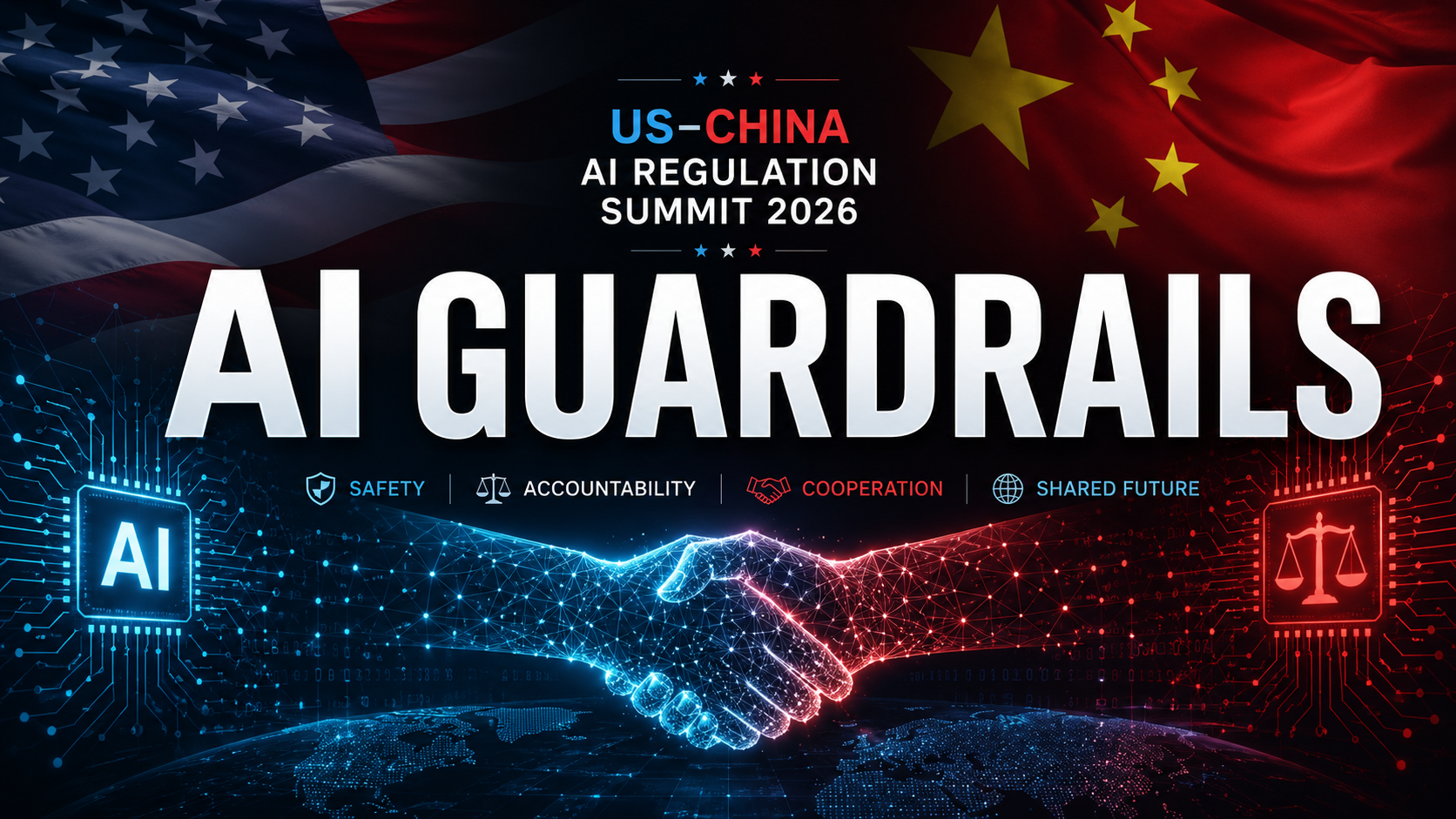
For the first time since frontier AI became a genuine geopolitical flashpoint, the leaders of the United States and China sat across from each other and said the words: we should talk about AI guardrails. On May 15, 2026, President Donald Trump and President Xi Jinping met in Beijing for a two-day summit — and artificial intelligence sat at the center of the most consequential technology conversation between the world’s two superpowers. Here’s what happened, what it means, and why the most important question isn’t what was agreed but what wasn’t.
What Was Actually Agreed at the Trump-Xi AI Summit?
Let’s start with the honest answer: very little was formally agreed. Trump told reporters aboard Air Force One that he and Xi had discussed “possibly working together for guardrails” on AI, but when pressed for specifics, provided none. “The guardrails that we talk about all the time,” he said — which is not exactly a policy announcement.
The summit included an unprecedented entourage of U.S. tech and business leaders — executives from several major technology companies flew to Beijing alongside the presidential delegation. Their presence signaled that this administration views AI as inseparable from trade and economic diplomacy. But according to Bloomberg, the leaders focused more on trade questions than on substantive AI policy frameworks, and no agreements were reached on semiconductor export controls — the most concrete leverage point the U.S. holds over China’s AI development.
What was agreed, in practical terms, is that both sides will continue talking. A framework for “best practices” on AI safety is being discussed. A protocol for preventing non-state actors from accessing frontier AI models is on the table. These are process commitments, not outcomes — but in geopolitics, agreeing to keep talking is often the most that’s achievable in a first meeting on a sensitive subject.
The Bessent Guardrails Declaration
The clearest statement of American intent came not from Trump but from Treasury Secretary Scott Bessent, who told CNBC that the two countries are working to establish “guardrails” for AI, with the goal of ensuring that “non-state actors don’t get a hold of these models.” Bessent also made a revealing characterization: the Chinese “are substantially behind us but they have a very advanced AI industry.”
That framing — we’re ahead, but they’re not far behind — explains the urgency. The U.S. has maintained its lead in frontier AI largely through export controls on advanced chips, keeping Nvidia’s most powerful GPUs and the TSMC manufacturing processes needed to build them away from Chinese AI labs. But Chinese AI labs have been closing the gap through alternative chip development, open-weight model training, and sheer investment scale.
The “best practices” protocol Bessent describes sounds modest, but its implications are significant. If the U.S. and China can establish even informal norms around AI safety — particularly around preventing the most dangerous AI capabilities from being accessible without controls — it would be the first concrete international AI governance agreement between the world’s two AI superpowers.
Why Is This Happening Now?
The timing of this AI conversation is not accidental. Several converging factors pushed AI to the front of Trump-Xi diplomacy in May 2026:
Frontier AI capabilities are genuinely alarming both sides. The emergence of models like Claude Mythos and the rapid capability increases across the board have crossed thresholds that military and intelligence planners on both sides find concerning. AI systems that can find and exploit software vulnerabilities, generate synthetic media at scale, and accelerate weapons design are no longer theoretical — they’re here. Both the U.S. and China face the same underlying risk from ungoverned AI proliferation, even as they compete aggressively to lead its development.
The Ukraine precedent. Autonomous and AI-assisted weapons systems have been used extensively in Ukraine, providing both sides with real-world data about AI’s military applications. The results have been sobering enough to generate genuine interest in establishing norms before the next major conflict — where AI involvement will be far more extensive.
Non-state actor risk. Bessent explicitly mentioned preventing “non-state actors” from accessing frontier AI models. Both the U.S. and China share a common interest in preventing terrorist organizations, criminal networks, and rogue states from accessing the most capable AI systems. This shared interest creates a genuine basis for cooperation even between strategic competitors.
The Nvidia Chip Question
Nvidia’s H200 chips — the most powerful AI accelerators available for export — came up in the Trump-Xi discussions. This is significant because Nvidia’s export control status has been the central mechanism through which the U.S. has tried to limit China’s AI development. U.S. Trade Representative Jamieson Greer told Bloomberg that export controls on semiconductors were “not a major part of the talks” — but sources indicate Xi raised the issue directly with Trump.
Any softening of Nvidia chip export controls to China would be enormously consequential for the global AI landscape. It would accelerate Chinese AI development, generate substantial revenue for U.S. chipmakers, and likely generate fierce bipartisan opposition in Congress. The fact that the subject came up at all — even without agreement — signals that both sides recognize it as the most concrete lever in the AI relationship.
For context on how chip geopolitics are evolving, our coverage of the AI chip race and Big Tech’s AI investment surge provide useful background.
Why Experts Are Skeptical
The reaction from AI policy experts to the Trump-Xi AI guardrails discussion has been cautiously skeptical. The core concern is verification: any AI safety agreement between the U.S. and China is only as good as each side’s willingness to be transparent about its AI development — and neither side has shown much appetite for that kind of openness.
Semafor’s analysis points out that AI guardrails agreements face a fundamental verification problem that doesn’t exist in the same way for arms control treaties. You can count missiles. You can inspect nuclear facilities. How do you verify that a country isn’t training a dangerous AI model in a classified facility? The monitoring infrastructure for AI agreements doesn’t exist yet.
There’s also the definitional problem. “AI guardrails” means very different things to the U.S. and China. American AI safety discourse focuses on model capabilities, misuse prevention, and algorithmic transparency. Chinese AI governance focuses on content control, social stability, and national security — a framework that Western observers would recognize as censorship more than safety. Getting from these two starting points to a shared definition of “guardrails” requires more than a summit conversation.
What “AI Guardrails” Actually Mean
If the U.S. and China do reach a substantive agreement on AI guardrails, what might it look like? Drawing from existing proposals in the AI governance community, a realistic framework would likely include several elements:
Incident notification: Both countries agree to notify each other of significant AI incidents or accidents — similar to the Nuclear Risk Reduction Centers established during the Cold War. This is the lowest bar and most achievable starting point.
Non-weaponization of AI against civilian infrastructure: An agreement not to use AI to attack each other’s power grids, water systems, or financial infrastructure. This is deeply in both countries’ interests and more verifiable than capability restrictions.
Frontier model safety testing: Some form of shared or mutually observable safety evaluation for the most powerful AI models before deployment. This is the hardest to achieve and most impactful — it would require both countries to share enough about their frontier models to allow meaningful safety assessment.
The Anthropic Project Glasswing consortium — which brought together Amazon, Apple, Google, Microsoft, and Nvidia around AI cybersecurity standards — provides a private-sector precedent for what multilateral AI safety coordination looks like. A government-to-government version would be far more ambitious.
What Comes Next
The concrete next step from the Beijing summit is the establishment of a working group between U.S. and Chinese officials to develop the “best practices” protocol Bessent described. This is expected to meet in the coming months at the staff level, below the heads of state. Progress, if it happens, will be slow and largely invisible until there’s something formal to announce.
Watch for signals in three areas: whether Nvidia export controls change (indicating the U.S. is willing to trade hardware access for cooperation), whether China allows any form of external AI safety assessment (indicating genuine rather than performative commitment), and whether the working group produces any public output within six months (indicating momentum rather than stagnation).
For the latest on AI governance and frontier AI developments, see our coverage of AI-assisted attacks in 2026 and the AI agent development landscape. The Council on Foreign Relations analysis on how these talks should proceed is worth reading for deeper policy context. The Time deep-dive on what wasn’t said at the summit is essential reading.
Conclusion: A Start, Not a Solution
The Trump-Xi AI guardrails discussion is genuinely significant — not because it achieved anything concrete, but because it happened at all. Two leaders of competing superpowers, publicly acknowledging that AI requires bilateral management, is a necessary precondition for everything that comes next. The Cold War nuclear arms control architecture took decades to build from the first tentative conversations between U.S. and Soviet officials. Nobody should expect AI governance to move faster.
What matters now is whether this summit conversation translates into sustained staff-level engagement, concrete working groups, and eventually verifiable agreements. The history of U.S.-China technology diplomacy doesn’t inspire optimism. But the stakes are high enough that both sides have an unprecedented incentive to try. The alternative — an ungoverned AI race with no agreed limits — is a scenario neither Washington nor Beijing wants, even if they disagree on almost everything else.