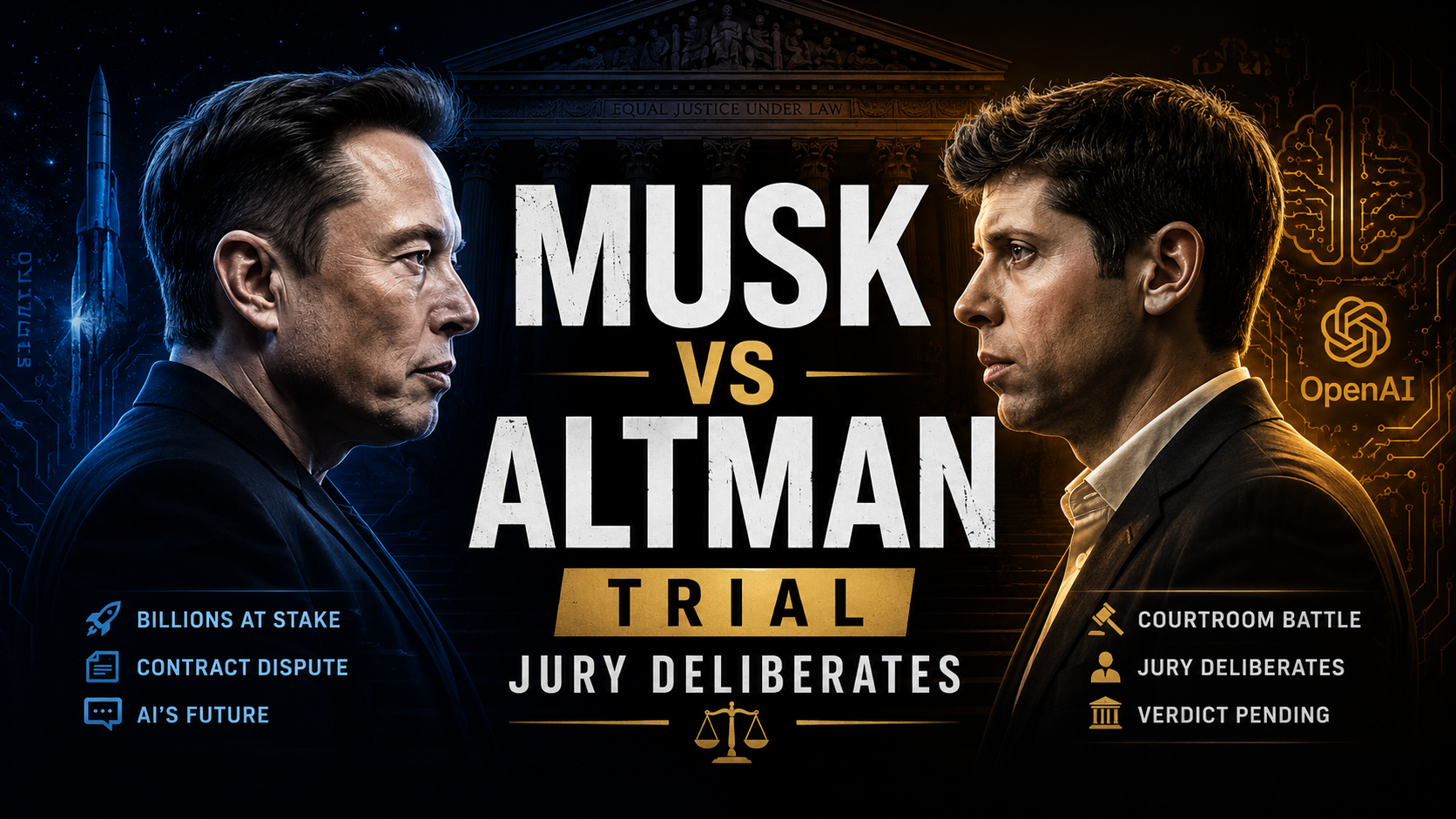
Musk v. Altman Jury Deliberates Today: The OpenAI Trial That Could Break AI Forever
Table of Contents
Table of Contents
After three weeks of explosive courtroom theater, lies, selective amnesia, and billions of dollars of AI ambition on the line, the Musk v. Altman trial has handed the fate of OpenAI — and possibly the future of AI governance itself — to a nine-person jury that begins deliberations today, Monday May 18, 2026. The stakes are almost impossible to overstate: a verdict against OpenAI could force the company to abandon its controversial for-profit conversion, unwind deals with Microsoft and other investors, and fundamentally reshape the trajectory of the AI industry.
Here’s everything that happened in the final week of trial, what each side argued in closing, and why Monday’s jury verdict could be the most consequential legal decision in tech history.
What the Lawsuit Is Actually About
Elon Musk co-founded OpenAI in 2015 as a non-profit research laboratory with the explicit mission to develop AI “for the benefit of humanity.” He contributed $44 million in early funding. In 2019, OpenAI launched a “capped profit” subsidiary, and in 2025 it announced a full conversion to a Delaware C-corporation, transforming non-profit assets worth billions into equity owned by Sam Altman and commercial investors.
Musk alleges that this conversion constitutes fraud and breach of fiduciary duty — that Altman and co-founder Greg Brockman used the non-profit’s charitable assets to enrich themselves, in direct violation of the promises made when Musk donated his money and time. Musk wants the court to reverse the conversion, disgorge profits from Altman and Brockman, and potentially return OpenAI to a non-profit structure.
OpenAI argues the conversion is entirely legal, that Musk was offered and declined an equity stake early on, and that his lawsuit is pure billionaire spite from a competitor now building his own AI company, xAI, which competes directly with OpenAI’s GPT line.
Week 3: Credibility Wars
The third and final week of testimony turned into an all-out credibility battle. Sam Altman took the stand in his own defense and faced withering cross-examination about internal communications, the timeline of the for-profit conversion, and specific promises allegedly made to Musk about maintaining OpenAI’s non-profit character.
Musk’s attorneys played multiple internal emails in which Altman’s language appeared to shift dramatically depending on his audience — reassuring non-profit donors about OpenAI’s mission while simultaneously pitching commercial investors on its profit potential. When pressed with the email evidence, Altman acknowledged “imprecise” language but maintained that his intent was always consistent.
The MIT Technology Review described the dynamic bluntly: “Jurors face tangled questions of trust, timing, and AI.” The jury must decide not just what was done, but what was promised — a notoriously difficult evidentiary standard in contractual fraud cases.
Musk’s Closing Argument: “Would You Trust This Man?”
Musk’s lead counsel Steven Molo delivered a closing argument centered almost entirely on Altman’s credibility. The bridge analogy he used was pointed: “Imagine you’re standing at a bridge suspended 150 feet above a river. The only data about its safety comes from Sam Altman’s version of the truth. Do you cross?”
Molo pointed to specific instances where Altman made representations about OpenAI’s mission to non-profit donors, the board, and the IRS that appear inconsistent with the commercial terms simultaneously being negotiated with Microsoft and other investors. The argument: Altman ran a double-ledger operation — one narrative for the mission-driven public, another for the money.
Musk’s team also highlighted that Altman stands to receive a multi-billion dollar equity stake from the for-profit conversion — an arrangement that only became possible after OpenAI’s transformation from a charity dedicated to humanity’s benefit into a commercial entity dedicated to shareholder returns.
OpenAI’s Defense: “Pageant of Hypocrisy”
OpenAI’s lead attorney William Savitt was equally blunt in his closing: “This whole lawsuit is a pageant of hypocrisy and that pageant has played out gloriously from the beginning of this trial to the close of evidence.”
OpenAI’s defense rested on three pillars. First, that Musk himself was offered a for-profit equity stake in OpenAI’s early commercial entity and declined. Second, that Musk departed from the board due to irreconcilable disagreements about control — not principle. Third, that OpenAI’s conversion was approved by the California Attorney General, its board, and every required regulatory authority, making Musk’s “fraud” claim legally baseless.
Altman’s attorneys also played Musk’s own communications, in which he proposed taking a controlling stake in OpenAI himself before his departure. The implication: Musk’s objection isn’t that OpenAI became commercial. It’s that it became commercial without him in charge.
The Advisory Jury and What Happens Next
Here’s the legally unusual wrinkle that could determine everything: the jury’s verdict is advisory. Under California law, in equity cases involving charitable assets, a jury verdict is not binding. Judge Yvonne Gonzalez Rogers will make the final decision on liability — the jury’s finding is just one input.
If the jury finds OpenAI liable, Judge Gonzalez Rogers will then hear a separate “remedies phase” in which Musk’s team will argue for specific relief: unwinding the conversion, disgorgement of profits, or injunctive relief that restricts how OpenAI can deploy its assets going forward. This could take months.
Even an adverse verdict for OpenAI does not automatically unwind the company. But it could trigger years of additional litigation, complicate OpenAI’s long-rumored IPO plans, and create regulatory exposure at the state level — California’s Attorney General has broad authority over charitable asset conversions and is watching the case closely.
Why This Verdict Matters for the Entire AI Industry
The Musk v. Altman case is not just a billionaire grudge match. It raises questions that the entire AI industry has been ducking: what obligations come with accepting donations in the name of humanity’s benefit?
OpenAI was founded with a specific promise — that unlike a conventional corporation, its work would be guided by humanity’s long-term interests, not shareholders. If courts ultimately find that Altman violated that promise by converting charitable assets to personal equity, it sets a precedent that constrains every future “mission-driven” AI lab that accepts philanthropic funding.
Conversely, if OpenAI wins cleanly, it legitimizes the model of founding a non-profit AI company, building credibility and regulatory goodwill under that umbrella, then converting to commercial form once the technology is proven. That’s a template with profound implications for how the next wave of AI companies structure themselves from day one.
Either way, the AI industry’s relationship between public mission and private profit will never look the same after this verdict is read.
When Will We Know?
The jury of nine began deliberations this morning, Monday May 18, 2026. There is no timeline for when they will return a verdict — complex commercial fraud cases can take days or weeks of deliberation. Once the advisory verdict is delivered, Judge Gonzalez Rogers has no deadline for issuing her final ruling.
For OpenAI, Musk, and the $852 billion AI industry watching from the sidelines, the waiting begins now.