Apple Kills the $599 Mac Mini as AI Boom Drains Global Memory Supply — Price Hikes Coming Next
The Apple Mac Mini price hike 2026 has arrived, and the beloved $599 base model — the Apple Mac Mini price hike is officially dead. An unprecedented AI memory shortage driven by explosive demand for AI server hardware has forced Apple to an Apple Mac Mini price hike that killed its most affordable desktop. This Apple Mac Mini price hike crisis is reshaping the entire product lineup.
What’s Happening to Mac Availability
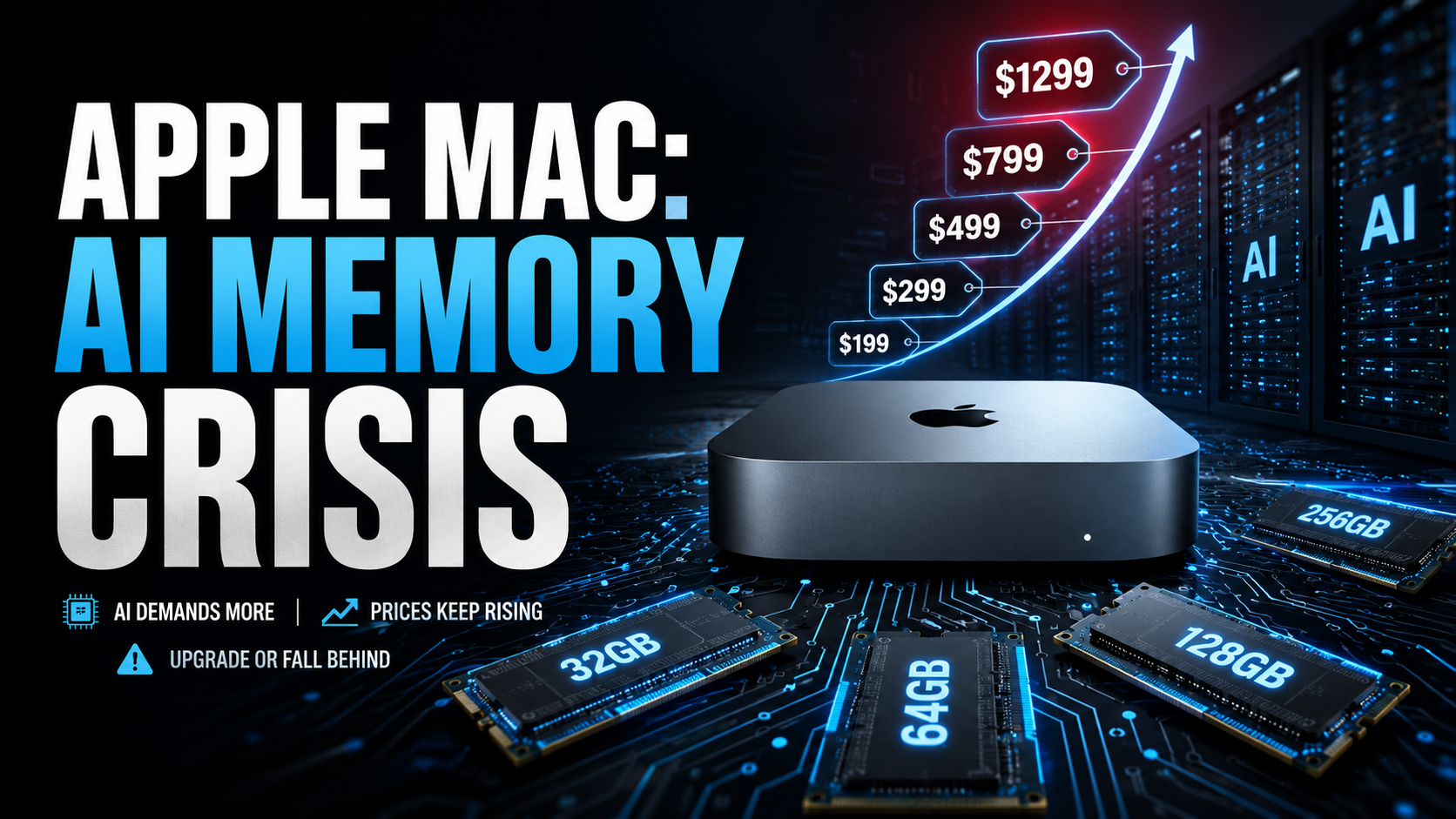
If you’ve tried buying an Apple Mac recently, you may have noticed something unusual: products are disappearing from the store, prices are quietly climbing, and shipping estimates are stretching into weeks. This isn’t a glitch. Apple is in the middle of a genuine supply crisis, and the root cause might surprise you — it’s not chip fabrication this time. It’s memory.
The global AI boom has created an insatiable appetite for high-bandwidth memory chips. Data centers building AI training infrastructure are buying every HBM and DDR5 chip Samsung, SK Hynix, and Micron can produce. And consumer products — including Macs — are getting squeezed out of the supply chain as manufacturers prioritize their highest-margin server customers.
The $599 Mac Mini Is Dead
The most visible casualty is Apple’s most affordable desktop computer. The company has removed the 256GB storage configuration for its M4 Mac Mini worldwide, effectively killing the $599 entry point that made the Mac Mini one of the best value propositions in Apple’s lineup. The cheapest Mac Mini you can now buy starts at $799 — a 33% price increase overnight.
Apple hasn’t explicitly stated that the price increase is due to memory costs, but the timing and pattern make the connection obvious. The 256GB configuration used a different NAND flash module than the higher-capacity options, and that specific component has become scarce as memory manufacturers redirect production capacity toward AI-optimized chips.
Apple Mac Mini Price Hike: Why Memory and the AI Server Problem
The memory shortage has a straightforward cause: AI training and inference servers consume enormous amounts of memory. A single NVIDIA H100 GPU requires 80GB of HBM3 memory. A typical AI training cluster might use thousands of these GPUs, meaning a single installation can consume more memory than an entire production run of consumer laptops.
Samsung, SK Hynix, and Micron — the three companies that control virtually all global memory production — have been aggressively shifting their manufacturing lines toward high-bandwidth memory (HBM) and server-grade DDR5. HBM commands prices roughly 5-10x higher per gigabyte than consumer memory, making the business decision straightforward for manufacturers: why sell memory for $599 Mac Minis when you can sell it for AI servers at massive premiums?
Tim Cook’s Earnings Call Warning
During Apple’s January-March 2026 earnings call, CEO Tim Cook delivered an unusually candid warning. Demand for Mac Mini and Mac Studio — fueled partly by the popularity of running local AI models — has “dramatically outstripped internal forecasts,” and it will take “several months” for supply-demand balance to normalize.
Cook specifically mentioned that memory costs are “set to rise significantly starting in the June quarter,” signaling that the current price increases may be just the beginning. The phrase “we’ll look at a range of options” suggests Apple is considering multiple strategies — absorbing some costs, passing others to consumers, and potentially redesigning products to use less memory-intensive configurations.
Beyond the Apple Mac Mini Price Hike: Mac Studio 512GB Gone
The Mac Mini isn’t the only product affected. Apple has stopped selling the Mac Studio configured with 512GB of unified memory — the high-end configuration favored by AI researchers, video editors, and 3D artists who need massive amounts of RAM for their workloads.
The 512GB Mac Studio represented the pinnacle of Apple Silicon performance, and its disappearance from the store is a strong signal that Apple simply cannot source enough high-capacity memory modules to build them. For professionals who depend on these machines, the situation creates a genuine workflow disruption with no clear timeline for resolution.
Apple Mac Mini Price Hike: How This Affects Regular Buyers
For average consumers, the immediate impact is straightforward: Macs are getting more expensive, and some configurations simply aren’t available. The $599 Mac Mini was a gateway product that brought many users into the Apple ecosystem, and its elimination raises the floor for Mac ownership.
But the ripple effects go deeper. Education institutions that bulk-purchase Mac Minis for computer labs will face significantly higher costs. Small businesses that relied on the Mac Mini as an affordable server or workstation will need to budget more. And developers who use Mac hardware for iOS app development — which requires a Mac — will see their overhead increase.
The timing is particularly unfortunate for consumers who were planning to buy Macs to run local AI models — one of the Mac’s emerging use cases. The memory configurations most useful for AI work (64GB and above) are precisely the ones most affected by the supply shortage.
It’s Not Just Apple — The Whole PC Market Is Hit
Apple is hardly alone in feeling the squeeze. IDC projects that the memory shortage will cause global PC shipments to decline 11.3% in 2026 — a staggering figure for an industry that was finally recovering from the post-pandemic demand hangover.
Dell, HP, and Lenovo are all facing similar supply constraints, though their ability to offer multiple memory tiers and adjust configurations gives them slightly more flexibility than Apple’s more curated product line. The entire consumer electronics industry is competing with AI data centers for a finite supply of memory chips, and the data centers are winning because they’re willing to pay more.
Apple Mac Mini Price Hike: When Will Supply Normalize?
The honest answer is: nobody knows for certain. Memory manufacturers are investing billions in new fabrication capacity, but semiconductor fabs take 2-3 years to build and commission. SK Hynix’s new HBM production facility in Indiana isn’t expected to begin volume production until late 2027 at the earliest.
In the meantime, Cook’s “several months” estimate for Apple’s supply to normalize seems optimistic. As long as AI infrastructure buildout continues at its current pace — and companies like the Pentagon and major tech firms are spending hundreds of billions on AI — consumer memory will remain scarce and expensive.
Final Thoughts on the Apple Mac Mini Price Hike
The AI boom’s impact on consumer technology is becoming impossible to ignore. Apple killing the $599 Mac Mini isn’t just a pricing decision — it’s a visible symptom of a fundamental supply chain disruption where AI infrastructure is literally consuming the components that consumer products need.
For Mac buyers, the practical advice is simple: if you need a Mac, buy it now rather than waiting for prices to drop, because they’re more likely to go up. And budget for more storage and memory than you think you need, because the option to upgrade later may not be available at any price.
Why the Apple Mac Mini Price Hike Was Inevitable in 2026
The Apple Mac Mini price hike didn’t happen in a vacuum. Global DRAM and NAND flash memory prices have surged 40-60% since early 2025, driven almost entirely by AI infrastructure demand. Companies like NVIDIA, Google, and Microsoft are purchasing massive quantities of high-bandwidth memory (HBM) for AI training clusters, creating severe supply constraints for consumer electronics manufacturers.
According to TrendForce market research, AI server memory demand consumed approximately 30% of total DRAM production in Q1 2026, up from just 8% in 2023. This shift has forced Apple and other consumer hardware makers to compete directly with hyperscaler data centers for the same memory chips, inevitably pushing prices upward.
Samsung, SK Hynix, and Micron — the three companies that control over 95% of global memory production — have all prioritized HBM production for AI customers willing to pay premium prices. Samsung Semiconductor reportedly allocated 60% of its advanced packaging capacity to HBM3E production, leaving less capacity for the standard LPDDR5X chips used in MacBooks and Mac Minis.
Apple Mac Lineup: What Happens Next After the Price Hike
The $599 Mac Mini was Apple’s entry-level gateway to the Mac ecosystem, popular with students, developers, and first-time Mac buyers. Its discontinuation signals a fundamental shift in Apple’s product strategy: the company is prioritizing margins over market share in an era of constrained component supply.
Industry analysts at IDC project that Apple Mac prices could increase an additional 10-15% by late 2026 if memory shortages persist. The MacBook Air, currently starting at $1,099, may see its base configuration pushed above $1,200. The MacBook Pro with M4 Pro, already at $1,999, could cross the $2,200 threshold.
For consumers, the practical impact is significant. The Apple Mac Mini price hike effectively raises the floor for Mac ownership, potentially pushing budget-conscious buyers toward Chromebooks or Windows PCs with more competitive pricing. Apple’s strategy appears to be a calculated bet that brand loyalty and ecosystem lock-in will prevent meaningful customer attrition even as prices climb.
The broader lesson is that AI’s resource demands are reshaping consumer electronics in ways most people haven’t noticed yet. When a company like Apple can no longer offer an affordable entry-level desktop, it’s a clear signal that AI infrastructure spending is cannibalizing the rest of the technology supply chain.
Apple’s competitors are facing the same pressure. Dell and Lenovo have both announced price increases across their 2026 laptop lineups, citing identical memory supply issues. The difference is that Apple’s premium positioning makes each price increase more visible and more painful for its customer base. Whether Apple can navigate this supply crunch without sacrificing its carefully cultivated accessibility remains the biggest question facing the Mac lineup in 2026 and beyond.