Musk Says Tesla Unsupervised FSD Will Be ‘Widespread’ by Year-End — With Just 38 Robotaxis on the Road
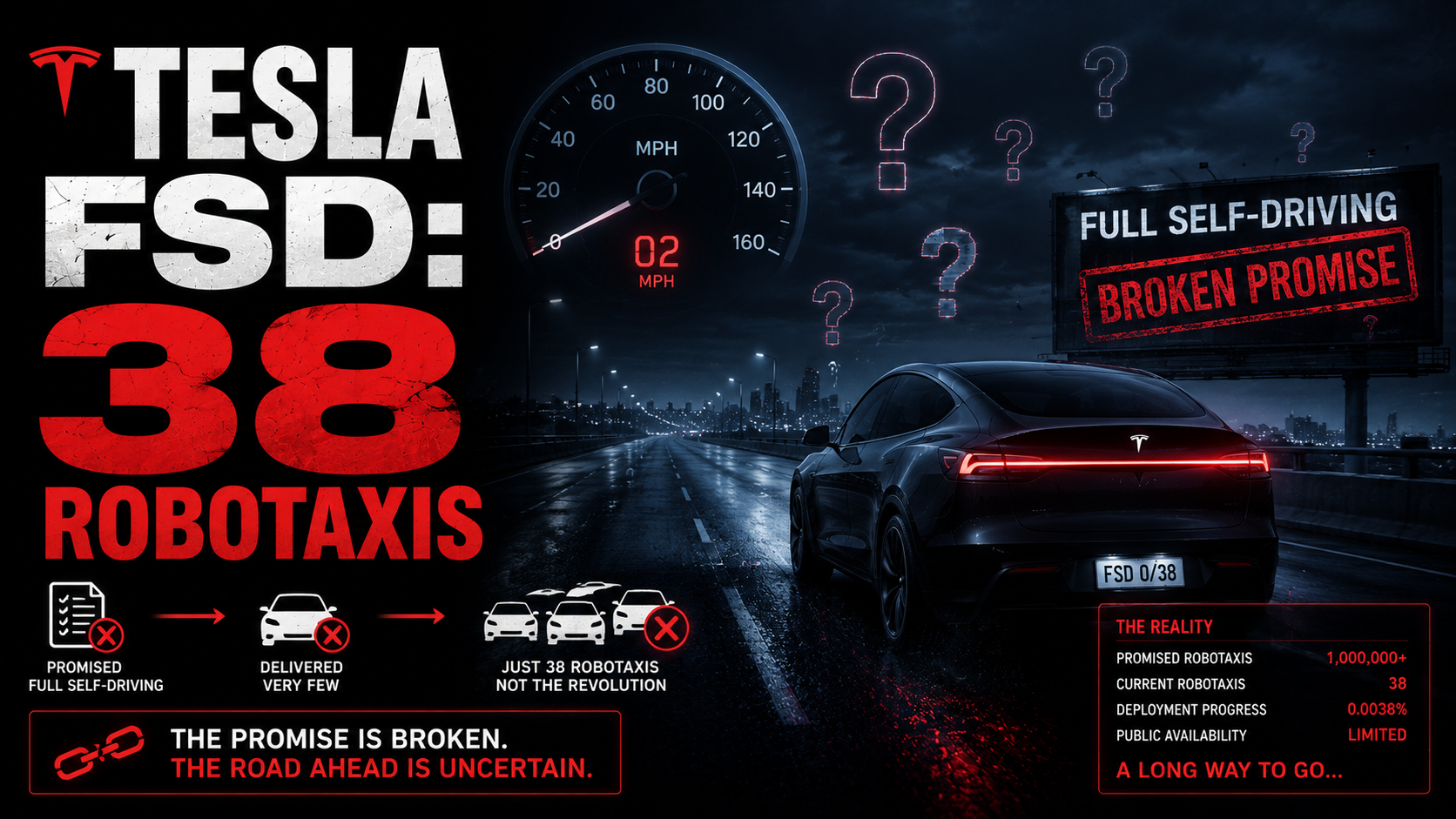
Elon Musk claims Tesla FSD widespread deployment will be “widespread” by year-end, but the reality tells a very different story. With just 38 Tesla robotaxi vehicles operating across three cities, the gap between Musk’s Tesla FSD widespread promises and actual Tesla FSD widespread autonomous driving capability has never been wider.
The Claim: Widespread by Year-End
Elon Musk was at the Smart Mobility Summit 2026 on May 18, and he made another one of his signature predictions. Tesla already has “some vehicles operating with no people inside and no safety monitors in three cities in Texas,” Musk told the conference audience, and the unsupervised FSD service will “probably be widespread in the US by the end of this year.”
If you’ve been following Tesla’s self-driving timeline, this should trigger immediate déjà vu. Musk has been saying variations of this for nearly a decade, and the goalposts keep moving further down the road.
The Reality: 38 Cars in Three Cities
According to the Robotaxi Tracker platform, Tesla’s combined unsupervised fleet across all three Texas cities — Austin, Houston, and Dallas — consists of exactly 38 vehicles. Not 38,000. Thirty-eight.
Waymo operates over 1,000 robotaxis across multiple cities including San Francisco, Los Angeles, Phoenix, and Austin, completing more than 250,000 paid rides per week. Tesla’s entire unsupervised fleet could fit in a mid-sized parking lot.
Going from 38 vehicles in three Texas cities to “widespread” coverage across the entire United States in seven months would require a manufacturing, regulatory, and technological scaling effort that has no precedent in the autonomous vehicle industry.
Tesla FSD Widespread: A Decade of Broken Self-Driving Promises
Musk’s track record on self-driving timelines is one of the most well-documented histories of broken promises in tech. In 2016, he claimed a Tesla would drive LA to New York by end of 2017 — it never happened. In 2019, he told investors there’d be one million robotaxis by 2020 — there were zero. In 2020, FSD was “feature complete” — it wasn’t. In 2022, full self-driving was coming by year-end — it didn’t.
In April 2026, Musk admitted millions of Tesla owners need hardware upgrades for true unsupervised driving, pushing the timeline to Q4 2026 “at the earliest.” Less than a month later, he’s telling a conference audience it’ll be “widespread” by year-end. The pattern is unmistakable.
Tesla FSD Widespread and The Hardware Upgrade Problem
One of the most underreported obstacles came in April when Musk acknowledged that millions of existing Teslas need hardware upgrades for true unsupervised driving. This undermines years of marketing that implied all Teslas sold since late 2016 had the necessary hardware.
“Widespread” FSD isn’t just a software problem — it requires physical modifications at a scale that would strain Tesla’s service infrastructure. For customers who paid $8,000 to $15,000 for FSD capability, the revelation that their hardware may be insufficient has fueled multiple class-action lawsuits alleging consumer fraud.
10 Billion FSD Miles: Does It Matter?
In early May 2026, Tesla reached 10 billion miles driven with FSD. Tesla bulls point to this as evidence the system is approaching human-level driving. But context matters: the vast majority of those miles were driven under human supervision.
Supervised miles are valuable training data, but they’re fundamentally different from unsupervised miles. A system requiring human oversight 99.9% of the time is not the same as one that operates safely with no human in the loop. The gap between 99% and 99.999% reliability involves solving the rarest, most dangerous edge cases — and there’s no evidence that more supervised miles automatically closes that gap.
Tesla FSD Widespread and The Regulatory Reality
Even if Tesla’s technology were ready tomorrow, the regulatory landscape would prevent widespread deployment. Autonomous vehicle regulations in the US are a patchwork of state-by-state rules. Texas has been permissive, but “widespread in the US” means operating everywhere, including states like California and New York with much stricter requirements.
California requires extensive reporting, insurance minimums, and DMV approval before any company can operate driverless vehicles on public roads. The regulatory approval process typically takes months to years per jurisdiction. Nationwide approval by end of 2026 isn’t grounded in reality.
Competitors Are Pulling Ahead
While Musk makes conference promises, competitors are operating commercial robotaxi services at meaningful scale. Waymo completes hundreds of thousands of paid trips weekly with no safety driver. Chinese companies like Baidu’s Apollo Go operate thousands of robotaxis across multiple cities.
Tesla’s camera-only approach — no lidar, no HD mapping — is technically ambitious but unproven for unsupervised operation. Every other company that has achieved commercial driverless deployment uses lidar as part of a multi-sensor approach. Tesla betting against the industry consensus is bold, but “bold” and “ready for widespread deployment” are very different things.
What This Means for Tesla Investors
Tesla’s valuation increasingly depends on the robotaxi narrative rather than automotive fundamentals. At 38 deployed vehicles, the massive future robotaxi revenue stream priced into the stock remains almost entirely theoretical.
Investors should weigh this latest claim against the decade of missed deadlines. Each previous promise was delivered with the same confidence, and each failed to materialize on schedule. The hardware upgrade admission adds significant future capital expenditure that could suppress FSD adoption rates.
Final Thoughts on Tesla FSD Widespread Claims
Elon Musk has built extraordinary companies, but on self-driving timelines specifically, his credibility is exhausted. The gap between promising “widespread” unsupervised FSD and having 38 cars in three cities isn’t minor — it’s an order-of-magnitude disconnect between rhetoric and reality.
Tesla may eventually achieve unsupervised FSD at scale. The AI technology is advancing rapidly. But “eventually” is not “by end of 2026.” Until the numbers change dramatically, these claims should be treated as aspirational marketing from a CEO whose self-driving predictions have been wrong every single time.
Tesla FSD Unsupervised: A Timeline of Broken Promises
Understanding the Tesla FSD widespread claim requires examining the full history of Musk’s self-driving predictions. In 2016, Musk said all Tesla vehicles would be capable of fully autonomous driving by 2018. In 2019, he promised one million robotaxis on the road by 2020. At Tesla’s AI Day 2021, the timeline shifted to 2023. Then 2024. Then 2025. Now 2026.
Each prediction has been accompanied by the same pattern: bold claims at investor events, followed by quiet revisions when deadlines pass. The National Highway Traffic Safety Administration (NHTSA) has opened multiple investigations into Tesla’s Autopilot and FSD systems, with over 900 crash reports involving driver assistance features since 2019.
The regulatory landscape presents another challenge. While Tesla FSD widespread operates in Austin under a limited permit, scaling to other cities requires state-by-state regulatory approval. California, Tesla’s home state, maintains strict autonomous vehicle testing requirements that Tesla has not yet fully satisfied for driverless operations.
How Tesla FSD Compares to Waymo and Cruise in 2026
The gap between Tesla FSD widespread and established robotaxi operators is stark. Waymo currently operates over 100,000 paid autonomous rides per week across San Francisco, Phoenix, Los Angeles, and Austin. Their fleet uses dedicated LiDAR and radar systems that Tesla has intentionally avoided in favor of a camera-only approach.
Tesla’s 38 robotaxis in Austin represent a proof of concept, not a commercial operation. Each vehicle requires geofenced routes, favorable weather conditions, and remote monitoring capabilities. By comparison, Waymo’s vehicles navigate construction zones, emergency vehicles, and adverse weather conditions with published safety data showing they outperform human drivers by significant margins.
The fundamental question isn’t whether Tesla FSD will eventually work — it’s whether the camera-only approach can match the redundancy of multi-sensor systems. Most autonomous driving researchers, including those at SAE International, remain skeptical that a vision-only system can reliably handle the full range of driving scenarios required for true Level 4 autonomy.
What Tesla FSD Unsupervised Means for Investors
For Tesla investors, the FSD unsupervised promise carries enormous financial implications. Tesla’s current valuation prices in significant revenue from robotaxi operations and FSD licensing. If the technology fails to scale as promised, it could trigger a substantial correction in the stock price.
Wall Street analysts have increasingly flagged the disconnect between Tesla’s self-driving rhetoric and operational reality. The company has collected billions in FSD subscription and purchase revenue from customers who were told full autonomy was imminent — a practice that has drawn scrutiny from the Federal Trade Commission and state attorneys general.
The Tesla FSD Safety Debate No One Wants to Have
Behind the marketing claims about Tesla FSD widespread lies a serious safety conversation. Every autonomous vehicle accident makes national headlines, creating public perception challenges that extend far beyond Tesla. But Tesla’s approach of deploying beta-grade software to paying customers on public roads remains uniquely controversial in the industry.
Other autonomous vehicle companies like Waymo, Cruise, and Aurora test extensively in controlled environments before public deployment. Tesla’s approach — using customer vehicles as real-world testing platforms — generates vast amounts of training data but exposes ordinary drivers and pedestrians to unverified software iterations. The ethical implications of this strategy have been debated extensively by IEEE’s transportation safety researchers and autonomous vehicle ethics scholars.
As Tesla FSD widespread expands beyond its initial 38-vehicle Austin deployment in 2026, the stakes will only grow higher. Every mile driven without incident strengthens Tesla’s case. Every accident — particularly any involving pedestrians or cyclists — could set the entire autonomous driving industry back years. The technology may be closer than skeptics believe, but it’s also further away than Musk has ever admitted.