This $1.2 Billion AI Startup Is About to Put Self-Driving Tech in Your Jeep by 2028 — And Tesla Should Worry
Table of Contents
Table of Contents
Wayve and Stellantis Partnership: AI Self-Driving Is Coming to Mass-Market Cars
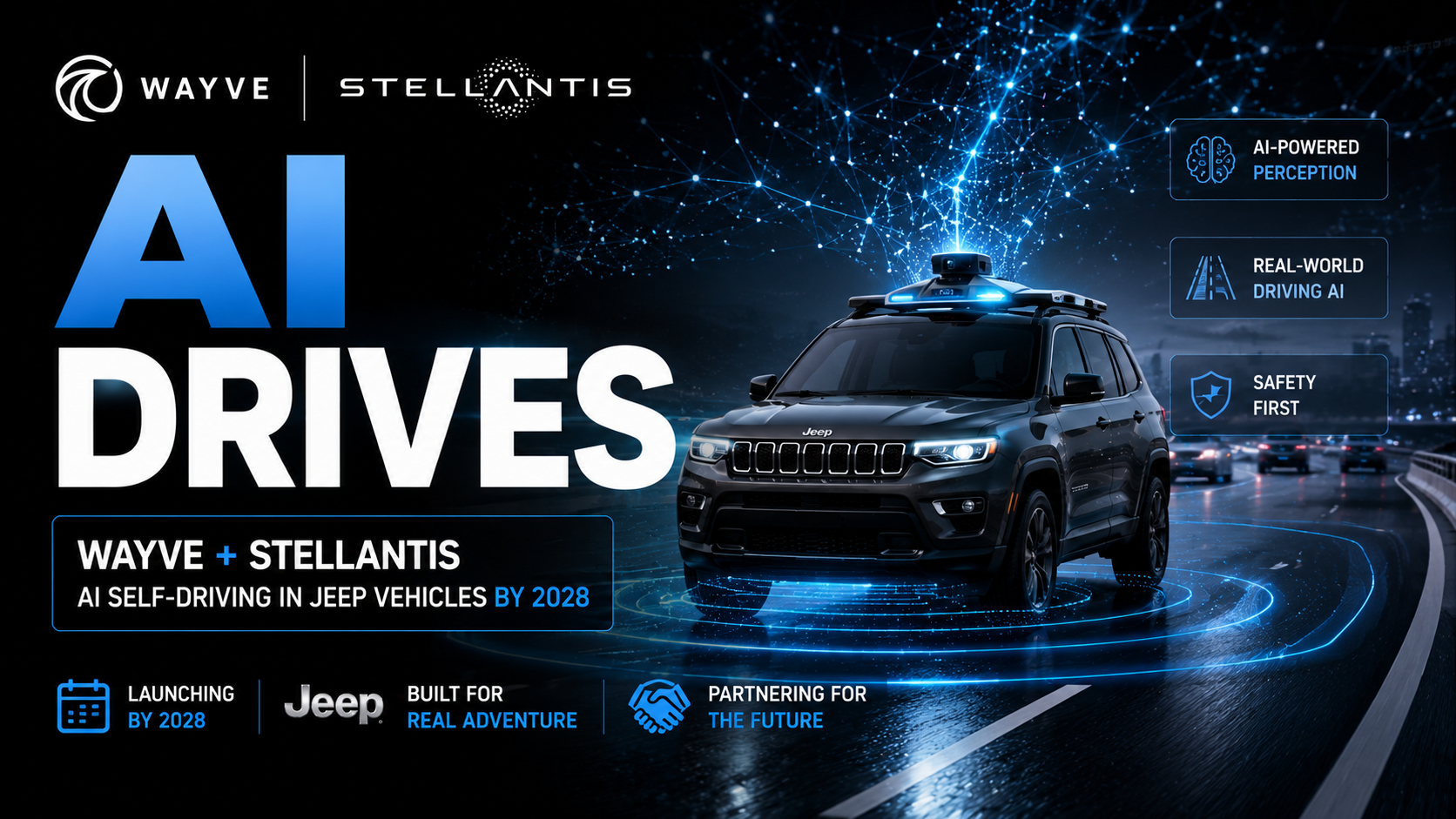
London-based AI startup Wayve just landed what might be the most important autonomous driving deal of 2026. Stellantis — the automotive giant behind Jeep, Ram, Dodge, Chrysler, Peugeot, and Fiat — has tapped Wayve to bring hands-free self-driving technology to its vehicles, with a targeted launch in 2028. The announcement was made at Stellantis’ investor day in Michigan and signals a dramatic acceleration of the timeline for AI-powered driving in mass-market vehicles.
This is not another concept car demo or vague “partnership exploration.” Wayve’s teams have already built a working prototype on a Stellantis vehicle in less than two months, demonstrating how quickly their technology can be integrated across different vehicle platforms. For an industry where development cycles typically span years, two months from integration start to working prototype is remarkable — and it reveals just how different Wayve’s approach is from traditional autonomous driving systems.
The deal is Wayve’s second major automaker partnership, following a similar agreement with Nissan. With $1.2 billion in fresh Series D funding from Microsoft, Nvidia, Uber, Nissan, and Stellantis itself, Wayve is positioning itself as the go-to platform for automakers who want self-driving capability without building it from scratch.
How Wayve’s AI Driver Works: No HD Maps, No Handcrafted Rules
What makes Wayve fundamentally different from every other autonomous driving company is its approach to the problem. Traditional self-driving systems — including those built by Waymo, Cruise, and Mobileye — rely heavily on high-definition maps, pre-programmed rules for handling specific driving scenarios, and sensor arrays that include expensive lidar units. These systems work well in mapped areas but struggle with new environments, unusual situations, and the infinite edge cases of real-world driving.
Wayve takes a radically different approach. Its AI Driver uses an end-to-end neural network that learns to drive by observing human driving behavior. The system does not rely on HD maps or handcrafted rules. Instead, it uses data from whatever sensors are available on the vehicle — cameras, radar, or lidar — and makes driving decisions based on what it has learned from millions of miles of real-world driving data.
According to TechCrunch’s reporting, this sensor-agnostic approach is exactly what cost-conscious automakers like Stellantis find appealing. They do not need to install expensive lidar arrays on every vehicle. They do not need to map every road in advance. They can use the cameras and radar sensors that are already standard equipment on modern vehicles and let Wayve’s software handle the rest. This dramatically reduces the per-vehicle cost of adding self-driving capability and makes it feasible to deploy across mass-market vehicle lineups — not just luxury flagships.
Hands-Free Door-to-Door Driving by 2028: What the Deal Actually Promises
The initial product Wayve and Stellantis will deliver is hands-free door-to-door supervised automated driving — classified as Level 2++ in the SAE autonomy scale. This means the vehicle handles all driving tasks — steering, acceleration, braking, lane changes, and navigation — while the human driver supervises and can take over at any time. It covers both highway and urban environments, which is a significant step beyond current systems that typically work only on highways.
The “door-to-door” aspect is key. Current advanced driver assistance systems from competitors typically handle only highway driving (like GM’s Super Cruise or Tesla’s Autopilot on highways). Wayve’s system is designed to handle the complete journey — from pulling out of your driveway to navigating through city streets to merging onto highways and arriving at your destination. The official Stellantis press release also mentions a pathway to support higher levels of automation in the future.
The 2028 launch timeline targets North America first, which is strategically important for Stellantis. The company’s strongest brands — Jeep and Ram — have their largest customer bases in the United States, and the American market has the most permissive regulatory environment for advanced driver assistance technologies.
Wayve’s $1.2 Billion War Chest: Who Is Betting on This Startup
The Stellantis deal comes on the heels of Wayve’s $1.2 billion Series D funding round — one of the largest raises ever for an autonomous driving startup. The investor list reads like a who’s who of the tech and automotive industries. Microsoft led the round, joined by Nvidia, Uber, Nissan, and Stellantis.
Each of these investors brings more than capital. Microsoft provides cloud computing infrastructure for training Wayve’s AI models. Nvidia provides the GPU hardware that powers the neural networks. Uber brings expertise in ride-hailing and mobility services. And the automakers — Nissan and Stellantis — provide the vehicles, manufacturing capability, and distribution channels needed to deploy the technology at scale.
For Wayve, this investor syndicate creates a powerful ecosystem that covers every stage of the self-driving stack — from AI training to chip manufacturing to vehicle integration to customer deployment. It is a vertical integration strategy assembled through partnerships rather than acquisitions.
Wayve vs. Tesla FSD: Why the Neural Network Approach Is Winning
The comparison to Tesla’s Full Self-Driving (FSD) is inevitable — and it is not entirely favorable to Tesla. Both Wayve and Tesla use vision-based, end-to-end neural networks for their driving systems. But there are critical differences in approach and business model.
Tesla’s FSD is a proprietary system that only works on Tesla vehicles. It has been perpetually “almost ready” for years, with Elon Musk’s timeline promises consistently falling short of delivery. Wayve’s AI Driver, by contrast, is platform-agnostic — it can be integrated into any vehicle from any manufacturer. This makes Wayve a potential partner for every automaker that does not want to (or cannot) build its own self-driving technology from scratch.
The fact that Wayve can go from initial integration to working prototype in less than two months is a direct threat to Tesla’s competitive position. If traditional automakers can add competitive self-driving capability to their vehicles quickly and affordably, one of Tesla’s key differentiators — its advanced driver assistance technology — becomes less unique. As AI capabilities become commoditized, the advantage shifts from the technology developer to the companies with the largest manufacturing scale and distribution networks. And on those dimensions, Stellantis — which sells over 6 million vehicles annually — has a significant edge over Tesla.
Wayve Built a Stellantis Prototype in Less Than 2 Months
According to the Wayve press announcement, their engineering teams demonstrated how quickly the AI Driver can be integrated by bringing up a working prototype on a Stellantis vehicle platform in less than two months. In the autonomous driving industry, where development timelines are typically measured in years, this speed of integration is unprecedented.
The speed is possible because of Wayve’s sensor-agnostic architecture. Traditional systems need to be custom-calibrated for specific sensor configurations, mapped environments, and vehicle dynamics. Wayve’s neural network-based approach treats driving as a learned skill rather than a programmed behavior — which means the system can adapt to new vehicles, sensors, and environments with relatively minimal retraining. This adaptability is what makes Wayve’s technology viable as a platform play rather than a single-vehicle product.
The Autonomous Driving Market Is Splitting Into Two Clear Camps
The Wayve-Stellantis deal illustrates a broader trend in the autonomous driving market: it is splitting into two distinct camps. On one side are the robotaxi companies — Waymo, Cruise, Zoox — that are building fully autonomous vehicles designed to operate without human drivers in specific geographic areas. On the other side are the ADAS companies — Wayve, Mobileye, and to some extent Tesla — that are building advanced driver assistance systems designed to make human-driven cars progressively more autonomous.
The ADAS approach has a clear economic advantage: it can be deployed on millions of vehicles sold through existing dealership networks, generating revenue at scale much faster than the robotaxi model. Stellantis sells over 6 million vehicles per year. If even a fraction of those vehicles are equipped with Wayve’s technology, the revenue potential dwarfs anything that a fleet of geo-fenced robotaxis can generate.
Why This Partnership Changes the Self-Driving Game
The Wayve-Stellantis partnership matters because it represents a fundamental shift in how self-driving technology reaches consumers. Instead of waiting for the perfect Level 5 autonomous car that drives everywhere without human oversight, Wayve and Stellantis are shipping an incrementally better product that solves a real problem (highway and urban driving fatigue) in a reasonable timeline (2028) at a price point that mass-market consumers can afford.
This is the pragmatic path to autonomous driving — and it is the one that is most likely to succeed. The robotaxi revolution may eventually arrive, but the next Jeep Grand Cherokee or Ram 1500 with hands-free door-to-door driving will be here much sooner. And for the millions of Americans who commute by car every day, that incremental improvement will feel like magic.
For Wayve, the Stellantis deal validates their entire approach. For Stellantis, it provides a path to competitive self-driving capability without the billions of dollars in R&D that Tesla and Waymo have spent. And for the broader AI industry, it is yet another proof point that the most successful AI applications are not the flashiest — they are the ones that solve practical problems at scale.