OpenAI Is Building a Phone That Kills Apps Forever — Here’s What We Know
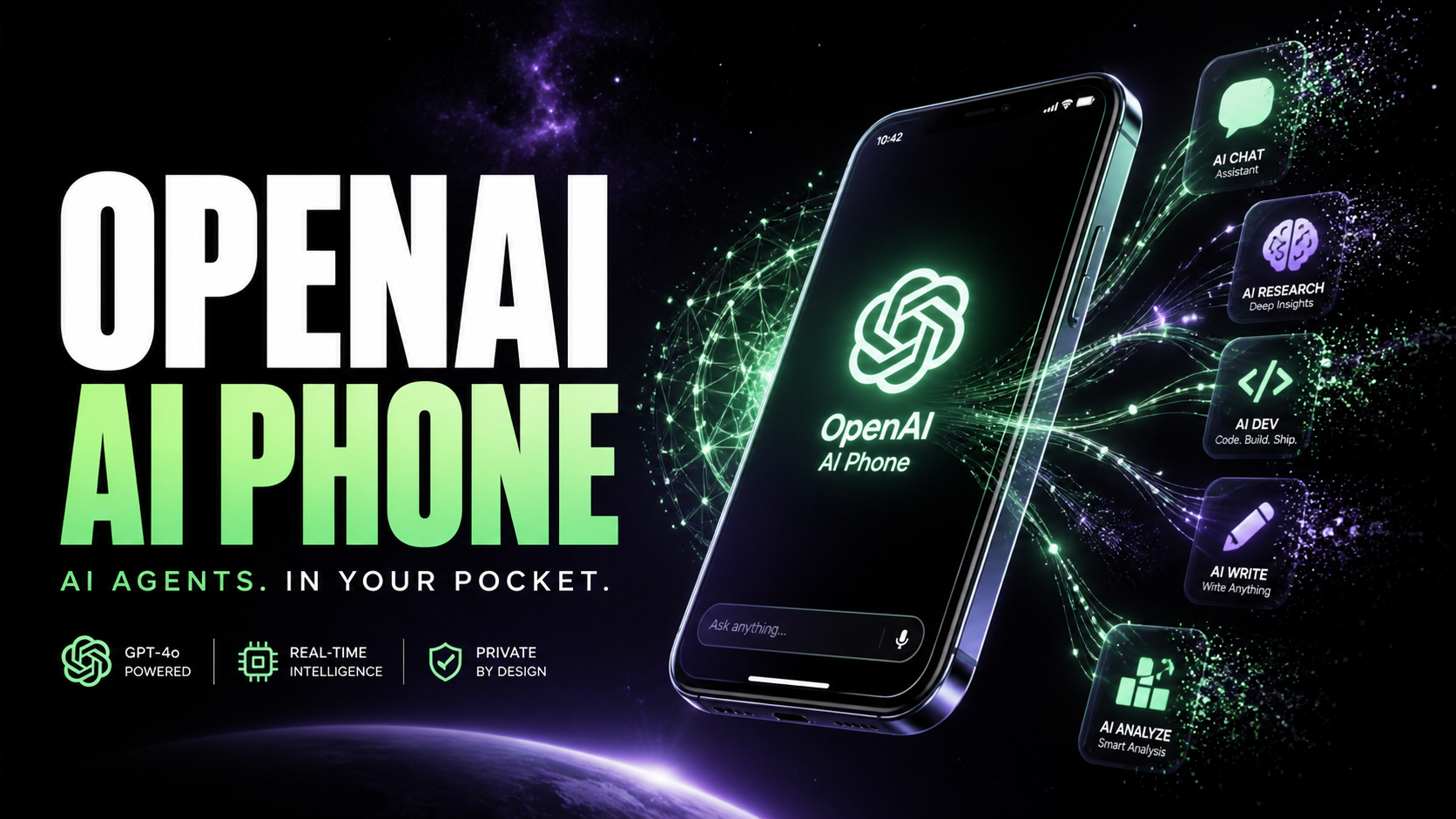
Table of Contents: Openai Ai Phone
OpenAI isn’t just building AI models anymore. According to industry analyst Ming-Chi Kuo and multiple reports, Sam Altman’s company is developing a smartphone where AI agents completely replace traditional apps. No App Store. No downloading. No swiping between apps. Just tell your phone what you want, and AI agents handle everything.
If this sounds like science fiction, consider this: OpenAI is already partnering with Qualcomm, MediaTek, and manufacturing giant Luxshare to build it. And separately, the company’s Jony Ive-designed device — codenamed “Sweetpea” — is on track for late 2026. OpenAI is going all-in on hardware, and the smartphone industry should be terrified.
The Vision: A Phone Without Apps: Openai Ai Phone
The OpenAI phone isn’t a smartphone with a better AI assistant. It’s a fundamentally different paradigm. The phone Kuo describes is one where the AI agent IS the interface and the app is obsolete.
Think about how you currently use your phone. You want to order food — you open DoorDash. You want to check the weather — you open a weather app. You want to send money — you open Venmo. Each task requires you to know which app to use, navigate that app’s specific interface, and manage dozens of accounts and passwords.
The OpenAI phone eliminates all of that. You say “order me Thai food from that place I liked last week” and an AI agent handles the rest — finding the restaurant, placing the order, paying, and tracking delivery. No app needed. No interface to navigate. The AI agent becomes the only interface you ever interact with.
This is what OpenAI has been building AI agents for — not just chatbots, but autonomous systems that can interact with the digital world on your behalf.
How It Works: AI Agents as Your Interface: Openai Ai Phone
The technical architecture behind the OpenAI phone is a hybrid system that splits processing between on-device and cloud:
On-device processing handles:
- Context awareness — knowing where you are, what you’re doing, who’s around you
- Memory management — remembering your preferences, routines, and past interactions
- Smaller AI models — for quick, privacy-sensitive tasks that don’t need cloud inference
- Environmental sensing — processing camera, microphone, and sensor data locally
Cloud processing handles:
- Complex reasoning and inference — the heavy lifting that requires GPT-level intelligence
- Multi-step agent workflows — coordinating across services, APIs, and external systems
- Real-time information — weather, news, prices, availability
- Deep personalization — learning from your patterns across long time horizons
The device maintains what reports describe as “full real-time state” — continuously capturing your location, activity, communication patterns, and environmental context. This state information feeds the agents, allowing them to proactively anticipate your needs rather than waiting for you to ask.
The Hardware Partners: Qualcomm, MediaTek, and Luxshare
OpenAI isn’t building this alone. The partnership structure reveals how serious this project is:
- Qualcomm — Likely providing the primary mobile processor (Snapdragon series) with integrated NPU (Neural Processing Unit) for on-device AI inference
- MediaTek — Co-developing a custom AI smartphone chip with OpenAI. MediaTek’s Dimensity series already leads in on-device AI performance
- Luxshare — Manufacturing partner. Luxshare is one of Apple’s key suppliers, manufacturing AirPods and Apple Watch components. Their involvement signals production-grade hardware, not a concept device
The fact that OpenAI is working with both Qualcomm and MediaTek suggests they’re either hedging their bets or developing custom silicon that combines capabilities from both chipmakers — potentially a dedicated AI chip paired with a traditional mobile SoC.
On-Device vs. Cloud: The Hybrid Architecture
The biggest technical challenge isn’t building agents — it’s making them fast enough to replace native apps. When you tap the Instagram icon, the app opens in under a second. If an AI agent takes 5 seconds to process your request, the phone is dead on arrival.
OpenAI’s solution is the hybrid architecture: lightweight models run locally for instant response, while complex tasks are offloaded to the cloud. The device pre-caches common actions based on your patterns — if you always check the weather at 7 AM, the agent has already fetched it before you ask.
This is where the custom chip partnership with MediaTek becomes critical. Running meaningful AI inference on a mobile device requires purpose-built silicon, not just a general-purpose CPU with an NPU bolted on. Google’s approach with Gemini Nano shows it’s possible, but OpenAI will need to go further if agents are truly replacing apps.
Always Listening, Always Watching: The Privacy Question
Here’s where things get uncomfortable. For AI agents to work as described, the phone needs to be always listening and always aware. It needs to know your location, your calendar, your conversations, your habits, and your surroundings — continuously.
This is a privacy nightmare that makes current smartphone tracking look quaint. The difference between Siri listening for a wake word and an AI agent maintaining “full real-time state” is enormous. One is a passive microphone waiting for a trigger. The other is an active intelligence system processing everything happening around you, all the time.
The Anthropic-Pentagon dispute over AI surveillance shows just how politically charged this territory is. If a frontier AI company is being blacklisted for refusing to enable government mass surveillance, what happens when every consumer is carrying an always-aware AI device in their pocket?
OpenAI hasn’t addressed these concerns publicly. And that silence is deafening.
The Jony Ive Device: Coming Late 2026
Separate from the smartphone project, OpenAI has a nearer-term hardware product designed by former Apple design chief Jony Ive. Here’s what we know:
- Company acquired: OpenAI bought io Products (Ive’s hardware startup) for approximately $6.5 billion in an all-stock deal in May 2025
- Codename: “Sweetpea”
- First product: A smart speaker with an integrated camera and Face ID-style facial recognition, priced between $200-$300
- Additional products: A smart lamp and potentially AI glasses are also in development
- Manufacturing: Foxconn is reportedly manufacturing 40-50 million units
- Timeline: OpenAI exec Chris Lehane confirmed the first device will debut in the second half of 2026
- Design team: Former Apple designer Evans Hankey leads industrial design, with Ive making final design decisions
The smart speaker appears to be a beachhead product — a way to get OpenAI hardware into homes before the more ambitious smartphone launches. Think of it as the Echo Dot strategy: establish a hardware presence, build a user base, then expand.
Can This Kill the iPhone?
Let’s be real: no. Not in 2028. Probably not in 2030. The iPhone has a 17-year ecosystem advantage, hundreds of millions of apps, and the deepest customer loyalty in consumer electronics history.
But the OpenAI phone doesn’t need to kill the iPhone to succeed. It needs to prove that the concept works — that AI agents can replace apps for enough use cases to make the traditional app paradigm feel outdated. If it captures even 5% of the smartphone market, that’s 70+ million devices running OpenAI’s agents as the primary interface.
Apple knows this. That’s why Apple Intelligence exists — it’s Apple’s preemptive defense against exactly this kind of disruption. Siri’s agentic capabilities, on-device AI processing, and App Intents framework are all designed to make apps agent-accessible before someone else makes them unnecessary.
The real question isn’t whether the OpenAI phone kills the iPhone. It’s whether it forces Apple to make the iPhone more like the OpenAI phone — and whether Apple can get there fast enough.
The App Store Apocalypse: Who Loses?
If AI agents replace apps, the casualties are obvious and massive:
- Apple and Google — The App Store and Play Store generated a combined $150+ billion in 2025. If agents replace apps, that revenue stream evaporates
- App developers — Millions of developers who build apps for a living would need to pivot to building agent-compatible services or APIs
- Advertising industry — In-app advertising is a $300+ billion market. If there are no apps, there are no in-app ads
- UI/UX designers — If the AI is the interface, traditional interface design becomes less relevant
The winners? Service providers who expose clean APIs that agents can interact with. If the OpenAI phone’s agent wants to book a hotel, it doesn’t need Booking.com’s app — it needs Booking.com’s API. The companies that make their services agent-accessible first will have an enormous advantage.
Timeline: When Is It Coming?
Based on current reporting:
- Late 2026 — Jony Ive smart speaker device launches (first OpenAI hardware product)
- Late 2026 / Q1 2027 — Smartphone specifications and component suppliers finalized
- 2027 — Development and testing phase for the OpenAI phone
- 2028 — Mass production begins; OpenAI phone launches to consumers
That’s a two-year wait for the phone itself. But the smart speaker in late 2026 will give us the first real taste of what an OpenAI hardware experience feels like — and whether the AI-first approach to hardware can actually deliver on its promises.
Reality Check: Will It Actually Work?
History is littered with failed smartphone challengers. The Amazon Fire Phone. The Essential Phone. The Facebook Phone. Even Microsoft couldn’t make Windows Phone work. Every single one tried to compete with iOS and Android on their terms and lost.
OpenAI’s approach is different — it’s not trying to build a better smartphone. It’s trying to build a different category entirely. The question isn’t “is this a good phone?” but “is an agent-first device a viable alternative to a phone?”
The honest answer: probably not yet. AI agents in 2026 are impressive but unreliable. They hallucinate, they misunderstand context, they fail on edge cases. An app might have a clunky interface, but it reliably does what you tap. An AI agent that orders the wrong food, sends money to the wrong person, or books the wrong flight isn’t just annoying — it’s unusable.
But here’s the thing about technology: the gap between “unusable” and “indispensable” can close faster than anyone expects. In 2022, AI chatbots were a novelty. In 2026, they’re writing code, passing bar exams, and replacing knowledge workers. Give agents two more years of development, and the 2028 launch might hit at exactly the right moment.
The smartphone as we know it has been the same for 17 years. OpenAI is betting that 2028 is the year that changes. Whether you think they’re visionary or delusional, the bet has been placed.
Understanding the full scope of the OpenAI AI phone situation requires looking at both the immediate impact and long-term consequences. The OpenAI AI phone story has generated significant discussion among industry analysts, with many pointing to the OpenAI AI phone developments as a potential turning point for the sector.
What makes the OpenAI AI phone case particularly noteworthy is the speed at which events unfolded. Within days of the initial OpenAI AI phone announcement, competitors and stakeholders began repositioning their strategies. The ripple effects of OpenAI AI phone continue to be felt across the technology industry.
Looking ahead, the OpenAI AI phone developments are expected to influence policy decisions and investment strategies throughout 2026 and beyond. Experts suggest that the OpenAI AI phone outcome could serve as a blueprint for similar situations in the future, making the OpenAI AI phone case a critical reference point for the industry.
For readers following the OpenAI AI phone story, staying informed about new developments is essential. The OpenAI AI phone situation remains fluid, and additional details are expected to emerge in the coming weeks.
Industry observers note that the OpenAI AI phone impact extends beyond the immediate parties involved. The broader implications of OpenAI AI phone are reshaping how organizations approach strategic planning in this space.
Key Takeaway: The OpenAI AI Phone story represents a major shift in the technology landscape for 2026. As OpenAI AI Phone continues to make headlines, we’ll keep tracking developments and providing analysis on SudoFlare.
The implications of the OpenAI AI phone story extend far beyond what most analysts initially predicted. Industry experts continue to debate the long-term impact of OpenAI AI phone on the broader technology ecosystem.