2026 Graduates Are Booing AI at Commencements Across America — And the Tech Industry Should Be Terrified
Table of Contents
Table of Contents
Graduates Are Booing AI at 2026 Commencement Speeches — And It Is Not Stopping
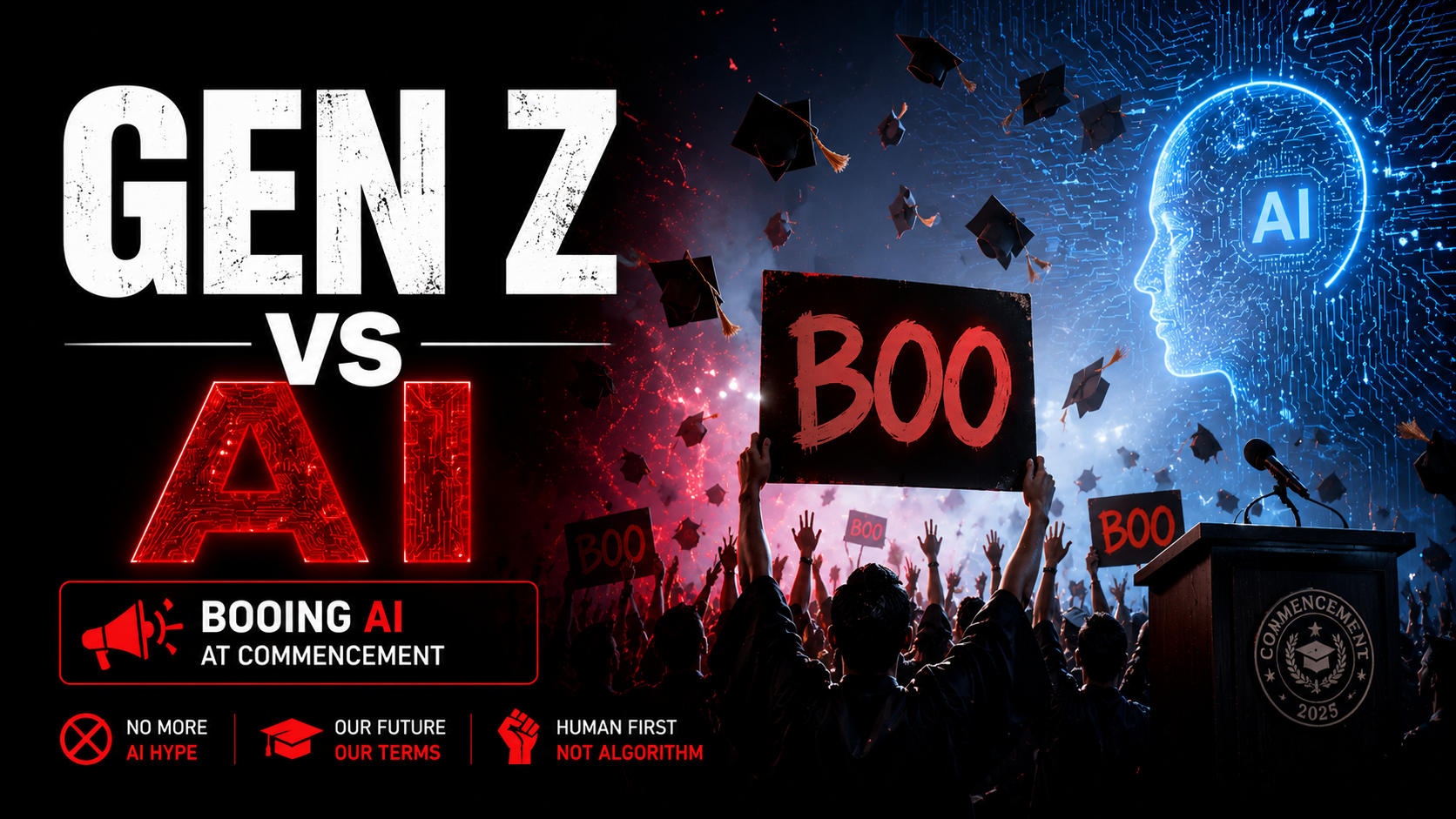
Something remarkable is happening at college commencement ceremonies across America in 2026. Graduating students — the same generation that grew up with smartphones, social media, and digital everything — are booing speakers who praise artificial intelligence. Not polite disagreement. Not awkward silence. Full-throated, stadium-wide booing that is making national headlines and sending a message the tech industry cannot ignore.
The pattern has repeated at universities from coast to coast. A speaker takes the stage, delivers the usual inspirational platitudes about embracing the future, pivots to AI as the defining opportunity of their generation — and the boos start. At Middle Tennessee State, at University of Central Florida, at University of Arizona, and at multiple other schools across the country, the Class of 2026 is making its position clear: they are not buying what Silicon Valley is selling.
This is not a fringe movement. It is a generational rejection of the AI optimism narrative — and it has profound implications for the technology industry, the labor market, and the political landscape around AI regulation.
Former Google CEO Eric Schmidt Got Booed Repeatedly at University of Arizona
Perhaps the most high-profile incident occurred on May 15 at the University of Arizona commencement, where former Google CEO Eric Schmidt was the featured speaker. Schmidt, who has been one of the most vocal advocates for AI development, attempted to deliver remarks about how AI would shape the future and create new opportunities.
The graduates were not having it. According to Slate’s coverage, Schmidt was repeatedly booed throughout his address, with the disruptions intensifying each time he mentioned AI. The spectacle of a billionaire tech executive being shouted down by the very generation his industry claims to be empowering was a potent visual — and it went viral on social media within hours.
Schmidt’s experience was particularly notable because he represents the establishment view of AI: it is inevitable, it will create more jobs than it destroys, and the only correct response is to embrace it. The graduates’ reaction suggested that they have heard this argument, considered it, and found it unconvincing — or worse, insulting.
Music Exec Scott Borchetta Told Graduates to ‘Deal With It’ — The Boos Got Louder
At Middle Tennessee State University on May 9, record executive Scott Borchetta — best known as the founder of Big Machine Records — triggered an eruption of boos when he told graduates that “AI is rewriting production as we sit here.” His response to the booing was remarkably tone-deaf: “Deal with it. Like I said, it’s a tool.”
As the booing continued and grew louder, Borchetta doubled down: “Then do something about it. It’s a tool. Make it work for you.” The exchange, captured on video, became one of the defining clips of the 2026 commencement season. The irony was not lost on observers: a music industry executive telling graduates to embrace AI — the same technology that has been accused of replacing creative workers and devaluing human artistry — while dismissing their concerns with a shrug.
For the graduating music, business, and media students at MTSU, Borchetta’s message was not just unwelcome — it was personal. Many of them are entering industries that are already being reshaped by AI-generated content, AI-assisted production, and AI-driven automation. Being told to “deal with it” by someone who built his career before AI existed felt less like advice and more like contempt.
UCF Graduates Booed the ‘Next Industrial Revolution’ Comparison
At the University of Central Florida on May 8, real estate executive Gloria Caulfield described AI as “the next industrial revolution.” According to Fast Company’s reporting, the boos started almost immediately. The graduates’ reaction was swift, vocal, and sustained — turning what was supposed to be an inspirational moment into an uncomfortable confrontation.
The “industrial revolution” comparison is one that AI advocates frequently use, intending it as a compliment — AI will create as much wealth and progress as the industrialization of the 19th century. But for graduates who know their history, the industrial revolution was also a period of massive worker displacement, exploitation, child labor, environmental destruction, and social upheaval that took decades to resolve. When you tell a 22-year-old that they are about to live through another industrial revolution, they hear: “Your career is going to be disrupted, and the people profiting from it will tell you it is progress.”
Why Gen Z Hates AI: It Is Not Ignorance — It Is Lived Experience
The commencement booing is not an expression of technophobia or ignorance. This is the most digitally native generation in history. They grew up with smartphones, social media, and the internet. They understand technology better than any previous generation. And that is precisely why they are skeptical of AI.
Gen Z has watched the previous cycle of tech promises play out in real time. Social media was supposed to connect people — instead it contributed to a mental health crisis. The gig economy was supposed to create flexibility — instead it created precarity. Big Tech was supposed to democratize information — instead it concentrated power and wealth. Now the same industry is promising that AI will create amazing new opportunities, and graduates are responding with the only rational conclusion available to them: why should we believe you this time?
One graduate quoted by U.S. News captured the sentiment perfectly: “How they’re making billionaires richer and depleting our environment has really opened our eyes to the ripple effects of AI.” This is not an anti-technology position. This is an anti-inequality position that uses AI as its focal point. The graduates are not opposed to AI in the abstract — they are opposed to a system where the benefits of AI accrue primarily to shareholders and executives while the costs are borne by workers entering the job market for the first time.
The Entry-Level Job Market Is Already Being Hollowed Out by AI
The graduates’ anxiety is not hypothetical — it is grounded in observable reality. Entry-level positions in fields like copywriting, graphic design, customer service, data entry, and basic coding have already contracted significantly as companies adopt AI tools that can perform these tasks at lower cost. The traditional career ladder — start at the bottom, learn the ropes, work your way up — is being dismantled from the bottom rung.
For the Class of 2026, the job market is a paradox. Companies want experienced workers who can supervise and fine-tune AI systems, but the entry-level jobs that would have provided that experience are being automated away. It is a Catch-22 that leaves new graduates feeling simultaneously overqualified and underqualified for the jobs that remain.
This is the context that commencement speakers are walking into when they extol the virtues of AI. When a billionaire tells a room full of debt-laden graduates that AI will create “amazing opportunities,” those graduates are hearing it through the filter of rejected job applications, LinkedIn posts about “AI-first hiring,” and news stories about mass layoffs at companies posting record profits. The disconnect between the optimistic narrative and the lived experience is creating a credibility gap that no amount of inspirational speechmaking can bridge.
The Tech Industry’s Response Has Been Remarkably Tone-Deaf
What makes the commencement booing phenomenon even more striking is how poorly the tech industry has responded. Instead of acknowledging the graduates’ legitimate concerns, the default response has been to dismiss them as uninformed, emotional, or resistant to change. Borchetta’s “deal with it” was the most extreme example, but the general pattern — acknowledge AI might cause some disruption, then pivot to how exciting the opportunities are — has been repeated by speaker after speaker.
NPR’s reporting titled their coverage with advice that was unmistakable: if you are giving a commencement speech in 2026, do not bring up AI. The fact that this has become universal advice for public speakers tells you everything about how badly the tech industry has misread the room. When your product has become so unpopular with young people that mentioning it at their graduation ceremony triggers jeering, you have a branding problem that no amount of marketing can fix.
What This AI Backlash Means for the Future of Technology
The 2026 commencement booing is more than a series of awkward moments — it is an early indicator of a political and cultural shift that could reshape the AI industry. The graduates booing today are the workers, consumers, voters, and potential regulators of tomorrow. Their skepticism toward AI is not going to soften as they enter a workforce that is being reorganized around technology they view with suspicion and resentment.
For the AI industry, the implications are significant. Public support matters — not just for customer acquisition, but for the regulatory environment. If a generation of workers views AI primarily as a tool for enriching executives while eliminating their career prospects, the political appetite for aggressive AI regulation will grow. That could mean restrictions on AI deployment in hiring, mandatory disclosure requirements for AI-generated content, or even tax policies that penalize automation-driven layoffs.
The tech industry has a narrow window to change this trajectory. That means not just talking about how AI will create new jobs, but actually creating those jobs. It means investing in reskilling programs that are more than PR exercises. It means sharing the economic gains of AI with workers, not just shareholders. And it means listening to the people booing at commencements — because they are telling you something important, and ignoring them is the most dangerous thing Silicon Valley could do right now.