Apple Will Be Forced to Let You Replace AirPlay With Google Cast in iOS 27 — The EU Just Won Another Battle
Table of Contents
The EU Strikes Again — And This Time It’s AirPlay
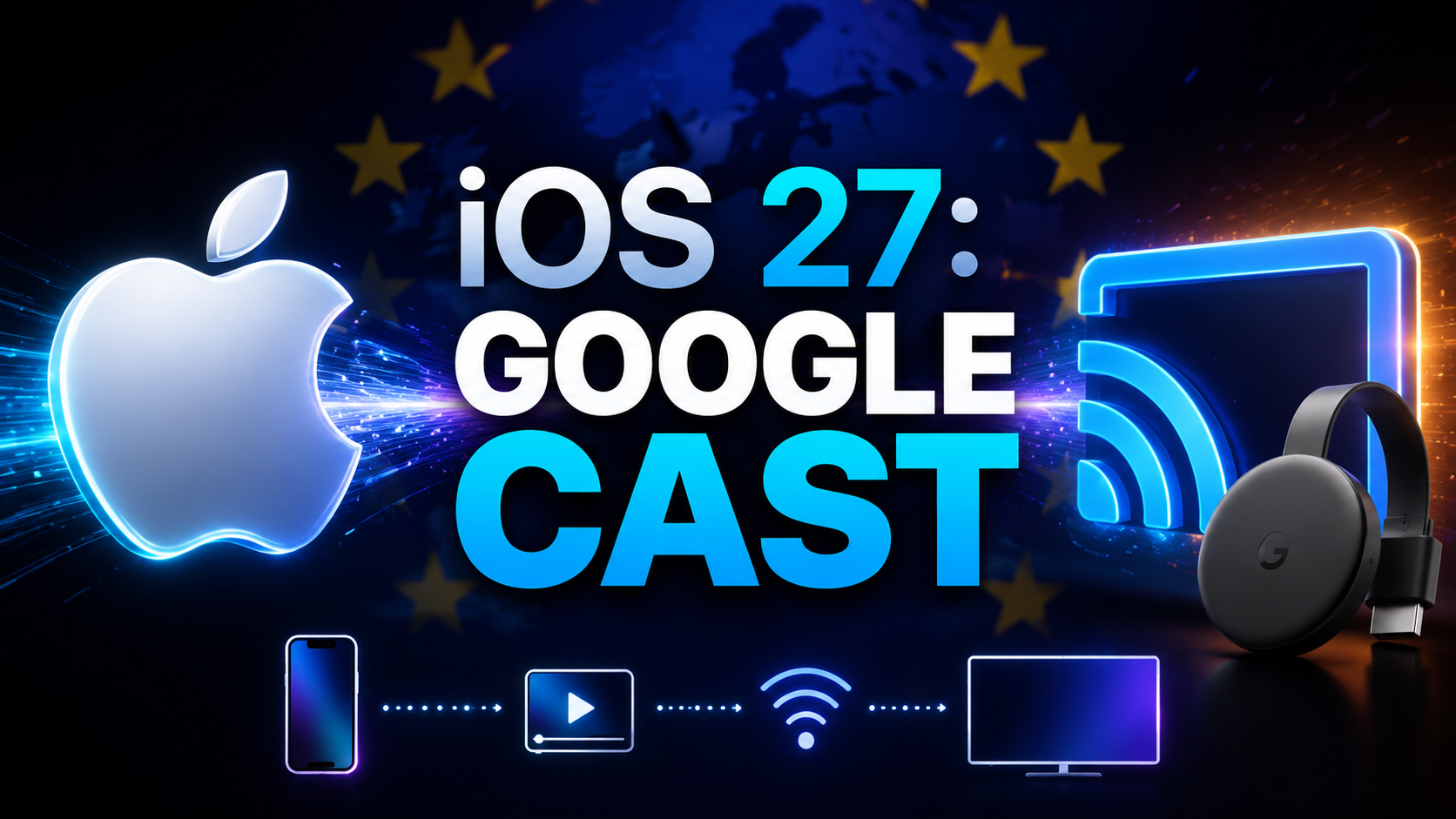
Apple is preparing to add native support for Google Cast and other third-party streaming protocols in iOS 27, according to Bloomberg’s Mark Gurman. The change is being driven by the European Union’s Digital Markets Act (DMA), which requires Apple to open up its platform to competing technologies in key areas.
For years, if you wanted to wirelessly stream content from your iPhone to a TV or speaker, you had exactly one choice: AirPlay. Third-party protocols like Google Cast worked, but only on an app-by-app basis — never as a system-level default. That monopoly is about to end, at least in Europe.
What Is Actually Changing in iOS 27
Currently, iOS supports only one streaming protocol natively: Apple’s own AirPlay. Third-party options like Google Cast (formerly Chromecast), Miracast, and others are locked out of system-level integration. They can only function within individual apps that have specifically built in support.
Under the iOS 27 changes, EU users will be able to set Google Cast or other third-party streaming protocols as their default casting solution. This means that when you tap the cast/share button anywhere in iOS, the system will use your chosen protocol instead of automatically defaulting to AirPlay.
Google Cast is the most obvious beneficiary — it’s the most popular third-party protocol, powering Chromecast devices, Google TV, and hundreds of third-party smart speakers and displays. But the change theoretically opens the door to any streaming protocol: Miracast, DLNA, or even custom protocols from manufacturers like Samsung, LG, or Sony.
Why This Matters More Than You Think
This isn’t just about convenience. AirPlay exclusivity has been one of the most effective lock-in mechanisms in Apple’s ecosystem. If you own an iPhone and want to cast content to your TV, you need an Apple TV, an AirPlay-compatible smart TV, or a HomePod. Google Cast devices — despite being dramatically cheaper and more widely available — are second-class citizens.
By forcing Apple to support Google Cast natively, the EU is attacking one of the invisible threads that keeps users locked into the Apple ecosystem. When a $35 Chromecast works just as well as a $149 Apple TV for casting from your iPhone, the value proposition of Apple’s hardware ecosystem changes significantly.
This is similar to how the emerging AI phone concepts are challenging the traditional smartphone ecosystem — by removing artificial barriers that only exist to maintain vendor lock-in.
The Google Cast Advantage
Google Cast has several advantages over AirPlay that Apple users have never been able to fully leverage:
Price. A Chromecast with Google TV costs $30-50. An Apple TV starts at $149. For casting video from your phone, they do essentially the same thing.
Ubiquity. Google Cast is built into virtually every non-Apple smart TV, smart speaker, and streaming device. LG, Samsung, Sony, Vizio, JBL, Sonos, and hundreds of other brands all support it. AirPlay compatibility, while growing, is still limited by comparison.
Cross-platform support. Google Cast works with Android, iOS (within apps), Windows, Mac, ChromeOS, and Linux. AirPlay only works within the Apple ecosystem.
Multi-room audio. Google’s speaker group functionality for synchronized audio across multiple rooms is more mature and affordable than Apple’s equivalent.
With native iOS integration, these advantages become directly accessible to iPhone users for the first time — without needing to rely on app-by-app implementations.
Apple’s Reluctant Compliance Pattern
If this sounds familiar, it’s because Apple has been reluctantly complying with DMA requirements across multiple fronts. The pattern is always the same: Apple fights the regulation, loses, implements the minimum viable compliance, and restricts it to EU users only.
We’ve already seen this with third-party app stores (allowed in the EU, nowhere else), default browser selection (changed in the EU first), NFC access for third-party payment apps (EU requirement), and now AirPlay alternatives. Apple treats DMA compliance as a regional obligation, not a product improvement.
The broader tech industry debate about open vs. closed platforms continues to intensify, with the EU consistently pushing for more openness while US regulators take a lighter touch.
Will This Come to the US?
Probably not anytime soon. Apple has historically limited DMA-driven changes to the European Union, offering the bare minimum required by law and keeping its global user base locked into its preferred architecture.
However, there’s an argument that maintaining two separate versions of iOS — one for the EU and one for the rest of the world — creates engineering complexity that could eventually push Apple toward global implementation. And if Google Cast support proves popular among EU iPhone users, the pressure to bring it worldwide will intensify.
The ongoing cost-cutting across Big Tech might actually accelerate this — maintaining separate codepaths for different regions is expensive, and at some point the engineering cost of EU-only features exceeds the business value of keeping them restricted.
The Bigger DMA Picture: Apple’s Walled Garden Is Cracking
The Digital Markets Act has forced Apple to make more changes to iOS in the last two years than the company would have made voluntarily in a decade. Third-party app stores. Default app selection. Payment processing alternatives. NFC access. And now, streaming protocol choice.
Each individual change might seem minor. But taken together, they represent a fundamental erosion of the walled garden strategy that has been Apple’s core competitive advantage since the iPhone launched. Every hole in the wall is a potential exit point for users — and a potential entry point for competitors.
Google is the biggest beneficiary of almost every DMA requirement. Google Cast replaces AirPlay. Chrome can become the default browser. Google Pay gets NFC access. YouTube can promote its own app store alternative. The DMA is essentially a Google empowerment act dressed up as consumer protection.
What This Means for Hardware and Software Developers
For hardware manufacturers, native Google Cast support in iOS is a game-changer. Companies that have been building AirPlay support into their devices — often paying Apple licensing fees for the privilege — now have an alternative path to iPhone compatibility. Cheaper devices that support Google Cast but not AirPlay suddenly become viable options for iPhone users.
For app developers, the change could simplify casting implementation. Instead of building separate AirPlay and Google Cast paths (which many apps already do), developers could potentially rely on the system-level casting protocol the user has chosen.
For the smart home industry, this opens the door to deeper iPhone integration with Google Home and other non-Apple ecosystems. The recent advances in Google’s Gemini AI being integrated into Google Home make this timing particularly interesting.
The Timeline: When Will iOS 27 Drop?
Apple typically announces the next version of iOS at its Worldwide Developers Conference (WWDC) in June, with a public release in September. WWDC 2026 is expected in the first or second week of June — just weeks away.
If Google Cast support is indeed coming in iOS 27, we’ll likely hear about it at WWDC, though Apple may not highlight it prominently. The company tends to downplay features it was forced to implement, burying them in technical sessions rather than showcasing them in the keynote.
For now, the message is clear: the EU’s Digital Markets Act continues to reshape the tech industry in ways that benefit consumers and competitors alike. Whether you love or hate regulation, AirPlay’s monopoly on iPhone casting is coming to an end — and a $35 Chromecast might finally be all you need.