Microsoft Dumps OpenAI: 7 Homegrown MAI Models Built From Scratch at Build 2026
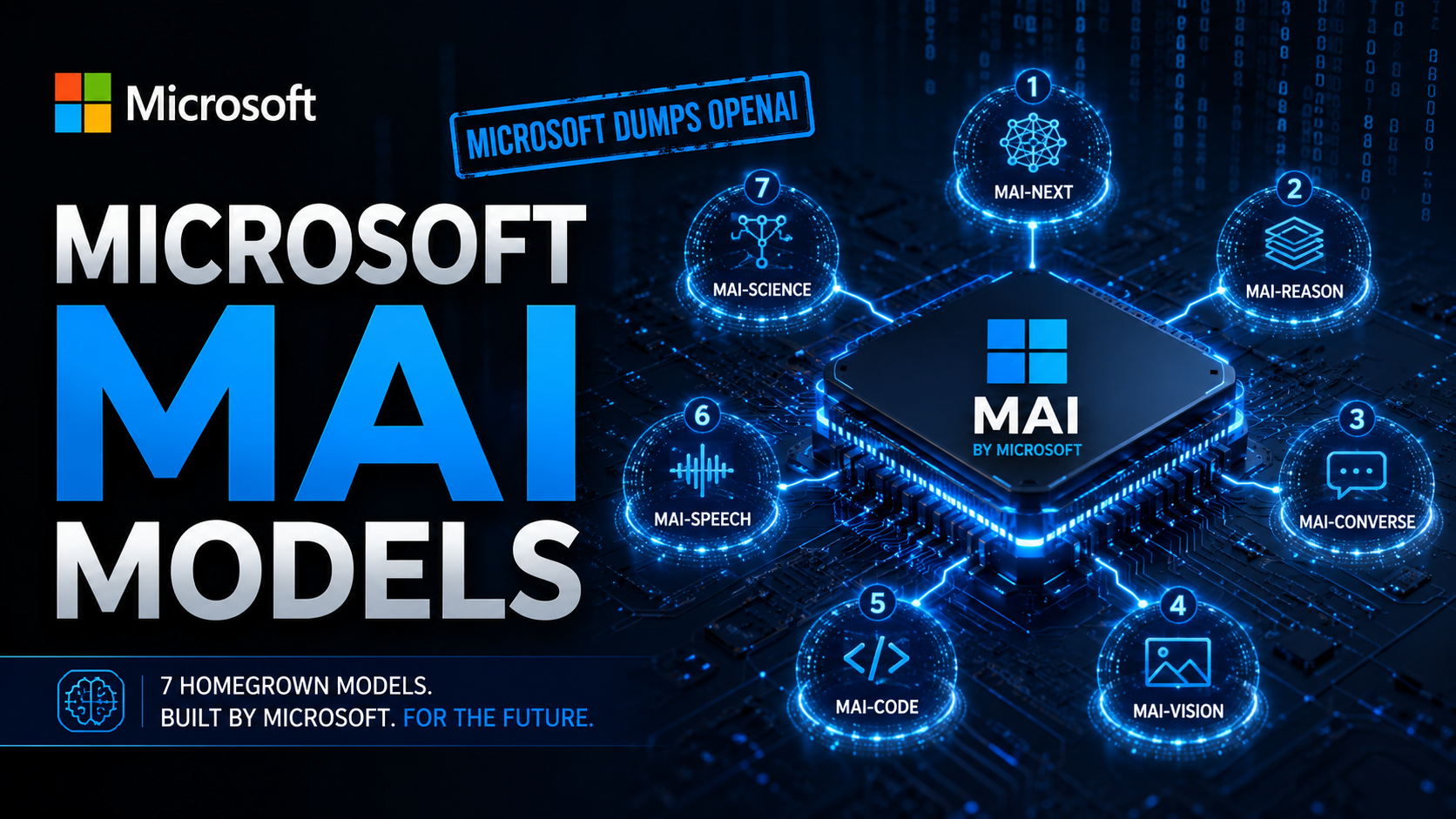
Microsoft just told OpenAI it doesn’t need them anymore — at least not exclusively. At Build 2026, Microsoft unveiled seven proprietary AI models built entirely in-house under the new MAI (Microsoft AI) brand. No OpenAI technology. No distillation from GPT. No borrowed architectures. These are Microsoft’s own models, built from scratch.
The move marks the most dramatic shift in the Microsoft-OpenAI relationship since the original $13 billion investment. After years of being OpenAI’s biggest customer, distributor, and cloud provider, Microsoft is now positioning itself as a direct competitor in the model-building space.
Microsoft Builds 7 AI Models Without OpenAI
The seven MAI models were announced at Build 2026 on June 2, representing Microsoft’s first major proprietary model family. The AI chief described the company as being “set free” from OpenAI to pursue its own path to superintelligence — a remarkably blunt statement about a partnership that was once described as the most important in tech.
The partnership agreement was altered in January 2026 and further amended in April, ending Microsoft’s exclusive access to OpenAI’s intellectual property and AI models. In return, Microsoft got the freedom to build competing models — and it’s wasted no time doing exactly that.
The MAI Model Family Explained
| Model | Parameters | Type | Key Feature |
|---|---|---|---|
| MAI-Thinking-1 | 35B active | Reasoning | 256K context, multi-step reasoning |
| MAI-Code-1-Flash | 5B | Code | 51% SWE-Bench Pro |
| MAI-Image-2.5 | Undisclosed | Vision | Text-to-image + image-to-image |
| MAI-Image-2.5-Flash | Undisclosed | Vision (Fast) | Optimized for speed |
| MAI-Text-1 | Undisclosed | General | Enterprise text tasks |
| MAI-Embed-1 | Undisclosed | Embeddings | Search & retrieval |
| MAI-Safety-1 | Undisclosed | Safety | Content filtering & guardrails |
MAI-Thinking-1: Microsoft’s First Reasoning Model
The flagship of the MAI family is MAI-Thinking-1, a reasoning model with 35 billion active parameters and a 256,000-token context window. Microsoft emphasizes that it was “trained from scratch on clean, commercially licensed data — with no distillation from OpenAI or any other third-party model family.”
That distinction matters enormously. Model distillation — where a smaller model is trained to mimic a larger one’s outputs — has been a controversial practice in the AI industry. By explicitly stating no distillation was used, Microsoft is asserting full ownership and commercial clarity over its model weights.
The 35 billion active parameter count suggests a mixture-of-experts architecture, where the total parameter count is much larger but only a subset activates for each query. This approach, pioneered by models like Mixtral and used extensively by Google’s Gemini, allows for powerful performance while keeping inference costs manageable.
MAI-Code-1-Flash: 5 Billion Parameters That Punch Above Their Weight
Perhaps the most impressive model in the lineup is MAI-Code-1-Flash. At just 5 billion parameters — roughly Haiku-scale — it achieves 51% on SWE-Bench Pro, a demanding benchmark that tests AI’s ability to solve real-world software engineering problems.
That score puts a 5B parameter model in the same ballpark as models 10-20x its size from just a year ago. For developers, the implications are significant: a model this small can run locally, be deployed at the edge, or be served at extremely low cost while still delivering competitive coding performance.
This is the “efficiency over brute force” approach that’s becoming increasingly important as AI deployment shifts from centralized cloud services to distributed, cost-sensitive applications. Not every AI agent needs a 400B parameter model behind it.
Why Microsoft Is Ditching OpenAI Dependency
The Microsoft-OpenAI relationship has been deteriorating for months. The January 2026 partnership amendments were the first public sign, ending the exclusive IP arrangement that had given Microsoft preferential access to OpenAI’s models.
Several factors drove the split:
Cost control: Microsoft was paying significant licensing fees to embed OpenAI models across its product line — Copilot, Azure, Office 365, and more. Building its own models eliminates these costs and gives Microsoft full control over its AI economics.
Competitive positioning: As long as Microsoft depended on OpenAI, it was essentially reselling someone else’s technology. With MAI, Microsoft can differentiate on model quality, customization, and pricing — competing directly with Google, Anthropic, and Amazon on Azure.
Strategic independence: Depending on a single model provider creates existential risk. If OpenAI’s models falter, or if the relationship sours further, Microsoft needs its own foundation models to fall back on. The MAI family provides that insurance.
What This Means for Developers
MAI models are available through Azure AI Foundry, and Microsoft confirmed availability on third-party platforms including Fireworks AI, Baseten, and Open Router. This multi-platform availability is a strategic choice — Microsoft wants MAI models used everywhere, not just on Azure.
For developers currently using OpenAI’s API through Azure, the transition path is straightforward. MAI models use compatible API formats and can serve as drop-in replacements for many workloads. Microsoft is positioning MAI as the cost-effective alternative: same Azure infrastructure, lower model costs, no third-party licensing overhead.
The availability of MAI-Code-1-Flash at 5B parameters is particularly interesting for edge and mobile deployments. A model that small can run on modern smartphones and laptops, opening up offline AI coding assistance that doesn’t require cloud connectivity.
The Competitive Landscape Just Got More Crowded
The AI model market just got another major player. With Microsoft entering as both a cloud provider and a model developer, the competitive dynamics shift significantly:
Google has Gemini 3.1 Pro and its own cloud infrastructure. Anthropic has Claude and is heading toward its own IPO. OpenAI still has GPT and the largest consumer user base. Meta is pushing open-source with Llama. And now Microsoft has MAI, backed by the world’s largest cloud platform.
The losers in this fragmentation? Smaller model providers who can’t compete on infrastructure, distribution, or R&D budgets. The winners? Developers, who now have more choices, lower prices, and better tools than ever before.
The Bottom Line
Microsoft building seven proprietary AI models isn’t just a product announcement — it’s a declaration of independence from OpenAI. The company that invested $13 billion to become AI’s biggest backer is now saying, effectively, “thanks, but we’ll take it from here.”
Whether MAI models can truly compete with GPT, Claude, and Gemini remains to be seen. But the signal is clear: the era of Microsoft as OpenAI’s distribution partner is over. The era of Microsoft as an AI model competitor has begun.
Follow SudoFlare for the latest tech and AI news.