Blue Origin’s New Glenn Rocket Just Exploded on the Launchpad — And It Was Supposed to Beat SpaceX Next Week
Table of Contents
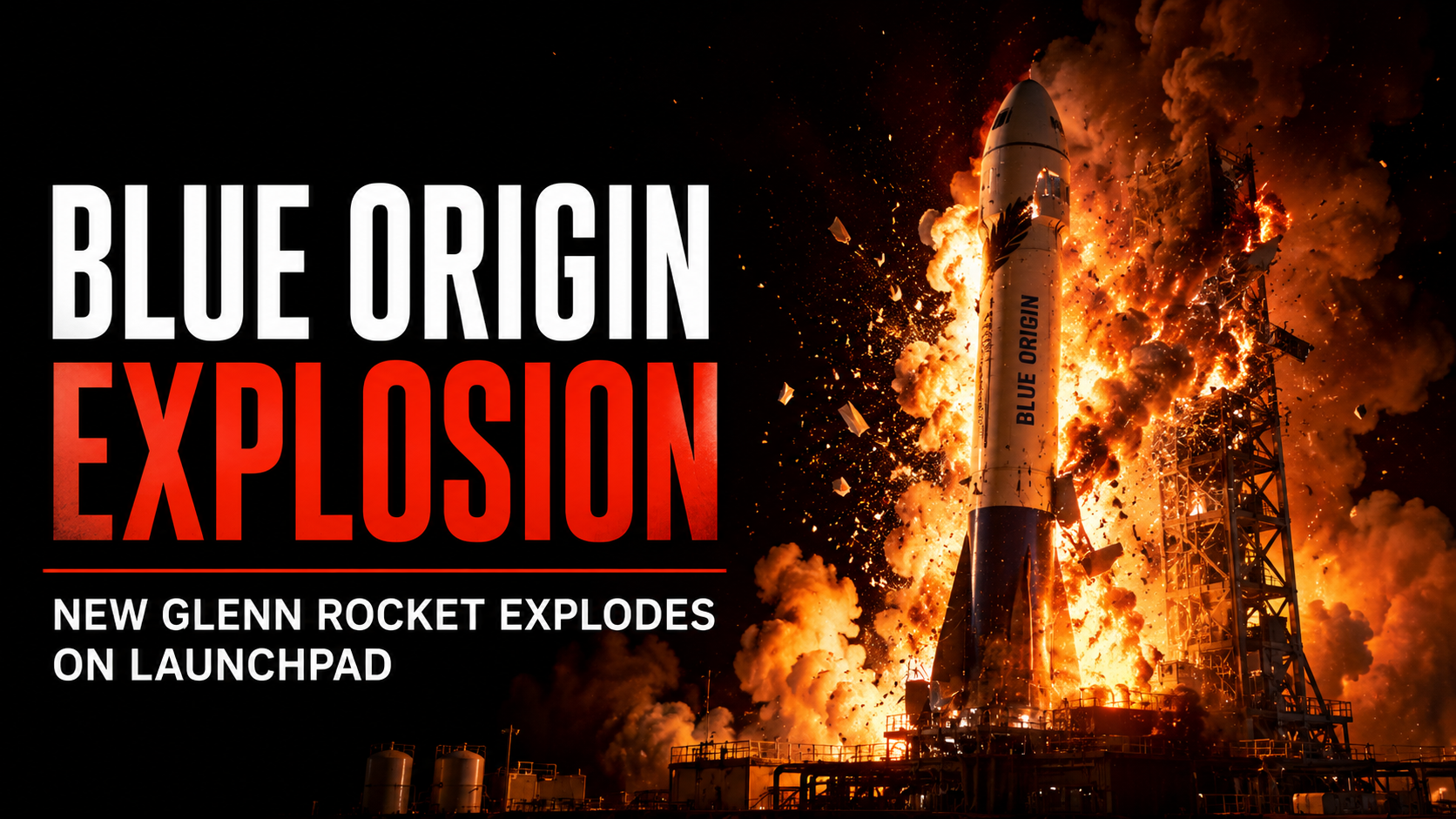
The Blue Origin New Glenn explosion on May 28, 2026, lit up the Florida sky and sent shockwaves through the space industry. Jeff Bezos’ flagship rocket detonated on the launchpad during a routine static fire test at Cape Canaveral Space Force Station, destroying the vehicle just days before it was scheduled to launch a batch of Amazon’s Leo satellites — the company’s answer to SpaceX’s Starlink constellation.
No one was injured. But the damage to Blue Origin’s credibility, its launch schedule, and Amazon’s satellite ambitions could take months or even years to repair.
What Happened at Cape Canaveral
At approximately 9:47 PM ET on May 28, Blue Origin’s New Glenn rocket was undergoing a static fire test — a standard pre-launch procedure where the engines ignite while the rocket remains bolted to the pad. Something went catastrophically wrong. The 320-foot rocket exploded, sending a fireball into the night sky that was visible for miles and shaking homes across Brevard County.
The Blue Origin New Glenn explosion occurred at Launch Complex 36, the same historic pad that once launched Atlas-Centaur rockets during the Apollo era. Cape Canaveral Space Force Station immediately issued a public safety advisory, warning that “launch vehicle debris is potentially hazardous” and that “direct contact poses a risk to personal health and welfare.”
Multiple videos posted to social media showed the explosion from various angles, with the initial flash followed by a sustained fire that burned for several hours as emergency crews responded. The Federal Aviation Administration confirmed it would be overseeing the investigation, as is standard procedure for any launch site incident.
The Blue Origin New Glenn Explosion Timeline
The static fire was being conducted ahead of New Glenn’s fourth launch, which had been scheduled for the following week. Here’s what the timeline looked like:
The test began normally, with countdown procedures following the expected sequence. Engines ignited at approximately T-0 for what was planned as a multi-second full-duration burn. Within seconds, telemetry data reportedly showed anomalies in one or more of the seven BE-4 methane-oxygen engines that power the first stage. The vehicle experienced a rapid unscheduled disassembly — the aerospace industry’s clinical term for an explosion.
The entire event, from ignition to detonation, lasted less than 15 seconds. But the consequences will be felt for far longer.
Debris Warnings and Public Safety Response
Cape Canaveral Space Force Station’s 45th Space Wing issued immediate warnings to the surrounding community. Debris from the Blue Origin New Glenn explosion was scattered across a significant area around the launch complex, and hazmat teams were deployed to assess potential environmental contamination from rocket propellant.
Residents in communities near the space station reported windows rattling and car alarms going off. Several local residents described the explosion as sounding like a thunderclap followed by sustained rumbling. While static fire tests are common at the cape, explosions of this magnitude during ground tests are exceptionally rare with modern rocket designs.
This Is New Glenn’s Second Major Failure
This is not New Glenn’s first significant setback. In April 2026, the rocket’s third flight ended in partial failure when an engine malfunction left a satellite payload in the wrong orbit. Blue Origin acknowledged the anomaly but characterized it as a learning experience that provided valuable flight data.
Now, with the launchpad explosion, the New Glenn program faces questions about fundamental reliability. Two major failures in two months suggests systemic issues rather than isolated incidents. The BE-4 engine, which Blue Origin also supplies to United Launch Alliance for its Vulcan Centaur rocket, will face intense scrutiny. Any design flaw in the BE-4 would have implications far beyond Blue Origin’s own launch manifest.
The company has invested over $15 billion in New Glenn development since the program’s inception, making it one of the most expensive private rocket programs in history. Each New Glenn vehicle is estimated to cost between $200 million and $400 million, meaning the launchpad explosion destroyed several hundred million dollars of hardware in seconds.
The Amazon Leo Satellite Problem
The immediate casualty of the Blue Origin New Glenn explosion is Amazon’s Leo satellite constellation — the company’s competitor to SpaceX’s Starlink internet service. The destroyed rocket was scheduled to deploy a batch of Leo satellites on its fourth mission, and every launch delay pushes Amazon further behind in the race to build satellite-based internet infrastructure.
Amazon has committed to deploying over 3,200 satellites for its Leo constellation, with an FCC-imposed deadline requiring half the constellation to be operational by 2029. SpaceX’s Starlink, by comparison, already has more than 7,000 satellites in orbit and has been launching at a pace of roughly one mission per week. Every month of delay for Blue Origin widens the gap.
The dependency on New Glenn makes this especially painful. Amazon’s initial Leo prototype satellites were launched on ULA’s Atlas V rockets, but the company’s long-term launch strategy relies heavily on New Glenn for its scale and cost advantages. With the rocket now grounded for an investigation that could last months, Amazon may need to seek alternative launch providers — potentially including SpaceX, which would be both ironic and expensive.
Jeff Bezos Responds
Jeff Bezos took to X shortly after the incident: “It’s too early to know the root cause but we’re already working to find it. Very rough day, but we’ll rebuild whatever needs rebuilding and get back to flying.”
The statement is measured but understates the severity. Blue Origin has been trying to establish itself as a reliable alternative to SpaceX for over a decade, and each failure reinforces the narrative that the company can’t match Elon Musk’s engineering execution. Blue Origin’s motto — “Gradatim Ferociter” (Step by Step, Ferociously) — is increasingly being used against it as critics ask how many steps it takes to achieve consistent reliability.
What This Means for Blue Origin vs SpaceX
The competitive dynamics couldn’t be more stark. While Blue Origin is dealing with a destroyed rocket and a grounded fleet, SpaceX continues to dominate the launch market. SpaceX’s Falcon 9 has achieved over 350 consecutive successful missions, and the company’s Starship program — despite its own early failures — has progressed to regular flight tests.
The national security implications are also significant. Blue Origin holds contracts with the U.S. Space Force and NASA’s Artemis program. A prolonged grounding could force these government customers to reallocate missions to other providers, further consolidating SpaceX’s already dominant position in the government launch market.
For the broader Big Tech ecosystem, the explosion highlights a fundamental challenge: building rockets is harder than building software. Amazon can iterate quickly on cloud services and AI models, but rocket development operates on a different timeline where failures are measured in hundreds of millions of dollars and months of delay.
The Artemis Program Impact
Blue Origin is a key contractor for NASA’s Artemis program, having won the contract to build the Human Landing System (HLS) that will carry astronauts to the lunar surface. While HLS uses a different vehicle architecture than New Glenn, any questions about Blue Origin’s engineering culture and quality control could ripple into the Artemis program’s timeline.
NASA has already faced repeated delays with Artemis, and adding uncertainty about a key contractor’s reliability won’t help. The investigation’s findings will be closely watched not just by Blue Origin’s commercial customers but by NASA leadership deciding how much confidence to place in the company’s hardware.
What Comes Next
Blue Origin will need to conduct a thorough investigation, identify the root cause, implement corrective actions, and obtain FAA clearance before New Glenn can fly again. Based on historical precedent from similar incidents at other launch providers, this process typically takes 3-6 months at minimum.
The financial impact will be substantial but manageable for a company backed by the world’s second-wealthiest person. Bezos has poured over $15 billion of his personal fortune into Blue Origin and has shown willingness to continue funding the company through setbacks.
The real question is whether the Blue Origin New Glenn explosion represents a temporary setback or a more fundamental problem with the program. Two failures in two months — one in flight and one on the ground — suggests that the root causes may be deeper than a single component failure. The investigation’s findings will determine whether New Glenn can recover its credibility or whether it joins the growing list of ambitious rocket programs that couldn’t quite get there.
For now, the Florida sky has gone dark over Launch Complex 36, and the space industry is watching to see how long the lights stay off.