Anthropic Just Raised $65 Billion and Is Now Worth More Than OpenAI — The AI Power Shift Nobody Expected
Table of Contents
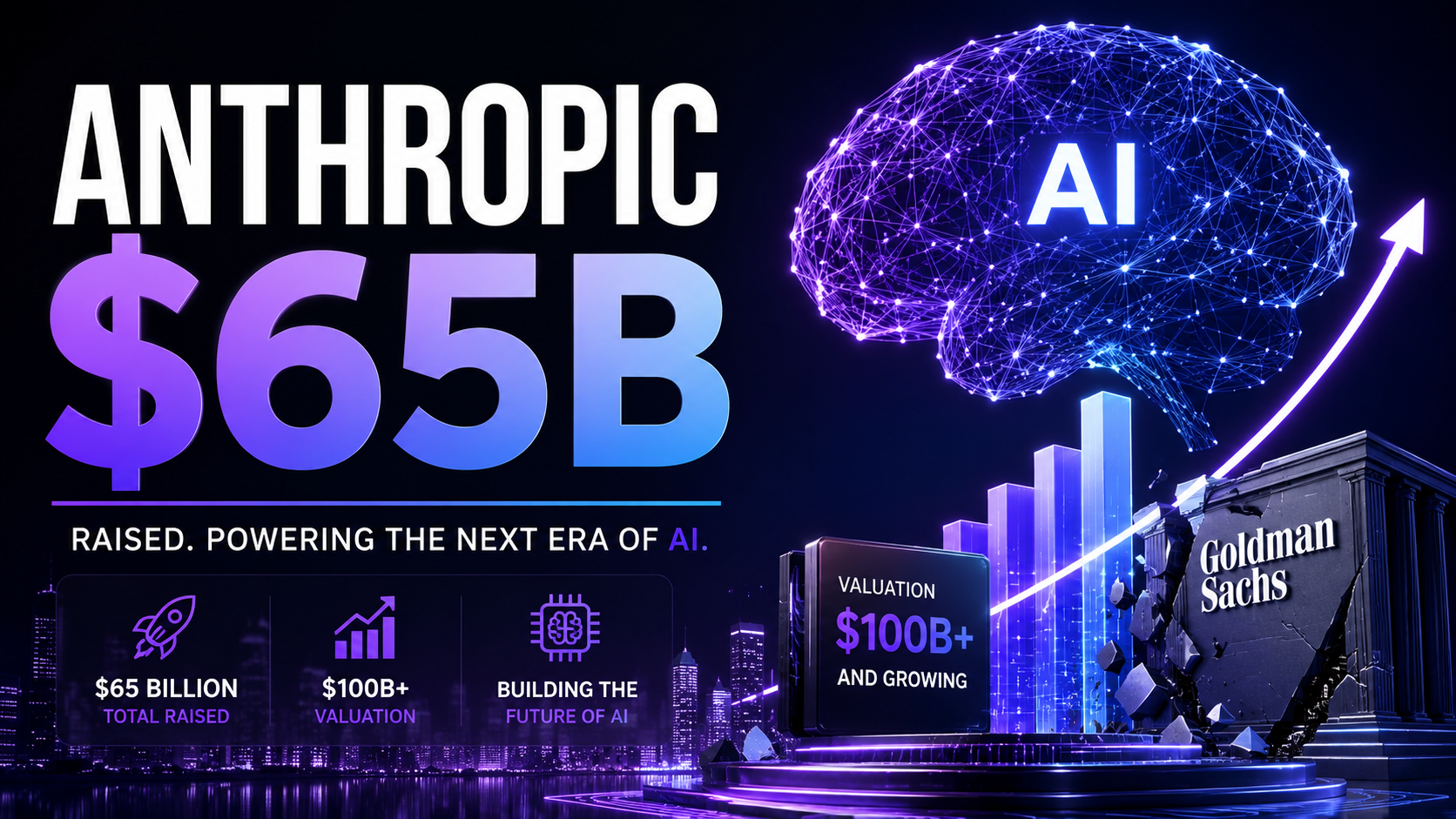
Anthropic just closed the largest private funding round in AI history. The Anthropic Series H round brought in $65 billion at a staggering $965 billion post-money valuation, and that number should terrify everyone at OpenAI, Google DeepMind, and every other lab trying to compete at the frontier of artificial intelligence.
This isn’t just another mega-round in an industry drowning in capital. This is the moment Anthropic officially leapfrogged OpenAI to become the most valuable AI startup on the planet — and it happened faster than anyone predicted.
The Numbers Behind Anthropic’s Series H Round
The Anthropic Series H round closed on May 28, 2026, raising $65 billion at a $965 billion post-money valuation. To put that in perspective, that’s more than the GDP of most countries and roughly equal to the market capitalization of companies like Walmart or JPMorgan Chase.
Of the $65 billion total, $15 billion came from previously committed investments by hyperscaler partners, including a $5 billion commitment from Amazon announced in April. The remaining $50 billion represents fresh capital from a consortium of the world’s most aggressive growth investors and strategic infrastructure partners.
The round was co-led by an unprecedented coalition: Altimeter Capital, Dragoneer Investment Group, Greenoaks Capital Partners, and Sequoia Capital each committed approximately $2 billion. Capital Group, Coatue Management, D1 Capital Partners, GIC (Singapore’s sovereign wealth fund), ICONIQ, and XN also participated with substantial allocations.
Who Backed the Biggest AI Fundraise in History
What makes this round unusual isn’t just its size — it’s the composition. Strategic infrastructure partners including Samsung, SK Hynix, and Micron all invested directly. These are the companies that manufacture the memory chips that make AI training possible, and their participation signals something important: they’re betting that Anthropic’s demand for compute will be so massive that it’s worth becoming equity partners rather than just suppliers.
Peter Thiel’s Founders Fund and General Catalyst, both existing Anthropic investors, increased their positions. The presence of GIC — which manages over $900 billion in assets for the Singapore government — adds sovereign-level validation to the bet.
This comes shortly after Cerebras filed for its own IPO, signaling that the AI infrastructure supply chain is consolidating around a small number of winners. The chip makers aren’t just selling to Anthropic — they’re investing in its future.
From $380 Billion to $965 Billion in Three Months
The velocity of Anthropic’s valuation growth is almost without precedent in business history. Just three months ago, in its Series G round in February 2026, Anthropic was valued at $380 billion. Going from $380 billion to $965 billion in a single quarter is a 154% increase — the kind of growth that would be remarkable for a seed-stage startup, let alone a company already worth hundreds of billions.
For context, it took Google about six years as a public company to go from a $380 billion market cap to $965 billion. Anthropic did it in 90 days as a private company.
The acceleration is driven by something concrete: revenue. Anthropic’s run-rate revenue crossed $47 billion earlier in May, according to the company’s own disclosure in its official Series H announcement. That’s not a projection — that’s actual money coming in the door from enterprise customers deploying Claude across their operations.
Anthropic vs OpenAI: The Valuation War
The most significant implication of the Anthropic Series H round is competitive. OpenAI’s most recent valuation stands at approximately $730 billion, based on secondary market transactions. That means Anthropic is now worth $235 billion more than the company that started the generative AI revolution with ChatGPT.
OpenAI isn’t standing still. The company filed a confidential S-1 with the SEC on May 22, targeting a September 2026 IPO at a valuation between $852 billion and $1 trillion. But even if OpenAI hits the high end of that range, it would still trail Anthropic’s current private valuation by roughly $100 billion.
The talent war tells the same story. Just weeks before the Series H closed, Andrej Karpathy — OpenAI’s co-founder and one of the most respected AI researchers alive — joined Anthropic to lead a new pre-training research team. Losing Karpathy to your direct competitor is the kind of signal that investors notice. It’s also the kind of signal that Big Tech companies watching the AI race cannot ignore.
Revenue Growth That Defies Logic
Anthropic’s financial trajectory has been extraordinary. The company generated $4.8 billion in Q1 2026 revenue, then projected $10.9 billion for Q2 — more than doubling quarter-over-quarter. That Q2 figure alone exceeds Anthropic’s entire 2025 revenue.
The revenue is coming from enterprise adoption of Claude, Anthropic’s AI model family. KPMG deployed Claude to its 276,000+ professionals across 138 countries. Financial institutions, law firms, healthcare organizations, and government agencies have all signed major contracts.
What’s perhaps more impressive is that Anthropic is on track for its first quarterly operating profit — ever. For a company burning billions on compute and talent, reaching profitability this quickly suggests that the unit economics of frontier AI models may be more favorable than skeptics assumed. The company that was once dismissed as “the safety-focused lab that would never compete commercially” is now printing money faster than its rivals.
What Anthropic Plans to Do With $65 Billion
According to Anthropic’s official announcement, the funding will be directed toward three priorities. First, advancing safety and interpretability research — the foundational mission that distinguishes Anthropic from its competitors. The company has consistently argued that building safer AI requires being at the frontier, and $65 billion buys a lot of frontier research.
Second, expanding compute capacity to meet growing demand for Claude. This is where the strategic partnerships with Samsung, SK Hynix, and Micron become critical. Training and serving frontier models requires massive quantities of specialized memory chips, and having your chip suppliers as equity partners ensures preferential access.
Third, scaling the products and partnerships that enterprise customers rely on. Anthropic has been building out its agent ecosystem, and the Series H funding will accelerate the rollout of autonomous AI agents that can operate across enterprise workflows.
The IPO Question
The elephant in the room is whether this is Anthropic’s last private round. Multiple reports have described the Series H as potentially the company’s “final private fundraise before a highly anticipated IPO.” With a $965 billion valuation, Anthropic is already larger than most public companies, and the only way to provide liquidity to early investors and employees is through public markets.
If Anthropic does go public, it would join what’s shaping up to be the most consequential IPO season in tech history. OpenAI is targeting September 2026. SpaceX has been rumored to be eyeing public markets. Cerebras has already filed. The convergence of these listings could test how much capital public markets are willing to allocate to AI and deep tech companies.
The timing is also influenced by market conditions. The AI sector has attracted over $300 billion in venture funding in Q1 2026 alone, a record that makes the dot-com boom look restrained. If sentiment shifts, the IPO window could close quickly.
What This Means for the AI Industry
The Anthropic Series H round crystallizes several trends. The AI industry is consolidating around two dominant players — Anthropic and OpenAI — with Google DeepMind as a well-funded but structurally different competitor (embedded within Alphabet rather than operating as an independent company).
The amounts of capital involved are reaching levels that create their own gravity. When one company raises $65 billion, it forces competitors to match or risk falling behind on compute, talent, and partnerships. OpenAI’s rumored next funding round will need to be enormous just to maintain parity.
For smaller AI labs and startups, the message is increasingly clear: compete in a niche, get acquired, or get left behind. The cost of training frontier models has reached a point where only a handful of organizations on Earth can afford to do it. Even with Google’s Gemini models and the growing ecosystem of open-source alternatives, the resources required to push the boundary keep increasing.
The involvement of chip manufacturers as equity investors also signals a deeper integration of the AI supply chain. Samsung, SK Hynix, and Micron aren’t just selling components to Anthropic — they’re betting their own capital that Anthropic will be one of the companies defining what AI looks like in 2030 and beyond.
The Bottom Line
Anthropic’s $65 billion Series H at a $965 billion valuation isn’t just a fundraising milestone — it’s a statement about where the AI industry is heading. The company founded by former OpenAI researchers who left because they believed safety should come first is now worth more than the company they left. That’s either vindication of their approach or evidence of a bubble that will make 2000 look quaint. Either way, it’s history.
With run-rate revenue crossing $47 billion, profitability in sight, and the most sought-after AI talent in the world choosing to work there, Anthropic has earned its position. The question now isn’t whether Anthropic can compete with OpenAI. It’s whether anyone can compete with Anthropic.