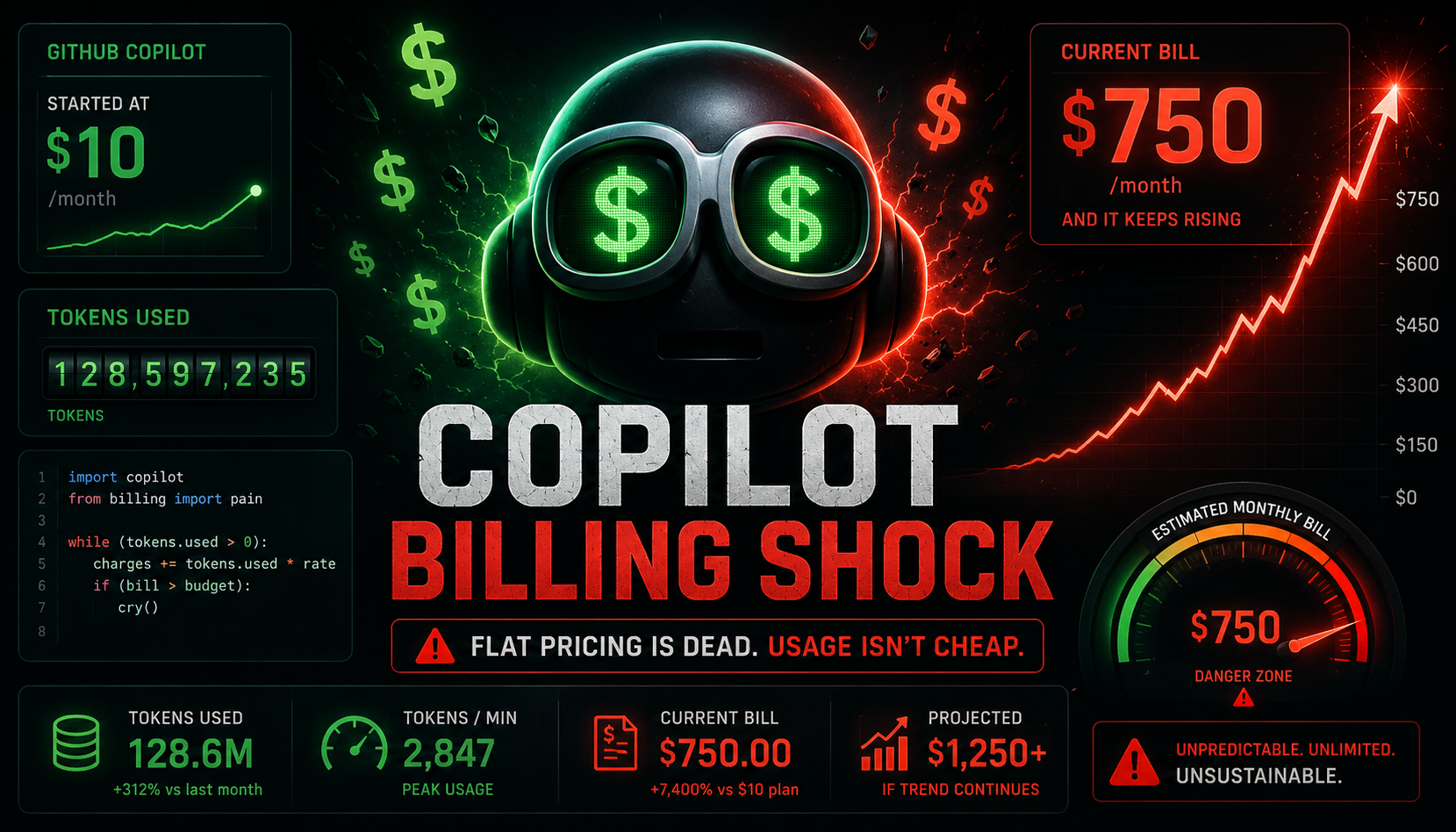
GitHub Copilot Kills Flat Pricing: Devs Face $750/Month Bills Starting Today
Table of Contents
Starting today — June 1, 2026 — GitHub Copilot’s flat-rate pricing is officially dead. Microsoft’s AI coding assistant is switching every plan to a token-based billing system called GitHub AI Credits, and the developer community is in an absolute uproar. Some users are projecting monthly bills jumping from $29 to over $750. Others say the panic is overblown. But one thing is clear: the golden age of unlimited AI-assisted coding at a fixed price is over.
Here’s everything you need to know about the change, why developers are furious, and what alternatives exist if you’re thinking about jumping ship.
What’s Changing June 1, 2026
GitHub announced the transition from its Premium Request Units (PRUs) system to a new token-based AI Credits model. Previously, Copilot plans came with a set number of premium requests per month. If you exceeded your limit, the system would gracefully downgrade you to a cheaper model — you’d still get responses, just from a less capable AI.
That fallback is now gone. Under the new system, every interaction with Copilot’s advanced features — chat, code review, agent mode, workspace queries — consumes AI Credits based on the actual tokens processed. Once your monthly credit allotment runs out, you either stop using those features or pay for additional credits.
The subscription prices themselves haven’t changed on paper, but what you get for that money has fundamentally shifted:
- Copilot Pro: $10/month → $10 in AI Credits (1,000 credits)
- Copilot Pro+: $39/month → $39 in AI Credits
- Copilot Business: $19/user/month → $19 per user in AI Credits
- Copilot Enterprise: $39/user/month → $39 per user in AI Credits
The critical difference? Those credits can burn through fast, depending on which models you use and how heavily you rely on Copilot’s AI features.
The New AI Credits System Explained
One GitHub AI Credit equals $0.01 USD. So your $10/month Copilot Pro subscription gives you exactly 1,000 credits to spend however you want.
But here’s where it gets complicated: different models consume credits at wildly different rates. Using GPT-4o for a chat query costs significantly less than spinning up Claude Sonnet 4.6 or Gemini 2.5 Pro for an agentic coding session. Token costs include input tokens, output tokens, and cached tokens — all metered separately at each model’s published API rate.
The real kicker is agent mode. When Copilot’s agent autonomously explores your codebase, spawns sub-agents, reads files, and iterates on solutions, it can churn through thousands of tokens in a single session. A complex refactoring task that previously counted as one premium request might now burn through $5-$15 in credits depending on the model and complexity.
And credits don’t roll over. Whatever you don’t use by month-end, you lose.
Developer Backlash: $29/Month to $750/Month
The reaction on Reddit and X has been swift and brutal. TechCrunch reported the backlash under the headline “What a joke” — and the quotes from developers tell the story.
One Reddit user shared that their projected monthly cost jumped from $29 to nearly $750: “This new usage model is just stupidly expensive. I’m adjusting mine by cancelling. At that cost, it is no longer cost-effective or useful in any practical way.”
Another developer posted a screenshot showing costs ballooning from $50 to approximately $3,000 per month under the new token-based system. While these projections represent heavy users, they illustrate just how dramatic the shift can be for teams that integrated Copilot deeply into their workflows.
Enterprise teams are particularly concerned. A company with 50 developers on Business plans ($19/user) gets $950 in total monthly credits. If those developers are actively using agent mode and premium models, that budget could evaporate in the first week of the month.
The Vibe Coder vs Real Developer Debate
Not everyone is sympathetic. A vocal contingent of developers has pushed back against the outrage, arguing that the astronomical cost projections come from “vibe coders” who treat Copilot as a replacement for actual development skills rather than as a productivity tool.
“The only way it gets crazy like that is if you are purely ‘vibe coding’ with a ton of bloated iterations,” one user argued on Reddit. “It’s pretty affordable for even small outfits if used as a tool, on pretty much any provider.”
The argument has some merit. Code completions and Next Edit Suggestions — the bread-and-butter features that made Copilot popular in the first place — remain unlimited and free on all plans. It’s the premium features like multi-model chat, agent mode, and code review that now eat into your credit budget.
But the counter-argument is equally compelling: Microsoft spent years encouraging developers to use Copilot’s most advanced features, marketing agent mode as the future of development. Pulling the rug out now feels like a classic bait-and-switch.
How Much Was Copilot Actually Losing?
One Reddit post cut through the noise with a simple question: “Holy f*** how much money was Copilot losing?”
It’s a fair question. GitHub Copilot has 4.7 million paid subscribers and 90% Fortune 100 adoption — impressive numbers by any measure. But running frontier AI models at scale is extraordinarily expensive. When a $10/month subscriber can spin up unlimited Claude Sonnet or GPT-4o sessions, Microsoft is almost certainly eating massive losses on power users.
The shift to usage-based billing is Microsoft’s attempt to make the economics sustainable. It’s the same pattern we’ve seen across the AI industry: subsidize heavily to capture market share, then adjust pricing once users are locked in.
What Still Works Without Credits
Before you panic, here’s what remains free and unlimited on all Copilot plans:
- Code completions — the inline suggestions as you type
- Next Edit Suggestions — AI-predicted edits to nearby code
Everything else — Copilot Chat, agent mode, code review, workspace queries, multi-model switching — now consumes AI Credits. For developers who primarily use Copilot for autocomplete, the practical impact is minimal. For teams that built their entire workflow around agent mode and premium chat, the impact could be severe.
The Alternatives Developers Are Switching To
The billing change is accelerating a migration that was already underway. The AI coding tool market in 2026 is vastly more competitive than when Copilot launched, and developers have real options:
Cursor has emerged as the primary destination for Copilot refugees. The AI-native IDE — a VS Code fork with first-party agent mode (Composer 2), cloud-run background agents, and Tab autocomplete — crossed $1 billion ARR in under two years. At $20/month for Pro, it’s more expensive than Copilot’s base plan but potentially cheaper than Copilot with heavy credit usage.
Claude Code by Anthropic maintains the deepest reasoning ceiling with Opus 4.7, making it the choice for complex architectural work. It operates as a terminal-based agent rather than an IDE extension, which appeals to developers who prefer keeping their editor simple.
OpenAI Codex offers a unique desktop command center for multi-agent work across projects. Windsurf (by Codeium) delivers roughly 80% of Cursor’s capability at 75% of the price, though ownership changes in early 2026 have raised questions about its long-term direction.
Open-source options like DeepSeek V4 Pro running locally are also gaining traction among privacy-conscious developers who want to avoid cloud billing entirely.
Microsoft’s Bait-and-Switch Playbook
The most pointed criticism centers on Microsoft’s strategy. The company spent years subsidizing Copilot to build market dominance, actively encouraging developers to rely more heavily on AI-assisted coding. Agent mode, multi-model support, and “unlimited” premium requests were all marketed as reasons to choose Copilot over competitors.
Now, with 4.7 million subscribers locked into GitHub’s ecosystem, Microsoft is tightening the screws. As one developer put it: “Microsoft provided this billing method and they kept making it easier and easier to burn through massive numbers of tokens on single premium requests that could churn for hours or even days while spawning dozens or even hundreds of sub-agents.”
The timing is also notable. This change arrives as AI infrastructure costs continue to climb and Microsoft faces pressure to show returns on its massive AI investments. Satya Nadella has repeatedly emphasized that AI must become a profit center, not just a growth story.
What This Means for the AI Coding Market
GitHub Copilot’s pricing shift signals a broader industry trend. The era of subsidized, unlimited AI access is ending across the board. OpenAI has already moved ChatGPT toward tiered usage limits. Anthropic’s Claude uses message-based throttling. Google’s Gemini has rate limits baked into every tier.
For developers, this means the cost of AI-assisted development is becoming a real line item in project budgets — not just a $10/month afterthought. Teams will need to be more intentional about when and how they use premium AI features, which model they select for each task, and whether certain workflows justify the token cost.
The silver lining? Competition is fierce. Cursor, Claude Code, Windsurf, Codex, and open-source alternatives are all fighting for the developers that Microsoft is pricing out. That competition will keep pushing quality up and costs down — just not on GitHub’s platform.
How to Protect Yourself
If you’re staying on Copilot, here are practical steps to manage costs under the new system:
- Set budget caps — GitHub now provides admin budget controls. Use them before your team burns through credits in week one.
- Choose models wisely — Not every task needs GPT-4o or Claude Sonnet. Use cheaper models for simple chat queries and reserve premium models for complex agent work.
- Monitor token usage — GitHub’s usage dashboard shows credit consumption in real-time. Check it daily during the first month to understand your actual burn rate.
- Lean on free features — Code completions and Next Edit Suggestions are still unlimited. Restructure your workflow to maximize these free features before reaching for credit-consuming tools.
- Evaluate alternatives — Run a two-week trial of Cursor or Claude Code alongside Copilot. Compare actual productivity and cost before committing.
Final Thoughts
GitHub Copilot’s move to token-based billing isn’t surprising — the economics of unlimited AI access were never sustainable. But the abruptness of the change, the elimination of the fallback experience, and the potential for dramatic cost increases have rightfully angered a developer community that was told to build their workflows around these tools.
The real question isn’t whether token-based billing is fair — it probably is, in principle. The question is whether Microsoft’s execution of this transition respects the developers who made Copilot a 4.7-million-subscriber product in the first place. Based on the community reaction so far, the answer is a resounding no.
If you’re feeling the squeeze, now is the time to explore your options. The AI coding market has never offered more choices — and GitHub just gave its competitors the best marketing campaign they could ask for.