Samsung’s 18-Day Strike Will Hit AI’s Chip Supply Chain Where It Hurts Most
Table of Contents
Table of Contents
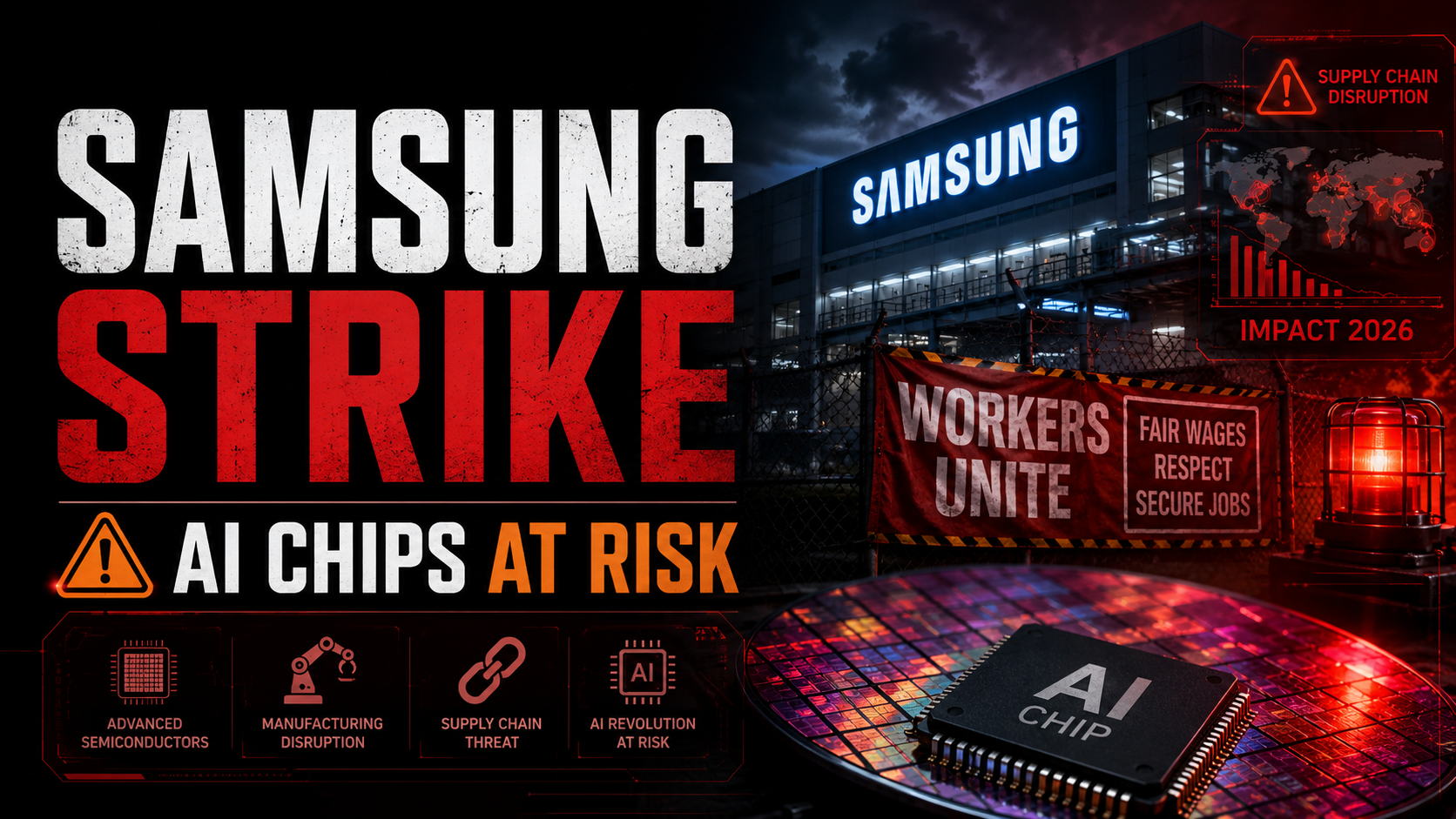
Something extraordinary is happening at Samsung Electronics right now — and it could shake the global AI chip market to its core. Over 50,000 Samsung chip workers are preparing to walk off the job starting May 21, launching an 18-day strike that analysts estimate could cost the company between $6.9 billion and $11.7 billion. The trigger? A bonus dispute that reads like a parable of the AI age: workers who make the chips powering the AI revolution want their fair share of the windfall — and they’re willing to stop the machines to get it.
What’s Happening at Samsung?
The National Samsung Electronics Union (NSEU) has been locked in negotiations with Samsung management for months over compensation. The core dispute centers on profit-sharing: how much of Samsung’s semiconductor profits — supercharged by booming AI demand for High Bandwidth Memory (HBM) and DRAM — should flow to the workers who produce those chips?
Samsung’s semiconductor division has had a remarkable run. AI data centers run on memory. Every Nvidia GPU requires stacks of HBM chips. Every inference server needs massive amounts of DRAM. Samsung, along with SK Hynix and Micron, sits at the center of this supply chain — and business has been very, very good.
But the union argues that the workers enabling this profit haven’t seen a proportional reward. And after months of failed negotiations, they’re done waiting.
The Numbers: $340K Rejected, $1M Demanded
Samsung management put a stunning offer on the table: a one-time bonus worth up to $340,000 per employee. In any other industry, in any other decade, that number would be jaw-dropping. The union rejected it.
The union is holding firm on a set of demands that, combined, could push per-employee compensation closer to $1 million — matching the payout structure at rival SK Hynix. Specifically, the NSEU is demanding a profit share equal to 15% of the chip division’s operating profit (Samsung offered 13%), a 7% base wage hike, and the removal of an existing 50% cap on performance bonuses.
Management’s counter-offer fell two percentage points short on the profit share, offered no wage hike, and kept the bonus cap in place. For the union, these weren’t minor differences — they represented the gap between being treated as participants in Samsung’s AI success versus being treated as interchangeable labor.
According to Tom’s Hardware, the union wants annual recurring payouts structured like SK Hynix’s — not a one-time check management can offer once and never repeat. The distinction matters enormously for long-term worker wealth.
Talks Collapse, Strike Begins May 21
Samsung called in government mediators, escalating to the level of a Korean Prime Minister emergency meeting. It didn’t work. The union walked away from the government-mediated talks eight days before the planned strike, with both sides too far apart to bridge the gap.
The NSEU announced that its general strike will run from May 21 to June 7 — 18 days of industrial action spanning Samsung’s chip fabrication facilities. These aren’t office workers. These are the engineers and technicians operating the photolithography machines, deposition chambers, and testing equipment that turn silicon wafers into the most valuable chips on Earth.
When fab workers walk out, production doesn’t just slow down — it becomes extraordinarily complicated to maintain. Semiconductor fabrication is a continuous process. Wafers in progress cannot simply be paused and restarted. Work stoppages cause yield losses that extend far beyond the strike period itself, as equipment recalibration, wafer restart procedures, and quality checks add weeks of recovery time after workers return.
Why This Strike Threatens the Global AI Chip Supply
The timing could not be worse — or better, depending on your perspective as a worker. The AI infrastructure build-out is in full swing. AI chip companies like Cerebras just went public at massive valuations. Google, Meta, Microsoft, and Amazon are all racing to expand data center capacity. Every one of these hyperscalers needs memory — specifically HBM (High Bandwidth Memory) — and Samsung is one of only three companies on Earth that can supply it at scale.
Samsung’s HBM3E production is already under pressure. The company fell behind SK Hynix in HBM yield rates last year, costing it critical Nvidia contracts. An 18-day strike hitting fab operations doesn’t just threaten Samsung’s revenue — it threatens the entire AI hardware supply chain at a moment of peak demand.
If Samsung’s HBM output drops significantly during and after the strike, the immediate beneficiary is SK Hynix, which has been aggressively ramping its own HBM capacity. But the global AI hardware ecosystem doesn’t have much slack. A meaningful supply disruption at Samsung could cause allocation shortages that ripple through Nvidia’s GPU shipment schedules and delay AI data center expansions at hyperscalers worldwide.
This is why Gizmodo called this potential strike “an earthquake for AI.” That’s not hyperbole. It’s an accurate description of what an 18-day fab shutdown at Samsung could mean for the AI infrastructure timeline.
Samsung vs. SK Hynix: The Envy Factor
To understand why Samsung workers are so resolute, you need to understand the SK Hynix comparison. SK Hynix workers — employees at Samsung’s direct competitor, making the same memory chips, working in similar fab environments — are on track to receive payouts approaching $900,000 to $1 million this year, thanks to a compensation structure that more aggressively ties worker pay to company performance.
That gap — between what Samsung workers receive and what SK Hynix workers receive — is the fuel for this dispute. Both companies are riding the same AI-driven memory boom. Both are expanding HBM capacity for the same hyperscaler customers. But Samsung’s compensation structure hasn’t kept pace with its competitor’s, and workers who can plainly see the disparity are no longer willing to accept it.
This dynamic extends beyond Samsung. It’s a leading indicator of a broader challenge that will confront every tech company riding the AI wave: as AI creates enormous concentrated wealth at the top of the value chain, the workers who physically build the hardware enabling that wealth will increasingly demand a larger share. The Samsung strike is likely a preview, not an anomaly.
The Cost: Up to $11.7 Billion
Analysts have put numbers on what an 18-day strike would cost Samsung. The range is staggering: $6.9 billion on the low end, $11.7 billion at the high end in direct losses. Indirect costs — lost contracts, market share shifts to SK Hynix and Micron, reputational damage with customers — push the total economic impact even higher.
For context: the difference between what the union is asking for in profit share (15%) versus what management offered (13%) represents a fraction of the cost of a strike. Samsung’s management may be calculating that giving in to union demands sets a precedent that costs more long-term than absorbing the strike. The union may be calculating that one credible show of force now is worth more than years of gradual negotiation.
Both calculations are rational from each side’s perspective. That’s what makes this dispute so difficult to resolve — and so likely to play out fully rather than settle at the last minute. The Korean government’s failed mediation attempt suggests neither side is bluffing.
According to DigiTimes, Samsung’s labor talks collapsed with eight days to go before the planned strike, and as of now no new talks have been scheduled.
What Happens Next?
Between now and May 21, there are three possible outcomes:
Last-minute deal: Samsung management, facing the prospect of $11.7 billion in losses, makes a concession significant enough to bring the union back to the table. This is possible but requires one side to blink first — and neither side has shown any inclination to do so after the government mediation collapse.
Partial strike: Not all 50,000 union members participate. Samsung maintains partial operations using non-union workers, engineers, and managers. Production is reduced but not halted. This is the most likely outcome if things get close — historically, Korean labor actions often produce partial rather than complete work stoppages.
Full 18-day strike: The worst-case scenario for Samsung, its customers, and the global AI chip supply chain. If this plays out in full, expect significant supply chain disruption, HBM price spikes, and a dramatic acceleration of SK Hynix and Micron’s market share gains.
For the latest on AI hardware supply chain disruptions, check out our coverage of Big Tech’s record profits amid cost-cutting and how OpenAI’s hardware ambitions depend on a stable memory supply chain.
Conclusion
The Samsung strike isn’t just a labor dispute — it’s the AI economy’s first major reckoning with the question of who gets paid when chips become gold. The workers building the hardware that powers ChatGPT, Gemini, and every AI model you use are asking for a larger share of the value they create. Samsung management is trying to hold the line on compensation structures that made sense before AI transformed their product into the most strategically important material on Earth.
Watch this space closely over the next week. If the strike happens as planned, the global AI infrastructure timeline gets more complicated — and the conversation about worker compensation in the AI era gets much louder.