Nvidia N1X Launches at Computex 2026: The ARM Chip That Could Kill x86 Laptops
Table of Contents
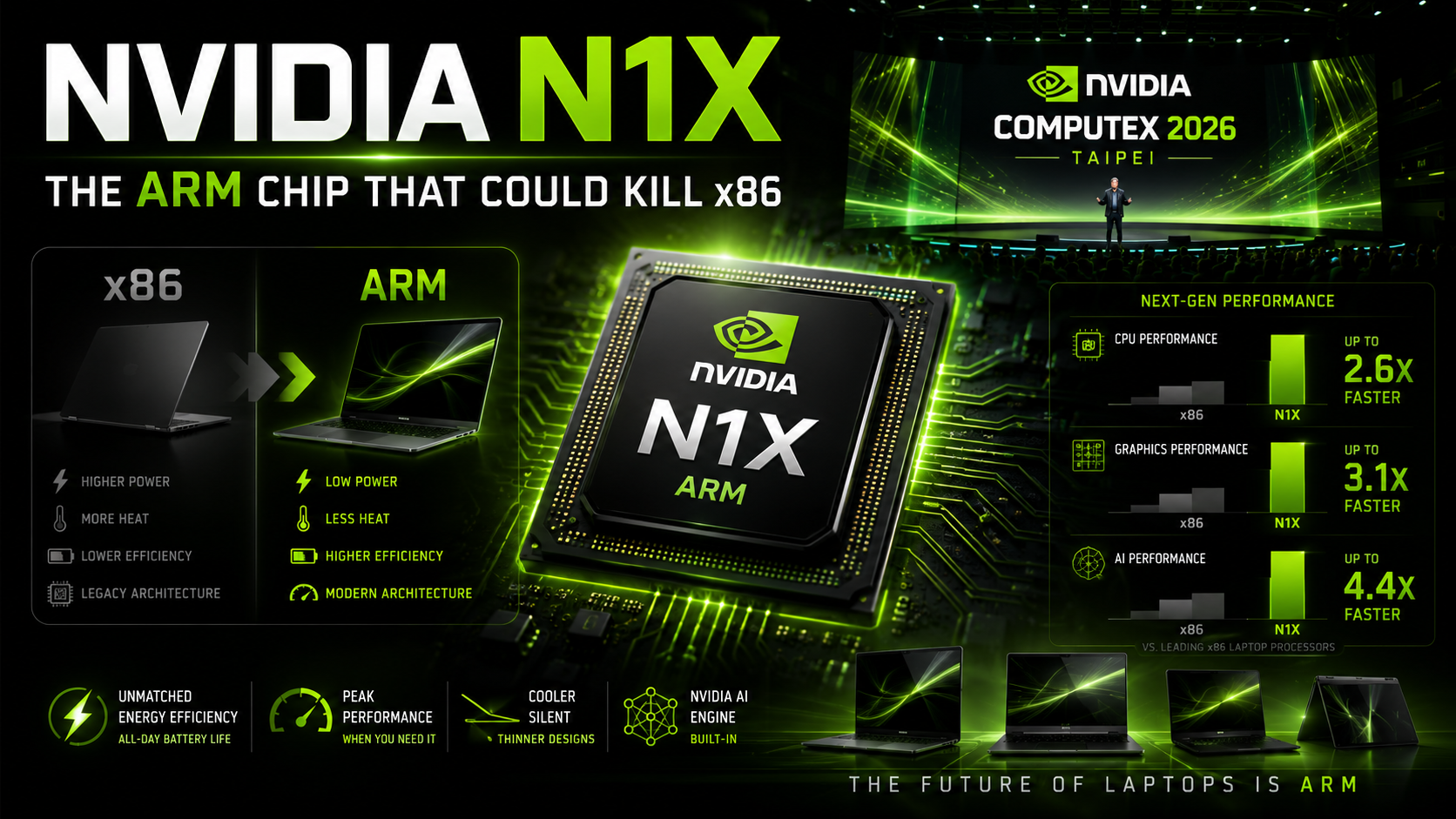
Nvidia just declared war on every laptop chipmaker on the planet. At Computex 2026 on June 1, Jensen Huang walked onstage in his trademark leather jacket and unveiled the Nvidia N1X — a 20-core ARM processor with 6,144 CUDA cores built on the Blackwell GPU architecture. This isn’t a GPU bolted onto someone else’s CPU. This is Nvidia building the entire laptop chip from scratch, co-developed with MediaTek, and it’s aimed squarely at killing x86 laptops as we know them.
For decades, Intel and AMD have owned the laptop market. Qualcomm tried to disrupt it with Snapdragon X Elite in 2024, and Apple proved ARM could dominate with M-series chips. But Nvidia? Nvidia was always the GPU company — the one you paired with an Intel or AMD CPU. Not anymore. The Nvidia N1X changes everything, and the holiday 2026 launch window means we’re months away from a completely different PC landscape.
Nvidia N1X: The ARM Chip Nvidia Built to Bury x86
Let’s be honest about what the Nvidia N1X actually represents. This is the company that controls 88% of the data center GPU market deciding that controlling the laptop market is next. Jensen Huang’s keynote wasn’t subtle — he called this the dawn of a “new era of PC” and he meant it. The N1X isn’t an experiment. It’s an invasion.
ARM-based Windows PCs have been a mixed bag. Microsoft’s Surface Pro X (2019) was embarrassing. Qualcomm’s Snapdragon X Elite (2024) was better but still had app compatibility headaches. Apple’s M-series chips proved the architecture could work, but Apple locked it behind macOS. What nobody had done was combine ARM efficiency with a world-class GPU capable of running professional creative workloads and gaming. Until now.
Nvidia’s pitch is simple: why pair a great GPU with a mediocre CPU when you can build both? The N1X integrates ARM CPU cores with Blackwell-architecture CUDA cores on a single chip, sharing a unified memory architecture. That means no bottleneck between CPU and GPU memory — similar to what Apple does with unified memory, but with Nvidia’s GPU firepower behind it.
This follows a broader trend of chip companies consolidating power. As we covered when Cerebras went public at $26.6B, the semiconductor industry is entering a phase where vertical integration wins. Nvidia building its own CPU is the natural next step.
Nvidia N1X Specs: 20 ARM Cores Meet Blackwell GPU
Here’s what Jensen revealed at Computex. The Nvidia N1X flagship packs serious silicon:
- CPU: 20 ARM-based cores (custom Nvidia design, not off-the-shelf Cortex)
- GPU: 6,144 CUDA cores, Blackwell architecture
- TDP: 45-80W configurable (laptop-grade)
- Memory: Unified memory architecture (LPDDR5X expected)
- AI Engine: Dedicated NPU for on-device AI inference
- Co-developed with: MediaTek (connectivity and power management IP)
- Target: Premium laptops, workstations, creator machines
- Availability: Holiday 2026
For context, the current Snapdragon X Elite ships with 12 Qualcomm Oryon cores and an Adreno GPU. Intel’s latest Core Ultra 200V “Lunar Lake” chips top out at 16 cores. The Nvidia N1X’s 20 cores alone would make it the most powerful ARM laptop chip on Windows — but pair that with 6,144 CUDA cores and you’ve got a machine that can compile code, render 3D scenes, and run local AI models without breaking a sweat.
The 45-80W TDP range is interesting. At 45W, this competes in thin-and-light territory. At 80W, it’s a gaming/workstation beast. OEMs can tune it based on the chassis, which explains why we’re seeing both Dell XPS and Lenovo Legion devices in the launch lineup.
Nvidia N1X vs Qualcomm Snapdragon X Elite: The Real Fight
Qualcomm should be terrified. The Snapdragon X Elite was supposed to be the ARM chip that finally made Windows on ARM viable. And to be fair, it did improve things significantly — native app support expanded, performance was genuinely competitive with Intel’s midrange, and battery life was exceptional. But Qualcomm had one massive weakness: GPU performance.
The Adreno GPU in Snapdragon X Elite is decent for productivity. It is not a gaming GPU. It is not a workstation GPU. It cannot run CUDA workloads, which means the entire ecosystem of AI/ML tools, creative software, and games that rely on CUDA simply doesn’t work. Nvidia’s N1X solves this overnight. Every CUDA-optimized application — and that’s a lot of software — runs natively on the N1X’s Blackwell GPU.
This is the same dynamic we tracked with the Pentagon’s AI infrastructure deals — when it comes to AI compute, Nvidia’s CUDA ecosystem is an almost unbreakable moat. Now that moat extends to laptops.
Qualcomm’s response will likely focus on price and battery life. The N1X at 45-80W will consume more power than Snapdragon X Elite’s 23W base config. But for anyone doing real work — video editing, 3D modeling, AI development, or gaming — the Nvidia N1X isn’t just better. It’s in a different category entirely.
MediaTek Partnership: Why Nvidia Didn’t Go Alone
One of the most underreported aspects of the Nvidia N1X is the MediaTek co-development. Nvidia doesn’t make connectivity chips. It doesn’t have decades of experience in power management for battery-powered devices. MediaTek does. This partnership gives Nvidia instant access to 5G modems, Wi-Fi 7, Bluetooth, and advanced power management IP that would take years to develop in-house.
MediaTek, in turn, gets to attach its name to the highest-profile laptop chip launch in years. It’s a classic win-win: Nvidia brings the compute architecture and brand recognition, MediaTek brings the mobile platform expertise. Think of it like how Apple designs the silicon but TSMC fabricates it — Nvidia designed the cores, MediaTek integrated the platform.
This is also why the N1X could succeed where Nvidia’s previous attempts at mobile chips (remember Tegra?) failed. Tegra was Nvidia trying to do everything alone in a market it didn’t understand. The N1X is Nvidia doing what it does best — GPU compute and AI — while partnering with someone who knows mobile platforms inside out.
Nvidia N1X Laptop Lineup: Dell, Lenovo, ASUS Ready
Nvidia didn’t just announce a chip. They announced an ecosystem. Dell, Lenovo, and ASUS all had devices ready to show at Computex:
- Dell XPS with N1X: Ultra-thin creator laptop, targeting the MacBook Pro crowd. 45W configuration, 14-inch OLED display, emphasis on video editing and AI creative tools.
- Lenovo Legion with N1X: Full 80W configuration for gaming. This is the first ARM-based gaming laptop that could actually compete with x86 gaming machines thanks to native CUDA support.
- ASUS ProArt with N1X: Professional workstation aimed at 3D artists, architects, and engineers. Native CUDA means tools like Blender, Maya, and SOLIDWORKS run without translation layers.
Having three major OEMs on board at launch is a statement. When Qualcomm launched Snapdragon X Elite, it took months for devices to actually ship. Nvidia is skipping the uncertainty phase — these manufacturers already have reference designs and are building production units for holiday 2026.
The big question is software support. Windows on ARM has improved dramatically, but x86 emulation through Prism still has overhead. The counter-argument is that GPU workloads — which represent the heaviest compute tasks most users perform — run natively on Nvidia’s CUDA cores without any emulation at all. For a 3D artist or AI developer, the CPU emulation overhead on lighter tasks is irrelevant when the GPU-heavy work screams.
The Nvidia N1 Budget Variant Nobody Is Talking About
While everyone’s focused on the N1X flagship, Nvidia also quietly confirmed the N1 — a lower-tier variant that could be even more disruptive. The N1 comes in two configs: 12 ARM cores with 2,560 CUDA cores, and 10 ARM cores with 2,048 CUDA cores. The TDP drops to 18-45W.
This is the chip that goes into $799-$999 laptops. And 2,048-2,560 CUDA cores is still more GPU power than anything Qualcomm or Intel offers in that price range. The N1 at 18W could deliver all-day battery life in a thin-and-light while still running local AI models and light creative workloads.
If the N1X is aimed at professionals and gamers, the N1 is aimed at everyone else — students, office workers, casual content creators. And that’s the market Intel and AMD really can’t afford to lose. Those millions of mid-range laptops are the bread and butter of x86 sales.
The AI angle is particularly compelling here. As we discussed in our guide to building AI agents in 2026, running AI workloads locally is becoming essential. An N1-powered laptop with 2,048 CUDA cores could run inference for small language models, image generation, and code completion without cloud dependency. Try doing that on an Intel integrated GPU.
What Nvidia N1X Means for Intel and AMD
Intel is in trouble. Already bleeding market share to AMD on the high end and Qualcomm on the efficiency end, Intel now faces Nvidia entering the laptop market with a product that combines the best of both worlds — ARM efficiency with desktop-class GPU performance. Intel’s response, Lunar Lake, improved integrated graphics significantly but still can’t touch dedicated Nvidia CUDA cores.
AMD is in a slightly better position thanks to its Ryzen AI series and Radeon integrated graphics, but the CUDA ecosystem advantage is brutal. Most professional software is optimized for CUDA first, AMD ROCm second (if at all). The Nvidia N1X means professionals who need CUDA can now get it in a laptop without needing a separate Nvidia discrete GPU paired with an Intel or AMD CPU.
The irony is delicious. For years, Intel and AMD competed fiercely while Nvidia happily sold GPUs to both camps. Now Nvidia is saying: we don’t need either of you. We’ll build the whole chip ourselves. It mirrors the broader industry consolidation we’re seeing — companies like Apple, Google, and Amazon all designing custom silicon instead of relying on third-party processors. The era of Big Tech consolidating power extends to hardware too.
The x86 architecture itself isn’t dead — server workloads and backward compatibility will keep it alive for years. But in laptops, where power efficiency and AI performance matter most, the momentum is clearly shifting to ARM. Apple proved it. Qualcomm validated it. And now Nvidia is about to accelerate it.
Nvidia N1X Bottom Line: Holiday 2026 Can’t Come Soon Enough
The Nvidia N1X isn’t just another chip announcement. It’s a tectonic shift in how we think about laptop processors. For the first time, a company with the world’s best GPU technology is building the entire SoC — CPU, GPU, NPU, memory controller — on a single chip optimized for unified performance.
Will it work perfectly at launch? Probably not. ARM on Windows still has rough edges. x86 app emulation, while improved, isn’t flawless. Driver support will take time. But the trajectory is unmistakable: Nvidia N1X represents the future of Windows laptops, and Intel and AMD are now playing defense.
If you’re shopping for a new laptop, wait until holiday 2026. The Dell XPS, Lenovo Legion, and ASUS ProArt devices powered by the Nvidia N1X will redefine what’s possible in a portable machine. Jensen Huang promised a new era of PC. Based on what we saw at Computex 2026, he might actually deliver.
Keep an eye on SudoFlare for deep dives into Nvidia N1X benchmarks, app compatibility testing, and head-to-head comparisons as launch approaches. This is going to be one of the biggest hardware stories of 2026, and we’ll cover every angle. Also watch how this impacts the future of AI-powered devices — if Nvidia can put this much AI compute in a laptop, the phone is next.