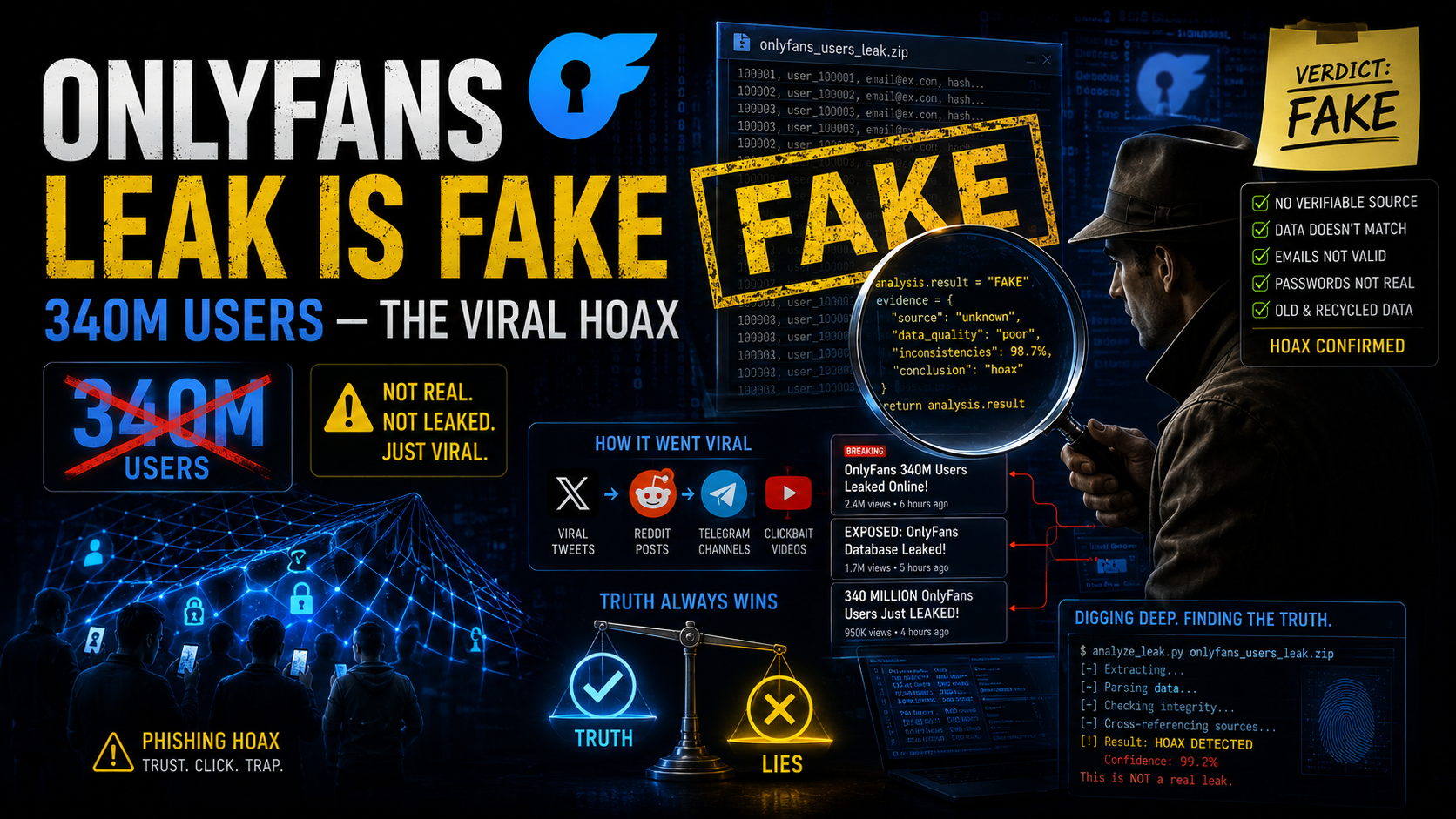
OnlyFans 340M User ‘Leak’ Is Fake: Inside the Viral Hoax That Fooled Everyone
Table of Contents
A massive OnlyFans data leak of 340 million user records just went viral across X, Reddit, and every tech news outlet on the planet. There’s just one problem: it’s completely fake. The hacker behind the listing — going by “Euphoric_Reply_5727” — has admitted the data wasn’t stolen from OnlyFans at all. It’s a Frankenstein dataset stitched together from old Twitter, Instagram, and Spotify breaches, mixed with publicly scraped profile information, and repackaged under OnlyFans’ name for maximum viral impact and a $76,000 Bitcoin payday.
This is a masterclass in cyber deception. Take old, worthless data. Slap a brand name that generates clicks (and panic) on it. List it on a breach forum for a price that’s high enough to seem credible but low enough that someone might actually pay. Watch the internet lose its mind. And the scary part? It almost worked. For about 48 hours, millions of OnlyFans users believed their most private information had been exposed. Let’s dissect exactly how this hoax fooled everyone — and what it teaches us about the breach notification ecosystem.
OnlyFans Data Leak: 340 Million Records Listed for Sale
The OnlyFans data leak claim first appeared on a well-known breach forum where a user named Euphoric_Reply_5727 posted a listing titled “OnlyFans.com — Full Database — 340M Records.” The listing price was 0.313 BTC, approximately $76,000 at the time of posting. The post included sample data rows showing usernames, email addresses, phone numbers, last four digits of payment cards, follower counts, and account creation dates.
The listing went viral almost immediately. Screenshots spread across X (formerly Twitter), Reddit’s r/cybersecurity and r/privacy communities, Telegram groups, and eventually mainstream tech publications. The combination of a massive record count (340 million — more users than many countries have people), the sensitive nature of the platform (adult content, creator identities, subscriber lists), and the presence of partial payment card data made this the perfect viral breach story.
Within hours, “OnlyFans breach” was trending on X. Creators began panicking about their real identities being exposed. Subscribers feared their account activity would become public. Privacy advocates issued urgent warnings. The entire situation escalated from forum post to global news in less than a day.
The OnlyFans Data Leak: What Was Actually Claimed
According to Euphoric_Reply_5727’s original listing, the OnlyFans data leak dataset allegedly contained:
- 340 million records total
- Usernames (both creator and subscriber accounts)
- Email addresses
- Phone numbers (where available)
- Last 4 digits of payment cards
- Follower/following counts
- Account creation and last active dates
- Linked social media accounts
- Geographic data (IP-derived locations)
The sample data looked convincing at first glance. It contained real email addresses, real usernames that corresponded to actual OnlyFans profiles, and plausible metadata. For casual observers — including many journalists who should have known better — the sample data was enough to run with the story.
But cybersecurity researchers who actually analyzed the sample data noticed inconsistencies almost immediately. More on that below.
OnlyFans Data Leak Debunked: The Hacker Admitted It
Here’s the twist that turned this from a breach story into a hoax story: Euphoric_Reply_5727 admitted it. Under pressure from multiple researchers who publicly challenged the data’s authenticity, the original poster acknowledged that the dataset was NOT obtained from OnlyFans’ systems. Instead, it was assembled from multiple existing data breaches and publicly available information.
OnlyFans issued a categorical denial, stating: “OnlyFans has not experienced a data breach. Our systems have not been compromised. The data circulating online does not originate from our platform.” The company’s security team confirmed no unauthorized access to their systems and no evidence of data exfiltration.
Multiple independent verification efforts confirmed the hoax:
- Security researcher Troy Hunt (of Have I Been Pwned) analyzed the dataset and found extensive overlap with previously known breaches
- Data fields matched patterns from the August 2025 Twitter/X data dump and a 2024 Spotify credential leak
- Email addresses in the “OnlyFans” data appeared in breach databases predating OnlyFans accounts by years
- The “last 4 card digits” field contained formatting inconsistencies that didn’t match OnlyFans’ payment processing system
The OnlyFans data leak was fake. But the damage — to OnlyFans’ reputation, to user trust, and to the credibility of breach reporting — was very real.
How the Fake OnlyFans Data Leak Was Assembled
Deconstructing the fake dataset reveals a surprisingly simple (and devastatingly effective) methodology:
- Start with old breaches. The foundation appears to be data from the August 2025 Twitter/X data dump, which contained hundreds of millions of email addresses and associated usernames. Instagram scraped data from 2024 was also mixed in.
- Cross-reference with OnlyFans. Using the email addresses from old breaches, the attacker likely used OnlyFans’ password reset or account lookup features to determine which emails had associated OnlyFans accounts. This is a technique called “credential enrichment.”
- Add public profile data. OnlyFans creator profiles are publicly visible. Follower counts, bio information, and linked social media accounts can be scraped without any hacking.
- Fabricate sensitive fields. The “last 4 card digits” were likely randomly generated or pulled from unrelated breaches and assigned to records to increase the perceived value of the dataset.
- Package and sell. Combine everything into a single database, label it as an OnlyFans breach, and post it on a breach forum with a Bitcoin price tag.
Total hacking required: zero. This was a data aggregation and marketing operation, not a security breach. The attacker’s skill wasn’t in penetrating OnlyFans’ defenses — it was in understanding human psychology and the viral mechanics of breach panic. As we’ve seen with the AI-assisted attacks trend, social engineering and data manipulation are becoming more sophisticated even without advanced technical tools.
Why the OnlyFans Data Leak Hoax Went Viral
The fake OnlyFans data leak exploited several psychological and media dynamics that virtually guaranteed virality:
Brand sensitivity. OnlyFans is synonymous with adult content. A data breach potentially exposing subscribers’ identities triggers visceral privacy fears that most other platform breaches don’t. People who might shrug at a LinkedIn breach panic at an OnlyFans exposure. The emotional stakes are inherently higher, which drives sharing.
Number shock. 340 million records is an attention-grabbing number. It’s larger than the population of the United States. Even people who don’t use OnlyFans share the headline because the scale is impressive. Never mind that the number itself was the first red flag — OnlyFans has approximately 220 million registered users. A “breach” containing 120 million more records than the platform has users should have immediately raised questions.
Media incentives. Tech publications and social media accounts compete for engagement. “OnlyFans 340M Data Breach” is guaranteed clicks. Many outlets published stories based on the forum listing alone, without waiting for verification. The correction/debunking articles that followed never reach as many people as the initial panic — that’s the fundamental asymmetry that fake breach merchants exploit.
Confirmation bias. People expect platforms to get breached because breaches happen constantly. When you see “$629 million in crypto stolen in one month” (as we covered at SudoFlare with April 2026’s crypto hack wave) and Microsoft Defender has zero-days being exploited in the wild, another breach feels inevitable. The OnlyFans data leak claim rode a wave of cynicism that made verification seem unnecessary.
OnlyFans Data Leak: How to Spot Fake Breaches
The fake OnlyFans breach offers a textbook case study for identifying fraudulent data breach claims. Here are the red flags that researchers spotted:
- Record count exceeds user base. 340M records for a platform with ~220M users. Always check reported user counts against breach claims.
- No technical details. Legitimate breach disclosures typically include information about the attack vector, vulnerability exploited, or affected systems. Euphoric_Reply_5727’s post provided none — just “I have the data.”
- Sample data overlap with known breaches. Cross-referencing sample email addresses with Have I Been Pwned or similar services showed the data already existed in earlier breaches.
- Inconsistent data formatting. Different fields showed different formatting patterns, suggesting they came from different sources. A legitimate single-source breach would have consistent formatting.
- No company confirmation. For hours, the story spread without any statement from OnlyFans. Legitimate mega-breaches are typically confirmed (or at least acknowledged) by the affected company quickly, either through SEC filings, press releases, or incident response notifications.
- Seller behavior. Legitimate data sellers on breach forums typically provide detailed proof of access, sometimes including screenshots of internal systems. Euphoric_Reply_5727 provided only sample data rows — the easiest thing to fabricate.
The security community needs better verification norms. Journalists and influencers who amplify unverified breach claims cause real harm — to the supposedly breached company, to panicking users, and to the credibility of legitimate breach reporting. A 24-hour verification hold before publishing breach claims would prevent most fake breach viral cycles.
The Real Danger of Fake Data Breaches
Fake data breaches aren’t just embarrassing media failures — they create concrete harms:
Phishing amplification. When a fake breach goes viral, scammers immediately launch phishing campaigns targeting the “affected” platform’s users. “Your OnlyFans account has been compromised — click here to secure it.” Users who believe the breach is real are more likely to fall for these phishing attacks, creating actual security incidents from a fictional one.
Stock manipulation. For publicly traded companies, a viral breach claim can cause stock price drops before verification occurs. While OnlyFans is private, the technique has been used against public companies to enable short selling. Claim a breach, short the stock, profit from the panic, and disappear before the debunking.
Breach fatigue. Every fake breach that gets debunked makes people more skeptical of real breaches. When the next actual data breach happens — and it will — users who remember the OnlyFans hoax may dismiss the warnings as more fake news. This is arguably the most dangerous long-term impact: training the public to ignore breach notifications. The ongoing erosion of trust in tech companies is made worse when breach claims are weaponized as disinformation.
Reputational damage. Even after debunking, the association between OnlyFans and “data breach” persists in search results, social media archives, and public memory. Some percentage of the public will forever believe the breach was real — corrections never travel as far as the original claim.
OnlyFans Data Leak Bottom Line: Verify Before You Panic
The OnlyFans data leak that fooled the internet is a stark reminder that in cybersecurity, verification must come before reaction. A single anonymous forum post, amplified by social media dynamics and confirmation bias, created a global panic over a breach that never happened.
Euphoric_Reply_5727 demonstrated something the security community has long understood: perception is more powerful than reality. You don’t need to hack a major platform to cause a crisis — you just need to convincingly claim you did. Old data, a famous brand name, and a Bitcoin price tag were enough to fool millions of people, dozens of media outlets, and even some security professionals who should have known better.
For users: if you see a breach notification going viral, don’t panic. Check the official company response. Check independent verification from reputable security researchers. Check whether the claimed record count makes sense against the platform’s actual user base. And critically, don’t click any “secure your account” links that arrive in the wake of a breach announcement — those are almost certainly phishing attempts, whether the breach is real or fake.
For the media: do better. Publishing unverified breach claims for clicks causes real harm. A 24-hour verification hold would cost you some traffic but gain you credibility and prevent your outlet from becoming a tool for data fraud.
The fake OnlyFans data leak won’t be the last of its kind. As long as viral breach claims generate clicks, fear, and potential Bitcoin payments, threat actors will keep manufacturing them. The only defense is a more skeptical, verification-first approach — from researchers, from journalists, and from every person who encounters a breach headline on their feed. Stay skeptical. Stay informed. And follow SudoFlare for verified, investigated cybersecurity coverage that separates the real from the fabricated.