SpaceX IPO 2026: $75B Record Offering at $1.75 Trillion Valuation — Biggest IPO Ever
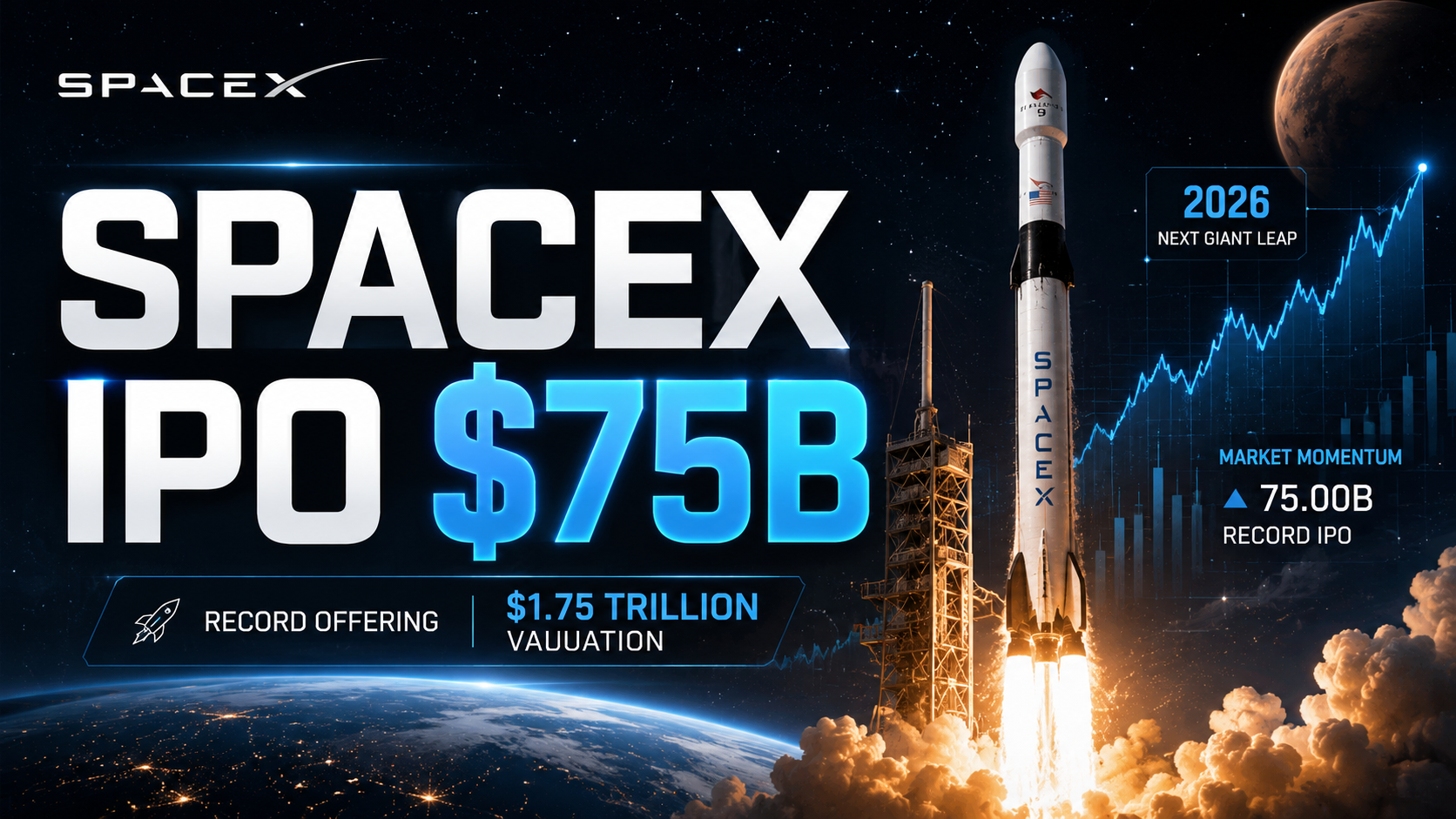
SpaceX just launched the biggest IPO in stock market history — and it’s not even close. The Elon Musk-led aerospace giant kicked off its roadshow on June 4, 2026, targeting a staggering $75 billion raise at a $1.75 trillion valuation. That’s more than 2.5x the previous record held by Saudi Aramco’s $29.4 billion offering in 2019.
The ticker? SPCX. The exchange? Nasdaq. The first trading day? June 12, 2026. And demand has already hit $150 billion — double the shares available. Here’s everything you need to know about the SpaceX IPO that’s rewriting financial history.
SpaceX IPO: The Numbers That Shatter Every Record
Let’s put this in perspective. SpaceX is offering 556.6 million shares at $135 per share, aiming to raise $75 billion in a single offering. The previous record holder, Saudi Aramco, raised $29.4 billion when it went public in 2019. SpaceX is more than doubling that.
The company’s pre-IPO valuation sits at approximately $1.75 trillion, which would make SpaceX one of the most valuable publicly traded companies on Earth from day one. For context, that’s larger than the market caps of companies like Cerebras, Meta, and Tesla combined at various points in the last year.
Here’s how the SpaceX IPO stacks up against history’s biggest offerings:
| Company | Year | IPO Size | Valuation |
|---|---|---|---|
| SpaceX | 2026 | $75B | $1.75T |
| Saudi Aramco | 2019 | $29.4B | $1.7T |
| Alibaba | 2014 | $25B | $231B |
| SoftBank Corp | 2018 | $23.5B | $54B |
| ARM Holdings | 2023 | $5.2B | $54B |
$1.75 Trillion Valuation: How SpaceX Got Here
SpaceX’s journey to becoming the world’s most valuable private company — and now potentially one of the most valuable public ones — has been driven by two major pillars: rocket launches and Starlink.
The company dominates the global launch market with its reusable Falcon 9 and Falcon Heavy rockets. SpaceX completed over 100 launches in 2025 alone, more than all other launch providers combined. The Starship super heavy-lift vehicle, while still in development, represents the company’s future ambitions for Mars colonization and deep space exploration.
But the real revenue engine is Starlink, the satellite internet constellation that now serves millions of subscribers across 100+ countries. Starlink alone is reportedly generating over $10 billion in annual revenue, with rapidly improving margins as the constellation scales.
The Roadshow That Broke Wall Street
SpaceX’s roadshow launched on June 4, 2026 — earlier than the initially planned week-of-June-8 estimate. The accelerated timeline came after a quicker-than-expected SEC review of the company’s S-1 filing.
The response from institutional investors has been nothing short of extraordinary. Demand has already reached approximately $150 billion, roughly double the $75 billion in shares available. That level of oversubscription is almost unprecedented for an offering of this size.
Share pricing is expected after market close on June 11, with the first trading day targeted for June 12 on Nasdaq under the ticker SPCX. Wall Street analysts are already predicting the stock could pop 20-40% on its first day of trading given the massive demand imbalance.
Retail Investors Get a Rare Seat at the Table
Perhaps the most surprising aspect of the SpaceX IPO is Elon Musk’s push to include retail investors. Musk is reportedly discussing allocating up to 25-30% of IPO shares to retail investors — at least three times the typical 5-10% reserved in standard public offerings.
This is a significant departure from traditional IPO practices, where the vast majority of shares go to institutional investors like hedge funds, pension funds, and mutual funds. Retail investors typically get scraps, if anything at all.
Musk’s rationale appears to be twofold: building a loyal shareholder base of enthusiasts who believe in SpaceX’s mission, and making a populist statement about democratizing access to wealth creation. Whether you view this as genuine or strategic, it’s a bold move that could set a new precedent for mega-IPOs.
Starlink: The Revenue Engine Behind the IPO
While SpaceX’s rockets capture the imagination, Starlink is what’s capturing the revenue. The satellite internet division has grown from a niche service for rural users to a global telecommunications powerhouse serving governments, militaries, airlines, and maritime operators.
Starlink’s subscriber base has exploded, and the service is now available in over 100 countries. The division’s revenue trajectory suggests it could become one of the largest internet service providers on the planet within the next few years.
For investors, Starlink represents the most predictable and scalable revenue stream in SpaceX’s portfolio. Unlike launch contracts, which can be lumpy and dependent on customer schedules, Starlink generates recurring monthly subscription revenue — the kind of predictable cash flow that Wall Street loves to value at premium multiples.
How SpaceX Compares to the Biggest IPOs Ever
The SpaceX IPO doesn’t just break records — it obliterates them. At $75 billion, it’s raising more than the next two largest IPOs combined (Saudi Aramco at $29.4B and Alibaba at $25B).
But what makes this IPO truly historic isn’t just the size — it’s the demand dynamics. With $150 billion in demand against $75 billion in supply, the book is 2x oversubscribed. For comparison, even the most hyped tech IPOs of the last decade typically saw 3-5x oversubscription on much smaller offerings.
The $1.75 trillion valuation also puts SpaceX in rarefied air. Only a handful of companies — Apple, Microsoft, Nvidia, Alphabet, and Amazon — have achieved that kind of market cap. SpaceX would join that exclusive club on day one.
Risks Investors Should Watch
No IPO of this magnitude comes without risks, and SpaceX has several that investors should consider carefully:
Regulatory risk is significant. SpaceX operates in heavily regulated industries — aerospace, telecommunications, and defense — all subject to government oversight that can change with political winds. FAA launch licenses, FCC spectrum allocations, and defense contracts all carry regulatory exposure.
Elon Musk concentration risk remains a factor. Musk’s involvement in multiple companies (Tesla, xAI, The Boring Company, Neuralink) and his government role have raised questions about attention span. SpaceX’s operational success depends heavily on its leadership team beyond Musk, particularly President Gwynne Shotwell.
Starship execution risk looms large. The Starship program, while making progress, has experienced multiple test flight anomalies. The vehicle’s success is critical to SpaceX’s long-term Mars ambitions and its ability to compete for large government contracts like the Pentagon’s space programs.
Valuation risk is real. At $1.75 trillion, SpaceX is priced for perfection. Any stumble in Starlink growth, launch cadence, or Starship development could lead to significant share price volatility.
What Happens on June 12?
The timeline is set. Share pricing is expected after market close on June 11, 2026, with SPCX shares beginning to trade on Nasdaq on June 12. Given the massive oversubscription, most analysts expect a strong first-day pop.
But the real question is what happens in the weeks and months after. SpaceX will face the intense scrutiny of quarterly earnings reports, public market analysts, and the short-sellers who have been waiting years for a chance to bet against the company.
For retail investors lucky enough to get an allocation, the decision of whether to hold or flip will be agonizing. For everyone else, June 12 marks the day one of humanity’s most ambitious companies finally becomes accessible to anyone with a brokerage account.
The Bottom Line
SpaceX’s $75 billion IPO at a $1.75 trillion valuation isn’t just the biggest IPO in history — it’s a moment that marks the maturation of the commercial space industry. A company that was once dismissed as a billionaire’s hobby is now worth more than most countries’ GDP.
Whether you’re bullish on space, skeptical of the valuation, or just watching from the sidelines, the SpaceX IPO is the kind of financial event that only comes along once in a generation. June 12 is the date. SPCX is the ticker. And $1.75 trillion is the price of admission.
Want more tech and finance news? Follow SudoFlare for daily coverage of the stories that matter.