Google I/O 2026: Gemini Spark, Android XR Glasses & AI Ultra — Everything Announced
Table of Contents
Table of Contents
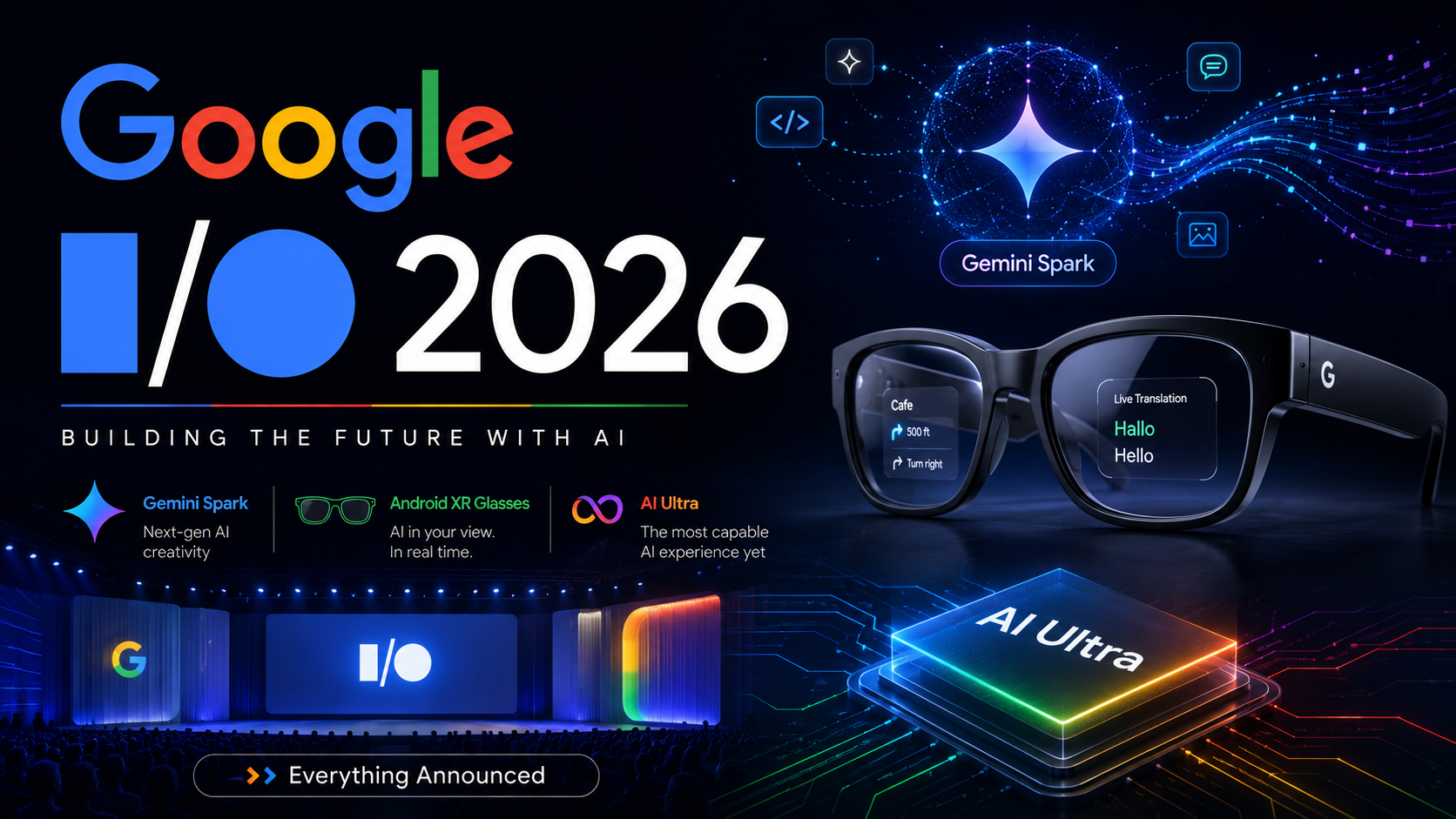
Google just dropped its biggest developer event of 2026 — and it didn’t disappoint. At Google I/O 2026 on May 19, the company unveiled a sweeping set of AI-powered products that signal a complete reimagining of how we’ll interact with technology. From a 24/7 AI agent that works while you sleep, to smart glasses that translate conversations in real time, to a new $100/month AI Ultra subscription — Google made it clear that 2026 is the year it goes all-in on agentic AI.
Here’s everything you need to know about every major announcement at Google I/O 2026.
Gemini Spark: Google’s 24/7 AI Agent Is Here
The biggest announcement of the night was Gemini Spark, Google’s new general-purpose AI agent that can reason across connected apps — Gmail, Docs, Calendar, Drive — and take action on your behalf, around the clock, even when your laptop is closed.
Unlike typical chatbots that wait for you to ask something, Gemini Spark proactively manages your digital life. It can summarize overnight emails, prepare meeting briefs before calls start, reschedule conflicting calendar events, and draft replies — all autonomously. Google says it runs on virtual machines via Google Cloud and is accessible via the Gemini app on Android, iOS, and desktop.
Gemini Spark is currently in beta, rolling out first to trusted testers and Google AI Ultra subscribers starting next week in the US. Think of it as a digital chief of staff that never sleeps. This is a direct shot at competitors like OpenAI’s Operator and Anthropic’s Claude — as we noted in our AI agents tutorial, 2026 is shaping up to be the year AI agents go mainstream.
Gemini 3.5 Flash: 4x Faster Frontier AI
Google also officially launched Gemini 3.5 Flash, a new model that outperforms 3.1 Pro across coding, agentic tasks, and multimodal benchmarks — while running at 4x faster output tokens per second. This is a massive leap over the Gemini 3.1 Pro and Gemma 4 we covered earlier this year.
The model is available immediately in the Gemini API via Google AI Studio and Vertex AI. Developers can access it for free in AI Studio with usage limits, with pay-as-you-go pricing for production workloads.
Gemini 3.5 Pro is also in testing and expected to launch next month — Google teased it as capable of handling “the hardest frontier tasks” including complex multi-step reasoning, scientific research assistance, and advanced code generation.
Additionally, Google introduced Gemini Omni, a new model series that combines Gemini’s reasoning with multimodal creation — accepting image, audio, video, and text input while outputting grounded video responses. It’s positioned as the backbone of Google’s creative AI tools going forward.
Android XR Smart Glasses: AI in Your Field of Vision
After years of rumors, Android XR smart glasses are finally arriving this fall — and they’re more capable than most people expected. Google announced two types of intelligent eyewear: audio glasses and display glasses.
The audio glasses (launching first, this fall) can:
- Provide real-time turn-by-turn directions as you walk, with Gemini adding restaurant stops based on your preferences
- Translate speech from 70+ languages in real time, directly in your ear
- Manage calls and texts without reaching for your phone
- Summarize missed messages on command
- Pair with both Android and iOS devices
Google partnered with Samsung and premium eyewear brands Gentle Monster and Warby Parker for the hardware. The “Hey Google” trigger or a tap on the frame activates Gemini instantly.
Google also partnered with Xreal on Project Aura, their display glasses that overlay information in your field of vision. Combined with Samsung’s own XR headset work and the audio glasses, Google says at least three smart glasses products are hitting the market this year.
This puts Google in direct competition with Meta Ray-Bans — and given Meta’s current AI-driven restructuring, the timing is pointed.
Google AI Ultra: $100/Month for Power Users
Google officially launched its new AI Ultra subscription tier at $100 per month, targeting developers, creators, and power users who want access to everything Google AI has to offer — simultaneously.
AI Ultra subscribers get:
- Priority access to Gemini Spark (launching next week for Ultra subscribers)
- Gemini 3.5 Flash and early access to 3.5 Pro
- Gemini Omni video generation
- Google Flow and Flow Music (now available as mobile apps)
- Gemini for Science — an AI research toolkit
- Highest rate limits across all Google AI tools
The $100/month tier is above Google One AI Premium ($19.99/month) and is explicitly positioned to compete with OpenAI’s ChatGPT Pro and Anthropic’s Claude Max plans. With OpenAI planning an AI phone and Google launching its own glasses, the arms race is accelerating.
Google Antigravity 2.0: 12x Faster AI Coding
Google also unveiled Antigravity 2.0 at I/O — its AI-powered coding assistant that’s now 12x faster than the previous version, with significantly lower token usage. The new version includes an updated desktop app, a CLI tool, and an SDK for custom workflows.
In a demo, Google showed Antigravity 2.0 helping a developer create an entire operating system from scratch, and even compile and run Doom — a classic benchmark for “can it really code?” The new version competes directly with tools like GitHub Copilot, Cursor, and Anthropic’s Claude Code (which we covered in our article on Claude Mythos).
Antigravity 2.0 is available now for free with a Google account, with increased usage limits for AI Ultra subscribers.
Talk to Your Gmail Inbox — With Your Voice
One of the crowd-pleasing demos at I/O was the new Gmail voice conversation feature. You can now literally talk to your Gmail inbox — asking Gemini to summarize your emails, find specific threads, draft responses, or move items to your calendar, all via natural speech.
Google also demoed Docs Live, a forthcoming Workspace feature that lets users dictate documents conversationally — including false starts, corrections, and tangents — and Gemini generates a clean, finished Google Doc from the audio. It handles complex research documents and long-form writing with contextual formatting.
The Daily Brief feature in Gemini is also new: each morning, Gemini generates a personalized digest sifting through your Gmail, Calendar, and Tasks, prioritizing what matters most and what you need to prepare for that day. It’s like having an executive assistant built into your inbox.
AI-Powered Universal Cart Coming to Google Search
Google announced a new Universal Cart launching this summer that works across merchants and services directly in Google Search and the Gemini app. Users can browse products across multiple retailers, add them to a single universal cart, and check out — all without leaving Google.
This is Google’s most aggressive move yet into AI-native commerce, eliminating the need to visit individual retailer websites for comparison shopping. It builds on AI Overviews and AI Mode in Google Search, which have already been rewriting how people shop online.
Gemini for Science: AI Enters the Lab
Google unveiled Gemini for Science — a dedicated toolkit bringing AI to research workflows. It can help scientists model complex molecular structures, synthesize research from thousands of papers, generate hypotheses, and run statistical analyses. Initial partners include leading research universities and pharmaceutical companies.
This isn’t just a novelty — it’s a direct continuation of the trend we covered when AI detected pancreatic cancer 475 days early. AI is no longer just a productivity tool for desk workers; it’s becoming core scientific infrastructure.
Verdict: Google Is Playing Offense in 2026
Google I/O 2026 was a statement. After years of being reactive — catching up to ChatGPT, rebuilding Search credibility after AI Overviews stumbled, fighting off Bing’s AI — Google came into I/O 2026 with a clear offensive strategy:
- Agent-first AI with Gemini Spark taking on OpenAI Operator
- Hardware integration with Android XR glasses taking on Meta Ray-Bans
- Developer ecosystem lock-in with Antigravity 2.0 and AI Ultra
- Commerce dominance with the Universal Cart in Search
- Science and enterprise with Gemini for Science and Workspace features
The AI infrastructure arms race is accelerating. As we covered, AI is reshaping cybersecurity, and now it’s reshaping everything from your glasses to your shopping cart. Google’s I/O 2026 isn’t just a product launch — it’s a declaration of intent.
The only question left: when will you be first touched by this wave?