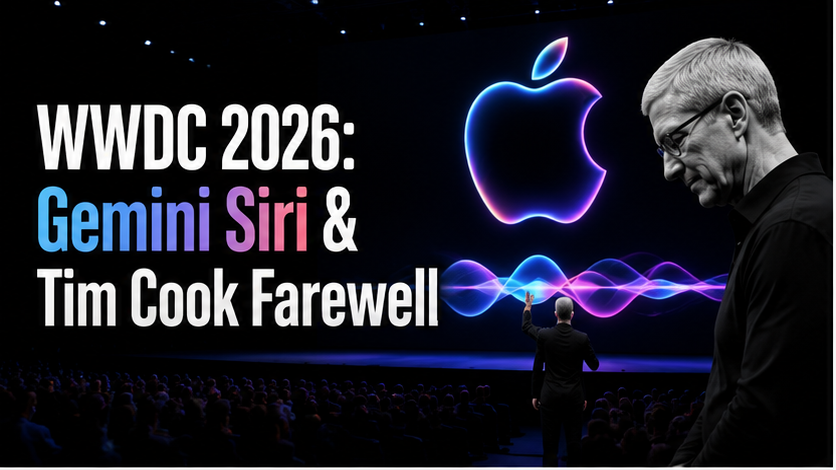
Apple WWDC 2026: Gemini Siri, iOS 27, and Tim Cook’s Farewell Keynote
Table of Contents
Apple WWDC 2026 just happened, and it was anything but boring. Tim Cook walked out at Apple Park for his final keynote as CEO — and dropped a Gemini-powered Siri rebuild, iOS 27, a revolutionary AI Extensions system, and the biggest shake-up to Apple Intelligence since it launched. If you thought Apple was falling behind in the AI race, today changes everything.
Here is everything Apple announced at WWDC 2026 on June 8, why it matters, and what the critics are getting wrong.
Apple WWDC 2026: The Biggest Announcements
WWDC 2026 was loaded. Apple unveiled iOS 27, macOS 27, iPadOS 27, watchOS 27, tvOS 27, and visionOS 27 in a single keynote. But the real headline? A completely rebuilt Siri powered by Google’s Gemini model, a new AI Extensions framework that lets users choose between ChatGPT, Claude, and Gemini, and the confirmation that Tim Cook is stepping down as CEO on September 1.
The keynote ran nearly two hours. Apple spent most of it on AI features — a dramatic pivot from years of playing catch-up. After a $250 million settlement over advertised-but-undelivered Siri improvements, Apple clearly got the message: fix Siri or lose relevance.
Gemini-Powered Siri: Apple’s $1 Billion Bet
The new Siri is not an upgrade — it is a ground-up rebuild. Apple licensed a custom 1.2-trillion-parameter Gemini model from Google in a deal worth approximately $1 billion per year. The deal was announced in January 2026, but Apple confirmed it officially on stage today.
Here is what the rebuilt Siri includes:
- Chatbot-style interface similar to ChatGPT and Claude conversations
- Standalone Siri app with a system-wide “Search or Ask” gesture
- Dynamic Island integration on iPhone 16 and newer
- Personal context access — emails, photos, messages, calendar, files
- On-screen awareness — Siri can see and understand what is on your screen
- Deeper cross-app actions — chain tasks across multiple apps in one command
The architecture uses three layers: a query planning system, a knowledge retrieval engine, and a summarization layer. Gemini handles the planning and summarization, while Apple’s on-device models handle personal and privacy-sensitive tasks.
The critical privacy detail: heavy Gemini reasoning runs on Apple Private Cloud Compute (PCC) servers — not Google’s infrastructure. Apple retains control over what data leaves the device. Personal tasks stay on-device entirely. Whether that distinction holds under security researcher scrutiny remains an open question, but Apple clearly designed this to avoid a “Google has all your data” narrative.
The strategic question is simple: every other major tech company — OpenAI, Anthropic, Google, Microsoft — decided that owning a frontier AI model was essential. Apple, the world’s most valuable company, chose to rent one. That is either the smartest contrarian bet in tech or a dependency that will haunt them for years.
iOS 27: Everything New
iOS 27 shipped as Beta 1 the same afternoon as the keynote, available immediately for Apple Developer Program members. Here are the key features:
AI-Powered Photos: The Photos app received major AI editing tools including “Extend” (generative background extension), “Enhance” (AI-powered quality improvements), “Reframe” (perspective adjustments), and an improved “Clean Up” feature. These were demonstrated live on stage with impressive results.
AI Calendar: A rebuilt Calendar app with Siri integration that can suggest meeting times, draft event descriptions, and automatically block focus time based on your work patterns.
Health App Rebuild: A completely redesigned Health app with Siri integration for natural language health queries, AI-powered trend analysis, and proactive health alerts based on your data patterns.
Accessibility: Natural language Voice Control and on-device subtitles for any audio or video content — both running locally without an internet connection.
Performance: Apple emphasized that iOS 27 focuses on improving performance, battery life, and system reliability over flashy design changes. This is a direct response to criticism that recent iOS updates prioritized features over stability.
AI Extensions: Choose ChatGPT, Claude, or Gemini
This is the announcement most coverage is underplaying, and it might be the most important one.
iOS 27, iPadOS 27, and macOS 27 will include a new AI Extensions system that lets users choose which AI model powers Apple Intelligence features. The three options at launch:
- Google Gemini (default)
- OpenAI ChatGPT
- Anthropic Claude
Each model has its own distinct voice so users know which one responded. You can switch between them in Settings, or set different models for different task types. This is the most significant AI platform policy decision Apple has made in a decade.
For Anthropic specifically, this is massive. Apple has approximately 2.2 billion active devices globally. Even if 5% of iOS 27 users select Claude, that is over 100 million new Claude users — more than double Anthropic’s current estimated user base. This arrives right as Anthropic finalizes its IPO filing.
For OpenAI, it reinforces ChatGPT’s position as the consumer-recognized AI brand. For Google, being the default gives Gemini an enormous distribution advantage — most users never change defaults.
Tim Cook’s Last Keynote: End of an Era
Tim Cook confirmed he will hand the CEO role to hardware chief John Ternus on September 1, 2026. This was his last WWDC keynote after 15 years as CEO.
Under Cook, Apple grew from a $400 billion company to a $3.5+ trillion one. He oversaw the launch of Apple Watch, AirPods, Apple Silicon, Vision Pro, and the services revenue explosion that now generates over $100 billion annually. His tenure was defined by operational excellence, supply chain mastery, and a relentless focus on privacy as a competitive differentiator.
John Ternus, who led the Apple Silicon transition and the hardware engineering behind every major product since 2020, takes over at a pivotal moment. The AI strategy announced today — licensing Gemini, opening to third-party AI models, and rebuilding Siri — will define whether Apple’s approach works or falls behind. Ternus inherits a company that has never been more profitable and has never faced more existential questions about its technology direction.
Device Compatibility: Who’s Left Behind
iOS 27 drops support for iPhone 11 and the second-generation iPhone SE. iPhone 12 and later remain supported. However, the full AI capabilities — including the rebuilt Siri, AI-powered Photos editing, and the AI Extensions system — require iPhone 15 Pro or newer at launch.
This creates a three-tier experience: iPhone 15 Pro+ users get everything, iPhone 12-15 users get iOS 27 without AI features, and iPhone 11 users get nothing. Apple’s AI future is tied to its newest hardware — which is exactly the upgrade incentive Apple wants heading into the iPhone 17 launch this fall.
What Apple Didn’t Announce
No new hardware. No HomePad (the rumored 7-inch smart home hub with an A18 chip and homeOS). No iPhone SE 4. No Mac Pro refresh. This was a pure software event, consistent with analyst expectations but disappointing for hardware enthusiasts hoping for a “one more thing” moment.
Apple also did not address Vision Pro sales numbers, which have been underwhelming according to multiple reports. visionOS 27 improvements were covered briefly but without the enthusiasm Apple usually brings to new platforms.
What This Means for the AI Industry
WWDC 2026 has three major implications for the broader AI industry:
1. Distribution is king. Apple just gave three AI companies — Google, OpenAI, and Anthropic — access to 2.2 billion devices. The model that wins the default position wins the consumer market. Google being the default is an enormous advantage.
2. The model race commoditizes further. By making AI models swappable, Apple is signaling that the model itself is not the differentiator — the platform, the integration, and the user experience are. This is bad news for companies whose entire business model is “our model is better.”
3. Privacy is the moat. Apple’s Private Cloud Compute architecture gives it a unique positioning: enterprise and privacy-conscious users get frontier AI without sending data to Google, OpenAI, or Anthropic servers. If this works as described, it is a genuine competitive advantage that no other company can replicate.
Final Verdict
WWDC 2026 is the most consequential Apple event since the introduction of Apple Silicon. The rebuilt Siri, the AI Extensions system, and the explicit acknowledgment that Apple is a platform company — not an AI model company — represent a clear strategic direction. Whether it works depends on execution: does the Gemini-powered Siri actually work reliably in September? Do third-party AI integrations deliver a seamless experience? Does Apple Private Cloud Compute hold up under security scrutiny?
The answers arrive in September. For now, Apple has stopped playing catch-up and started playing a different game entirely.
WWDC 2026 runs through Friday, June 12, with developer sessions on new APIs, frameworks, and tools available throughout the week.