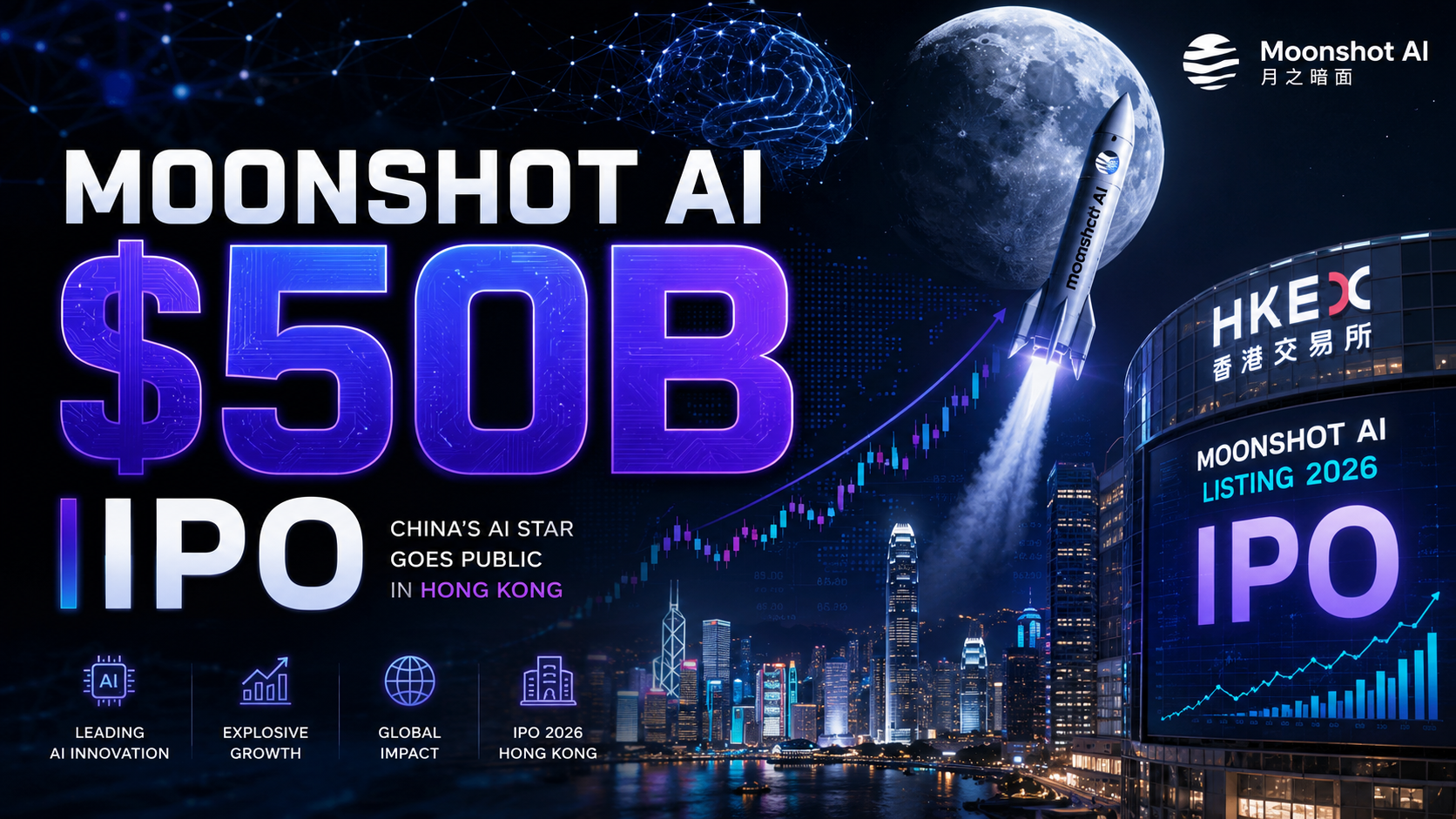
Moonshot AI IPO 2026: $50B Valuation Shakes the AI Market
Moonshot AI is preparing what could become the largest AI startup IPO of 2026 — a Hong Kong listing that values the Chinese artificial intelligence company at a staggering $50 billion. The Moonshot AI IPO signals a dramatic shift in the global AI landscape, as Chinese labs race to go public while their American rivals remain private. Backed by Goldman Sachs and CICC, this offering could reshape how investors think about the entire AI sector.
[rank-math-toc]
Moonshot AI IPO: Why $50 Billion Changes Everything
The numbers behind the Moonshot AI IPO are hard to ignore. The company is seeking a pre-IPO funding round that would push its valuation from $31.5 billion to roughly $50 billion, according to Bloomberg reporting. That figure would make it one of the most valuable AI startups on the planet — and the first major Chinese AI company to test the public markets at this scale.
Goldman Sachs and China International Capital Corporation (CICC) are underwriting the deal. Both firms have deep experience in cross-border tech listings, and their involvement suggests institutional confidence that Moonshot AI can deliver the kind of growth story public market investors demand. The IPO is expected to happen within six months, targeting Hong Kong’s stock exchange.
For context, Cerebras raised $3.5 billion at a $26.6 billion valuation in its own IPO earlier this year. Moonshot AI is aiming nearly twice as high — and it is doing so with a fundamentally different business model focused on consumer and enterprise AI applications rather than hardware.
Kimi K3: The AI Model Driving Moonshot’s Revenue Surge
At the center of the Moonshot AI IPO story is Kimi K3, the company’s flagship large language model. Kimi K3 is a 280-billion-parameter model that launched in early 2026 and has quickly become one of the most popular AI assistants in China. Since its release, Moonshot AI’s daily revenue has increased sixfold — a growth trajectory that caught the attention of Wall Street and Hong Kong’s financial establishment.
The model powers an AI chatbot that competes directly with Baidu’s ERNIE Bot and Alibaba’s Qwen. But Kimi K3’s real differentiator is its reasoning capability and multimodal performance. Independent benchmarks have placed it ahead of several Western competitors on Chinese-language tasks, code generation, and long-context understanding.
Moonshot AI’s annualized recurring revenue (ARR) has hit $300 million, according to TechNode. That is a remarkable number for a company that was generating negligible revenue just 18 months ago. The revenue acceleration is largely subscription-driven, with both individual users and enterprise clients paying for premium Kimi K3 access.
The Chinese AI IPO Wave: Moonshot Isn’t Alone
Moonshot AI is not the only Chinese AI company eyeing the public markets. MetaX, a semiconductor company that designs AI accelerator chips as alternatives to Nvidia’s restricted GPUs, has also filed for a Hong Kong listing. Together, these filings represent a broader trend: Chinese AI companies are choosing to go public at a moment when their American counterparts — OpenAI, Anthropic, and xAI — remain private.
The timing is strategic. US export controls on advanced AI chips have forced Chinese labs to develop their own hardware and model architectures. Companies like Moonshot AI have turned that constraint into a narrative advantage: they are building competitive AI systems despite the restrictions, which makes their technology story compelling to investors.
DeepSeek, another major Chinese AI lab, recently stabilized its V4 model and has raised approximately $7.4 billion in total funding. However, DeepSeek has not announced IPO plans, choosing instead to remain privately funded. That leaves Moonshot AI as the leading candidate to become the first publicly traded Chinese AI foundation model company.
Moonshot AI IPO Valuation: How It Compares to Global Rivals
A $50 billion valuation would place Moonshot AI in rarefied territory. Here is how it stacks up against the global AI landscape:
- OpenAI: Last valued at approximately $300 billion (private)
- Anthropic: Last valued at approximately $61.5 billion (private)
- xAI: Last valued at approximately $50 billion (private)
- Cerebras: IPO at $26.6 billion valuation
- Moonshot AI: Targeting $50 billion IPO valuation
- DeepSeek: Estimated $7-10 billion (private, not seeking IPO)
What makes Moonshot AI’s valuation particularly notable is its revenue multiple. At $300 million ARR and a $50 billion target, the company is asking investors to pay roughly 167 times annual revenue. That is aggressive even by AI industry standards, but it reflects the expectation that Kimi K3’s growth curve will continue steepening.
The Pentagon’s recent AI contracting decisions and broader geopolitical dynamics also play a role. As the US government channels AI spending toward domestic companies, Chinese AI firms need alternative capital sources — and public markets in Hong Kong offer exactly that.
Goldman Sachs and CICC: The Banks Behind the Deal
The choice of underwriters reveals Moonshot AI’s ambitions. Goldman Sachs brings credibility with Western institutional investors who may be hesitant about Chinese AI companies. CICC, meanwhile, is the dominant investment bank for Chinese tech listings and has deep relationships with mainland Chinese investors and sovereign wealth funds.
According to Benzinga, the pre-IPO round is expected to close within weeks, with the formal IPO filing following shortly after. Early investors include Sequoia Capital China, Hillhouse Capital, and Alibaba Group — all of whom stand to see significant returns if the IPO prices at or above the $50 billion target.
Risks and Red Flags for Moonshot AI Investors
Despite the impressive growth numbers, the Moonshot AI IPO carries real risks that investors should not overlook:
Regulatory uncertainty: Chinese tech companies face unpredictable regulatory environments. Beijing’s previous crackdowns on tech giants like Alibaba and Didi rattled investors and destroyed billions in market value. While the current government stance is more supportive of AI, that could change.
US-China tensions: Export controls, potential investment restrictions, and geopolitical friction could limit Moonshot AI’s ability to attract Western capital or expand internationally. The company’s reliance on domestically produced AI chips adds hardware supply chain risk.
Profitability questions: Like virtually every AI foundation model company, Moonshot AI is spending heavily on compute infrastructure. The $300 million ARR figure is impressive, but the company’s burn rate and path to profitability remain unclear. Training and running large models is extraordinarily expensive.
Competition is intensifying: DeepSeek V4, Baidu’s ERNIE 5.0, and Alibaba’s Qwen 3 are all competing for the same Chinese AI market. Internationally, Google’s Gemini 3.1 Pro and Anthropic’s Claude continue to push the frontier. Maintaining Kimi K3’s competitive edge will require continuous, massive R&D investment.
What the Moonshot AI IPO Means for the Global AI Race
The Moonshot AI IPO is more than a single company going public. It is a signal that the AI industry is entering a new phase — one where public market capital, not just venture funding, drives the competition.
If Moonshot AI successfully lists at $50 billion, it will create pressure on American AI companies to follow. OpenAI has been exploring various corporate restructuring options, and Anthropic has not ruled out an eventual IPO. A successful Moonshot listing could accelerate those timelines.
The IPO also tests whether investors are willing to pay premium valuations for AI companies that have not yet proven they can be profitable. The AI sector has seen enormous private market valuations, but public markets tend to be less forgiving. How Moonshot AI trades after its listing will set expectations for every AI company considering going public.
Meanwhile, the rise of AI-assisted cyberattacks and growing enterprise demand for AI tools suggest that the total addressable market for AI products continues to expand. Whether Moonshot AI can capture a meaningful share of that market — against both Chinese and Western competitors — will determine if its $50 billion price tag was justified.
Timeline: What Happens Next
Based on available reporting from Yahoo Finance and Quartz, here is the expected timeline:
- July-August 2026: Pre-IPO funding round closes at ~$50B valuation
- September 2026: Formal IPO filing with Hong Kong Stock Exchange
- Q4 2026 or Q1 2027: Shares begin trading
If the IPO proceeds as planned, Moonshot AI will become the highest-valued Chinese AI company to ever go public — and one of the most closely watched tech listings of the decade.
The Bottom Line on Moonshot AI’s $50B IPO
The Moonshot AI IPO represents a pivotal moment in the global AI industry. With Kimi K3 driving $300 million in annualized revenue, Goldman Sachs and CICC underwriting the deal, and a $50 billion valuation that rivals the biggest names in Western AI, this is not a company that can be dismissed. Whether you are an investor, an AI researcher, or simply someone watching the Big Tech landscape evolve, Moonshot AI’s Hong Kong listing deserves your attention. The outcome will shape not just one company’s future, but the trajectory of the entire AI industry.