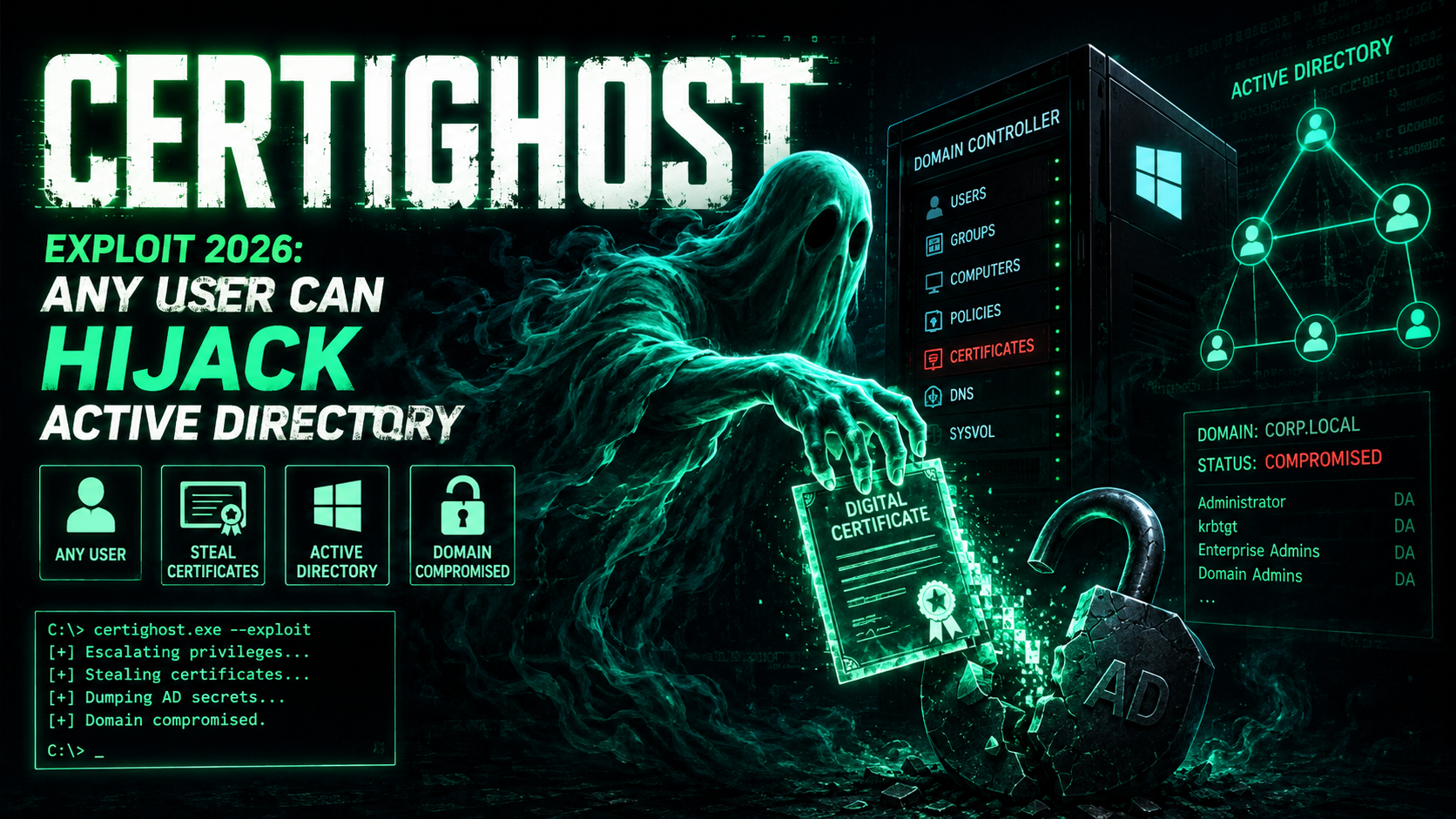
Certighost Exploit 2026: Any User Can Hijack Active Directory
The Certighost exploit is the kind of vulnerability that keeps system administrators awake at night. Published on July 24, 2026, by security researchers H0j3n and Aniq Fakhrul, this Active Directory Certificate Services (AD CS) attack lets any low-privileged domain user impersonate a Domain Controller, perform a DCSync attack, and steal the krbtgt secret — effectively giving an attacker full control over an entire Active Directory environment. Tracked as CVE-2026-54121 with a CVSS score of 8.8, the Certighost exploit comes with a fully working proof-of-concept, and organizations that have not applied Microsoft’s July 2026 patches are sitting ducks.
[rank-math-toc]
What Is the Certighost Exploit?
The Certighost exploit targets a fundamental flaw in how Active Directory Certificate Services handles enrollment requests. AD CS is Microsoft’s built-in public key infrastructure (PKI) that issues digital certificates to users, computers, and services within an Active Directory domain. Organizations use it for everything from securing email with S/MIME to authenticating VPN connections and encrypting web traffic on internal servers.
The vulnerability (CVE-2026-54121) exists in the enrollment fallback mechanism — specifically in how AD CS processes what researchers call the “chase” mechanism. When a certificate enrollment request fails at one enrollment endpoint, AD CS can be configured to fall back to alternative endpoints. The Certighost exploit abuses this fallback logic to trick the Certificate Authority into issuing a Domain Controller certificate to a regular, unprivileged user account.
Once an attacker holds a valid Domain Controller certificate, they can authenticate as the Domain Controller itself using Kerberos. From there, they perform a DCSync attack — a technique that replicates the Domain Controller’s behavior to extract password hashes for every account in the domain, including the krbtgt account. Compromising krbtgt means the attacker can forge Golden Tickets, granting persistent, virtually undetectable access to the entire Active Directory forest.
How the Certighost Exploit Works Step by Step
Understanding the attack chain is critical for defenders. Here is the step-by-step breakdown of how the Certighost exploit achieves Domain Controller impersonation:
Step 1: Initial Access
The attacker needs only a standard domain user account. No administrative privileges, no special group memberships, no elevated access of any kind. This is what makes Certighost so dangerous — the barrier to entry is the lowest possible level of access in any Active Directory environment. Any employee, contractor, or compromised service account qualifies.
Step 2: Certificate Enrollment Request
The attacker submits a certificate enrollment request to the AD CS Certificate Authority, specifically crafted to trigger the enrollment fallback (“chase”) mechanism. The request exploits a bug in how AD CS validates the identity of the requestor during the fallback process.
Step 3: Fallback Exploitation
During the chase process, AD CS fails to properly verify that the requesting account matches the subject of the certificate being issued. The attacker’s request is processed as if it came from a Domain Controller, and the Certificate Authority issues a certificate with Domain Controller attributes to the attacker’s regular user account.
Step 4: Kerberos Authentication
With the fraudulently obtained Domain Controller certificate, the attacker authenticates to Active Directory via Kerberos PKINIT (Public Key Cryptography for Initial Authentication). The Key Distribution Center (KDC) sees a valid Domain Controller certificate and issues a Ticket Granting Ticket (TGT) with Domain Controller privileges.
Step 5: DCSync and Credential Theft
Using the Domain Controller TGT, the attacker performs a DCSync attack using tools like Mimikatz or Impacket’s secretsdump. This replicates the domain replication protocol (MS-DRSR) to extract the NTLM password hashes and Kerberos keys for every account in the domain, including the krbtgt account.
Step 6: Golden Ticket and Persistence
With the krbtgt hash, the attacker forges Golden Tickets — Kerberos TGTs that are valid for any account, any service, with any expiration date. This provides persistent access that survives password resets for individual accounts and can only be fully remediated by resetting the krbtgt password twice (to invalidate all existing tickets).
CVE-2026-54121: Technical Details
The vulnerability has been assigned CVE-2026-54121 with a CVSS base score of 8.8 (High). Here are the key technical details:
| Attribute | Detail |
|---|---|
| CVE ID | CVE-2026-54121 |
| CVSS Score | 8.8 (High) |
| Attack Vector | Network |
| Attack Complexity | Low |
| Privileges Required | Low (any domain user) |
| User Interaction | None |
| Impact | Complete domain compromise |
| Affected Component | Active Directory Certificate Services (AD CS) |
| Patch Available | Yes — July 2026 Patch Tuesday |
| Exploitation in Wild | Not yet reported |
The CVSS score of 8.8 reflects the low barrier to exploitation (any domain user, network access, no user interaction) combined with the catastrophic impact (full domain compromise). Some security professionals have argued the score should be even higher given that a single exploitation effectively compromises the entire Active Directory forest, but the CVSS framework caps certain impact categories.
Who Discovered the Certighost Exploit?
The Certighost exploit was discovered and published by security researchers H0j3n and Aniq Fakhrul on July 24, 2026. Both researchers have a track record of AD CS vulnerability research, and they followed responsible disclosure practices by coordinating with Microsoft before publishing the full details and proof-of-concept code.
The name “Certighost” is a portmanteau of “certificate” and “ghost,” reflecting the attack’s ability to create a phantom Domain Controller identity from thin air. The researchers chose the name to emphasize that the attacker becomes an invisible, ghost-like presence with Domain Controller privileges — something that should not exist outside of legitimate Domain Controllers.
The full proof-of-concept (PoC) exploit is publicly available, which significantly increases the urgency for organizations to patch. While no exploitation in the wild has been reported as of the publication date, Mandiant’s M-Trends 2026 report has documented how quickly attackers weaponize public PoCs — often within days of release.
Why the Certighost Exploit Is So Dangerous
Active Directory Certificate Services vulnerabilities are among the most dangerous classes of security flaws in enterprise environments, and the Certighost exploit exemplifies why:
- Low privilege requirement: Any domain user can execute the attack. There is no need for admin rights, special group memberships, or pre-existing elevated access.
- No user interaction: The attack is fully automated and does not require phishing, social engineering, or any action from a victim.
- Complete domain compromise: A successful attack yields the krbtgt secret, which enables Golden Ticket attacks and persistent access to the entire domain.
- Difficult to detect: Certificate-based authentication is a legitimate AD CS function. The malicious certificate request may not trigger alerts in environments without specific AD CS monitoring.
- Public PoC available: The full exploit code is publicly available, lowering the barrier for attackers to reproduce the attack.
- Widespread AD CS deployment: AD CS is deployed in the majority of enterprise Active Directory environments, making the potential attack surface enormous.
This vulnerability is particularly concerning because AD CS attacks have been a growing trend since the original “Certified Pre-Owned” research by SpecterOps in 2021. The security community has identified numerous AD CS attack techniques (ESC1 through ESC14), and Certighost adds another devastating vector to this growing list.
How the Certighost Exploit Compares to Other AD CS Attacks
The AD CS attack landscape has expanded significantly over the past several years. Here is how the Certighost exploit compares to previously known AD CS escalation techniques:
| Attack | Technique | Privilege Required | Impact |
|---|---|---|---|
| ESC1 | Misconfigured certificate templates | Domain user | User impersonation |
| ESC8 | NTLM relay to AD CS HTTP endpoint | Network position | Domain admin |
| Certighost | Enrollment fallback abuse | Domain user | Domain Controller impersonation |
| PetitPotam | NTLM relay via EFS | None/low | Domain admin |
What sets Certighost apart is the directness of the attack path. Unlike ESC1, which requires misconfigured templates (a configuration error that many organizations have already remediated), Certighost exploits a bug in the AD CS enrollment mechanism itself. It does not require misconfigurations — it works against properly configured AD CS deployments that have not been patched.
Microsoft’s Patch and Remediation Steps
Microsoft addressed CVE-2026-54121 in the July 2026 Patch Tuesday update. The patch fixes the enrollment fallback validation flaw by ensuring that AD CS properly verifies the identity of certificate requestors during the chase process.
Organizations should take the following immediate actions:
- Apply July 2026 patches immediately. This is the single most important remediation step. Every Domain Controller and AD CS server must be patched.
- Audit AD CS certificate issuance logs. Review Certificate Authority logs for any Domain Controller certificates issued to non-DC accounts. Look for Event ID 4887 (Certificate Services approved a certificate request) with suspicious subject names.
- Monitor for DCSync activity. Deploy detection rules for replication traffic (DRS GetNCChanges) originating from non-Domain Controller IP addresses.
- Review AD CS enrollment endpoints. Identify all certificate enrollment endpoints in your environment and ensure they are secured with proper authentication requirements.
- Consider krbtgt password reset. If there is any suspicion that the vulnerability may have been exploited before patching, perform a double krbtgt password reset following Microsoft’s documented procedure.
- Enable advanced AD CS auditing. Ensure that certificate enrollment and issuance events are being logged and forwarded to your SIEM.
Certighost Exploit in the Context of 2026 Threats
The Certighost exploit does not exist in isolation. It arrives during a period of escalating cybersecurity threats across all sectors. Earlier this year, the cPanel zero-day (CVE-2026-41940) compromised 44,000 servers, demonstrating how quickly infrastructure vulnerabilities can be weaponized at scale.
The Mandiant M-Trends report for 2026 highlighted that AI-assisted attacks are accelerating the speed at which threat actors exploit newly disclosed vulnerabilities. With a full PoC publicly available for Certighost, the window between disclosure and active exploitation is likely measured in days, not weeks.
Active Directory remains the backbone of identity management for the vast majority of enterprise organizations worldwide. A single Certighost exploitation can compromise an entire organization’s identity infrastructure, making it one of the highest-impact vulnerabilities disclosed in 2026.
Organizations that are still running on-premises Active Directory should also consider this as further motivation to evaluate hybrid or cloud-native identity solutions. Even the Pentagon is modernizing its IT infrastructure, and the steady stream of AD CS vulnerabilities suggests that traditional on-premises PKI deployments carry significant ongoing risk.
Detection and Hunting Guidance
Security teams should proactively hunt for evidence of Certighost exploitation using the following indicators:
- Certificate issuance anomalies: Look for Domain Controller certificate templates being issued to non-computer accounts or to accounts that are not Domain Controllers.
- Kerberos PKINIT authentication: Monitor for PKINIT authentication events (Event ID 4768 with certificate-based pre-authentication) from accounts that are not Domain Controllers.
- DCSync indicators: Alert on Directory Replication Service (DRS) GetNCChanges requests from IP addresses that do not belong to known Domain Controllers.
- Unusual AD CS enrollment patterns: Review certificate enrollment logs for requests that triggered the fallback/chase mechanism, particularly for Domain Controller templates.
- Golden Ticket indicators: Monitor for TGTs with abnormally long lifetimes or TGTs issued for accounts that do not match expected patterns.
Tools like CrowdStrike Falcon, Microsoft Defender for Identity, and open-source solutions like Bloodhound and Certify can help identify AD CS misconfigurations and potential exploitation attempts. Organizations should also review the detailed technical analysis published alongside the PoC for specific indicators of compromise.
What Happens If You Don’t Patch the Certighost Exploit
The consequences of leaving CVE-2026-54121 unpatched are severe and straightforward:
- Any domain user becomes a potential domain admin. Insider threats, compromised accounts, and contractor access all become paths to total domain compromise.
- Ransomware operators will use this. Ransomware groups actively scan for AD CS vulnerabilities because domain compromise enables enterprise-wide encryption. The $629 million in crypto losses in April 2026 alone shows how aggressively attackers pursue high-value targets.
- Recovery is extremely expensive. A full Active Directory compromise requires rebuilding the AD environment from scratch in the worst case, at a cost of hundreds of thousands to millions of dollars.
- Regulatory and compliance implications. Organizations subject to regulations like SOX, HIPAA, PCI-DSS, and GDPR face potential fines and mandatory breach disclosures if a preventable vulnerability leads to a data breach.
The Bottom Line on the Certighost Exploit
The Certighost exploit (CVE-2026-54121) is a critical Active Directory vulnerability that demands immediate attention. The combination of low privilege requirements, devastating impact, and a publicly available proof-of-concept makes this one of the most urgent patches of 2026. Any organization running Active Directory Certificate Services must apply the July 2026 Patch Tuesday updates without delay.
The broader lesson is that AD CS continues to be a high-value attack surface that organizations underinvest in monitoring and securing. Every AD CS vulnerability since the original Certified Pre-Owned research has reinforced this point, and Certighost is the most dangerous example yet. Patch now, audit your certificate infrastructure, and make AD CS monitoring a permanent part of your security operations.