EU Google Android AI Order 2026: Gemini Monopoly Ends
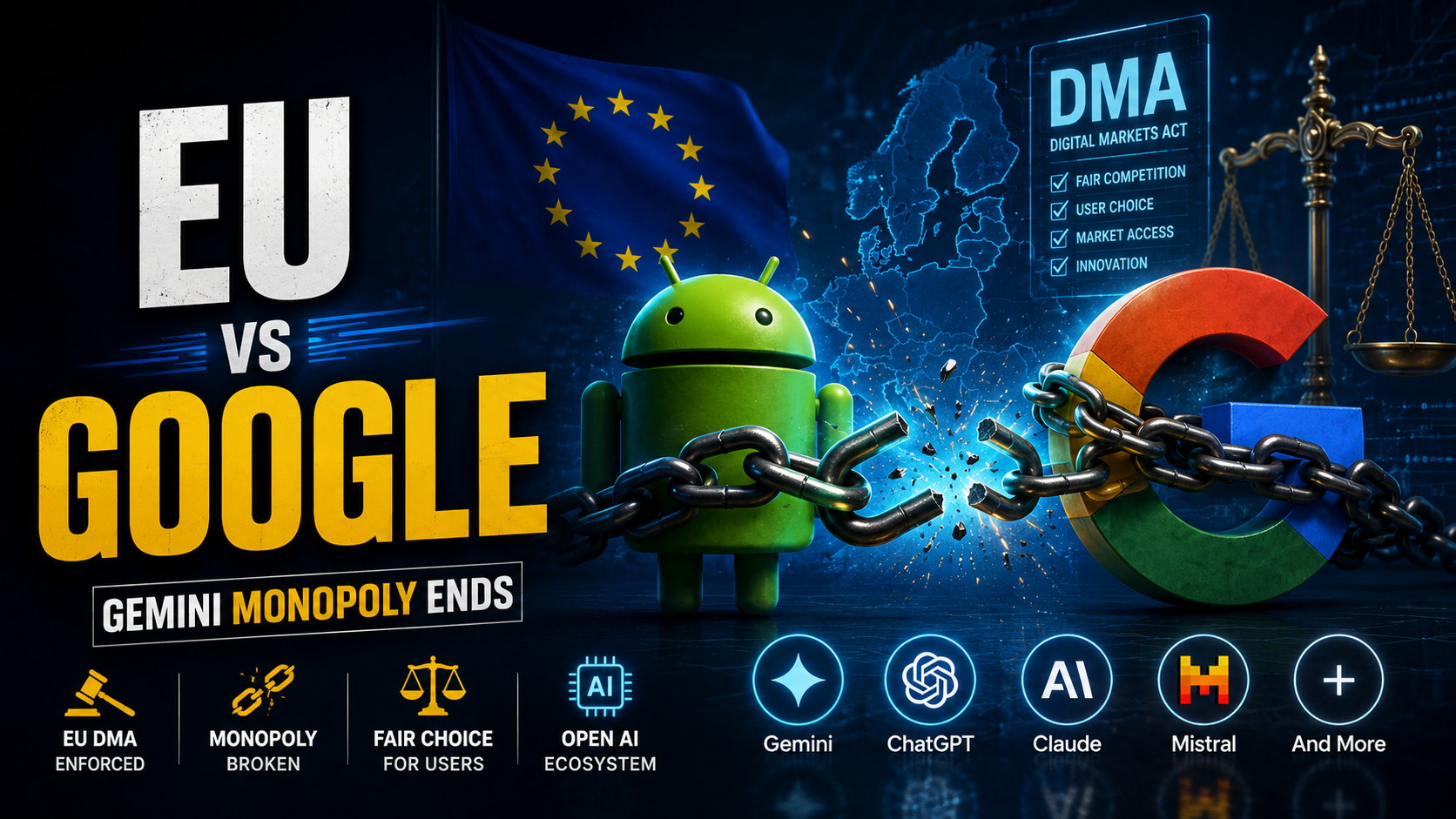
EU Google Android AI regulation just reached a tipping point that will reshape the smartphone industry. On July 16, 2026, the European Commission adopted two binding decisions that force Google to dismantle Gemini’s privileged position on Android and open the operating system’s deepest features to competing AI assistants. This is not a warning letter or a preliminary finding — these are enforceable orders with hard deadlines, and Google has no realistic path to avoid compliance. The era of one AI assistant ruling Android is officially over.
[rank-math-toc]
What the EU Google Android AI Decision Actually Says
The European Commission’s two decisions target different aspects of Google’s AI dominance on Android, but together they form a comprehensive assault on the company’s ability to bundle Gemini as the default, deeply integrated AI assistant.
The first decision addresses AI assistant access. Google must give competing AI assistants the same system-level access that Gemini currently enjoys on Android devices. This means third-party AI — whether it is OpenAI’s ChatGPT, Anthropic’s Claude, or any other competitor — must be able to hook into 11 specific Android features that are currently exclusive to or optimized for Gemini.
The second decision addresses search data sharing. Google must share search data with competing services by the end of 2026, removing another competitive moat that has kept rivals at a disadvantage. According to Gizchina, this data-sharing requirement could be even more impactful than the Android access changes because it strikes at Google’s core business model.
Both decisions fall under the Digital Markets Act (DMA), the EU’s landmark regulation that designates large tech platforms as “gatekeepers” and imposes specific obligations to ensure fair competition.
The 11 Android Features Google Must Open to EU Google Android AI Rivals
The Commission’s order specifies 11 Android features that must be opened to competing AI assistants. This is not a vague directive — each feature is explicitly named, and Google must provide equivalent access, not a degraded version.
- Voice activation: Third-party AI must be activatable by voice command, just like “Hey Google” triggers Gemini. Users must be able to set a custom wake word for their preferred AI assistant.
- Cross-app actions: Competing AI must be able to perform actions across apps — sending messages, setting alarms, opening apps, making calls — with the same permissions Gemini has.
- Location history access: Third-party AI assistants must be able to access location data (with user permission) to provide contextual recommendations and navigation assistance.
- Notification reading: Rival AI must be able to read and summarize notifications, a feature currently optimized for Gemini’s integration with Android’s notification system.
- Calendar and contacts integration: Full read and write access to the user’s calendar and contacts, enabling competing AI to schedule meetings, add contacts, and manage reminders.
- Settings control: The ability to toggle device settings — Wi-Fi, Bluetooth, brightness, volume — through voice commands to the user’s chosen AI assistant.
- Lock screen presence: Third-party AI must be accessible from the lock screen, not just within apps. Currently, only Google Assistant and Gemini have lock screen integration.
- Always-on listening: Competing AI must have access to Android’s always-on listening hardware, enabling wake-word detection without requiring the user to open an app first.
- On-device processing: Google must provide APIs for on-device AI processing that third-party assistants can use, rather than forcing them to rely on cloud processing while Gemini uses on-device capabilities.
- Screen context: Rival AI must be able to read and understand what is currently on the user’s screen, enabling contextual assistance based on visible content.
- Default assistant selection: Users must be presented with a clear, unbiased choice screen to select their preferred AI assistant during device setup, similar to the browser choice screens the EU has mandated previously.
As Android Authority reported, the breadth of these requirements goes far beyond what anyone in the industry expected. Google is essentially being forced to turn Android’s AI layer into an open platform.
EU Google Android AI Timeline: When Do Changes Take Effect?
The Commission set two distinct deadlines, giving Google some runway but not much:
- Search data sharing: Must be implemented by the end of 2026. Google has roughly five months to build the infrastructure for sharing search data with competitors.
- Android AI access changes: Must be fully implemented by June 2027. This gives Google approximately 11 months to redesign Android’s AI integration layer.
These timelines are aggressive by any standard. Redesigning how an operating system handles AI assistant integration — across billions of devices running different Android versions — is an enormous engineering challenge. Google will almost certainly argue that the timelines are unrealistic, but the Commission has shown little patience for delay tactics in DMA enforcement.
The Commission also reserved the right to impose additional measures if Google’s implementation is deemed insufficient or if the company attempts to comply in letter but not in spirit — a tactic Google has employed in previous EU regulatory battles.
Why the EU Says Gemini’s Android Monopoly Hurts Consumers
The Commission’s investigation found that Google’s deep integration of Gemini into Android creates a significant competitive disadvantage for rival AI assistants. The key finding: 60% of EU users find third-party AI assistants less attractive specifically because they lack Android system-level access.
This statistic is damning because it shows that the competitive harm is not theoretical — it is measurable and substantial. Users are not choosing Gemini because it is better. They are choosing it because it is the only AI assistant that works properly on their phone.
According to Unite.AI, the Commission’s research also found that developers of competing AI assistants invest significantly less in Android-specific features because they know those features will be hamstrung by limited system access. This creates a vicious cycle: limited access leads to inferior products, which leads to lower adoption, which leads to less investment.
The Commission explicitly stated that this dynamic undermines innovation in the AI assistant market and deprives European consumers of the benefits of competition — better products, lower prices, and more choices. The launch of Google Gemini 3.1 Pro earlier this year only deepened these concerns, as Google continued to tighten Gemini’s integration with Android while rivals remained locked out.
Google’s Response: Warning of a “Security Catastrophe”
Google has not taken this lying down. The company issued a detailed response opposing the Commission’s decisions, with its central argument revolving around security.
Google warns that giving external AI assistants deep system-level access to Android would create a “security catastrophe.” The company argues that the 11 features the Commission wants opened — particularly always-on listening, screen context reading, and cross-app actions — could be exploited by malicious actors if the security model is not carefully designed.
There is some validity to this concern. As Mandiant’s M-Trends report documented, AI-assisted attacks are becoming more sophisticated, and expanding the attack surface on billions of Android devices is not without risk. The cPanel zero-day incident earlier this year demonstrated how quickly vulnerabilities in widely-deployed systems can be exploited at scale.
However, critics point out that Google’s security argument is self-serving. The same deep permissions that Google claims are dangerous for third parties are already granted to Gemini. If these permissions are safe for Google’s AI, they should be safe for any AI that passes equivalent security review. Euronews quoted a Commission spokesperson saying, “Security concerns cannot be used as a pretext to maintain a monopoly.”
Google also argued that the timelines are too aggressive and that a rushed implementation would compromise both security and user experience. The company has indicated it may challenge the decisions in the European Court of Justice, though such challenges typically take years to resolve and do not suspend the obligation to comply.
How EU Google Android AI Rules Connect to the Digital Markets Act
These decisions are part of the broader DMA enforcement wave that has been building throughout 2025 and 2026. The DMA designates certain large platforms as “gatekeepers” — companies whose size and market position give them the power to control access to digital markets. Google, Apple, Amazon, Meta, Microsoft, and ByteDance are all designated gatekeepers.
Under the DMA, gatekeepers must allow third parties to interoperate with their platforms, must not favor their own services over competitors, and must give users genuine choice about which services they use. The Android AI decisions are a direct application of these principles.
Google has already been fined over $1 billion under EU digital competition law, and the DMA’s penalty structure is even more severe — fines can reach up to 10% of global annual revenue for violations, and up to 20% for repeat offenses. For Google, whose parent company Alphabet generated over $340 billion in revenue in 2025, the maximum fine could exceed $34 billion.
As TechTimes noted, the EU is clearly establishing precedent with these Android AI decisions. If Google is forced to open its AI layer, similar requirements could follow for Apple’s integration of AI into iOS, Amazon’s Alexa ecosystem, and any other platform that bundles a proprietary AI assistant.
Impact on ChatGPT, Claude, and Other AI Competitors
The biggest immediate beneficiaries of the EU’s decision are OpenAI and Anthropic. OpenAI has been building toward an AI-native phone experience, and system-level Android access would give ChatGPT a massive distribution channel without needing to build its own hardware. The recent launch of GPT-Live with full-duplex voice capabilities makes this even more relevant — ChatGPT with system-level Android access and full-duplex voice could rival Gemini’s entire value proposition.
Anthropic’s Claude could also benefit significantly, though Anthropic has traditionally focused more on enterprise and developer markets than consumer-facing voice assistants. Still, the opportunity to reach billions of Android users through system-level integration could accelerate Anthropic’s consumer strategy.
Samsung, which has been developing its own AI capabilities while also partnering with Google, faces an interesting strategic choice. Samsung could use the EU’s rules to reduce its dependence on Gemini and offer customers a more diverse AI experience — potentially partnering with multiple AI providers or developing its own assistant with full system access.
For smaller AI startups, the EU’s decision could be transformative. Currently, building a competitive voice assistant requires either building your own mobile OS (impractical) or accepting severely limited functionality on Android and iOS. If Android’s AI layer becomes truly open, startups could compete on the quality of their AI rather than on their ability to negotiate platform access deals with Google. According to MediaNama, several Indian and European AI startups have already expressed interest in building Android-integrated assistants once the new rules take effect.
Will Apple Face Similar EU Google Android AI-Style Requirements?
Apple is watching these developments closely, and for good reason. Apple is also a designated gatekeeper under the DMA, and its integration of AI into iOS raises similar competition concerns.
Apple’s approach has been slightly different from Google’s — rather than building a single dominant AI assistant, Apple has integrated Gemini into Siri while maintaining Siri as the user-facing interface. But the underlying issue is the same: third-party AI assistants on iOS have significantly less system access than Apple’s own solutions.
The Commission has not yet issued similar decisions for Apple, but the precedent set by the Android AI orders makes it likely. If Google must open Android’s AI layer, it would be inconsistent to allow Apple to maintain a closed AI ecosystem on iOS.
The Pentagon’s recent AI deals demonstrated that even government buyers are thinking about AI platform diversity. The EU’s regulatory approach could accelerate this trend globally, as other jurisdictions — particularly Japan, South Korea, and India — have been developing their own versions of platform interoperability rules.
What This Means for Android Users in 2027
By June 2027, Android users in the EU should see meaningful changes in how they interact with AI on their phones. The most visible change will be a choice screen during device setup, similar to the browser selection screens that have been standard in Europe for years.
Beyond the choice screen, users should be able to:
- Set any compatible AI assistant as their default, with full voice activation support
- Use their preferred AI to control device settings, manage calendars, read notifications, and perform cross-app actions
- Access their chosen AI from the lock screen without opening an app
- Enjoy on-device AI processing regardless of which assistant they choose
Whether these changes extend beyond the EU depends on Google’s implementation strategy. In some cases, companies implement regulatory requirements globally to avoid maintaining separate versions. In others, they limit changes to the regulated market. Given the engineering complexity of the required changes, Google may find it easier to implement them universally rather than maintain two different Android AI architectures.
The Bigger Picture: AI Platform Regulation Is Just Beginning
The EU’s Android AI decisions represent a new frontier in tech regulation. Previous antitrust actions focused on search results, browser choice, and app store policies. Now regulators are targeting AI integration — the layer that is rapidly becoming the primary interface between users and their devices.
This is significant because AI integration is arguably more important than any previous regulatory battleground. Search and browsers are tools you use occasionally. An AI assistant is something you interact with constantly — it shapes your entire experience of the device. Whoever controls the AI layer controls the user relationship, and the EU has decided that no single company should have that control.
For the tech industry, the message is clear: building a great AI is not enough. If you want to bundle it with a platform you control, you had better be prepared to share that platform with competitors. The days of using operating system dominance to guarantee AI assistant adoption are numbered — at least in Europe, and likely everywhere else soon after.
The big tech layoffs of 2026 showed that even the largest companies are restructuring around AI. The EU’s regulatory framework will shape how that restructuring plays out, ensuring that the AI future is competitive rather than monopolistic.